Haplogroup R1b1a2a1a2b1c2

– 4 min read


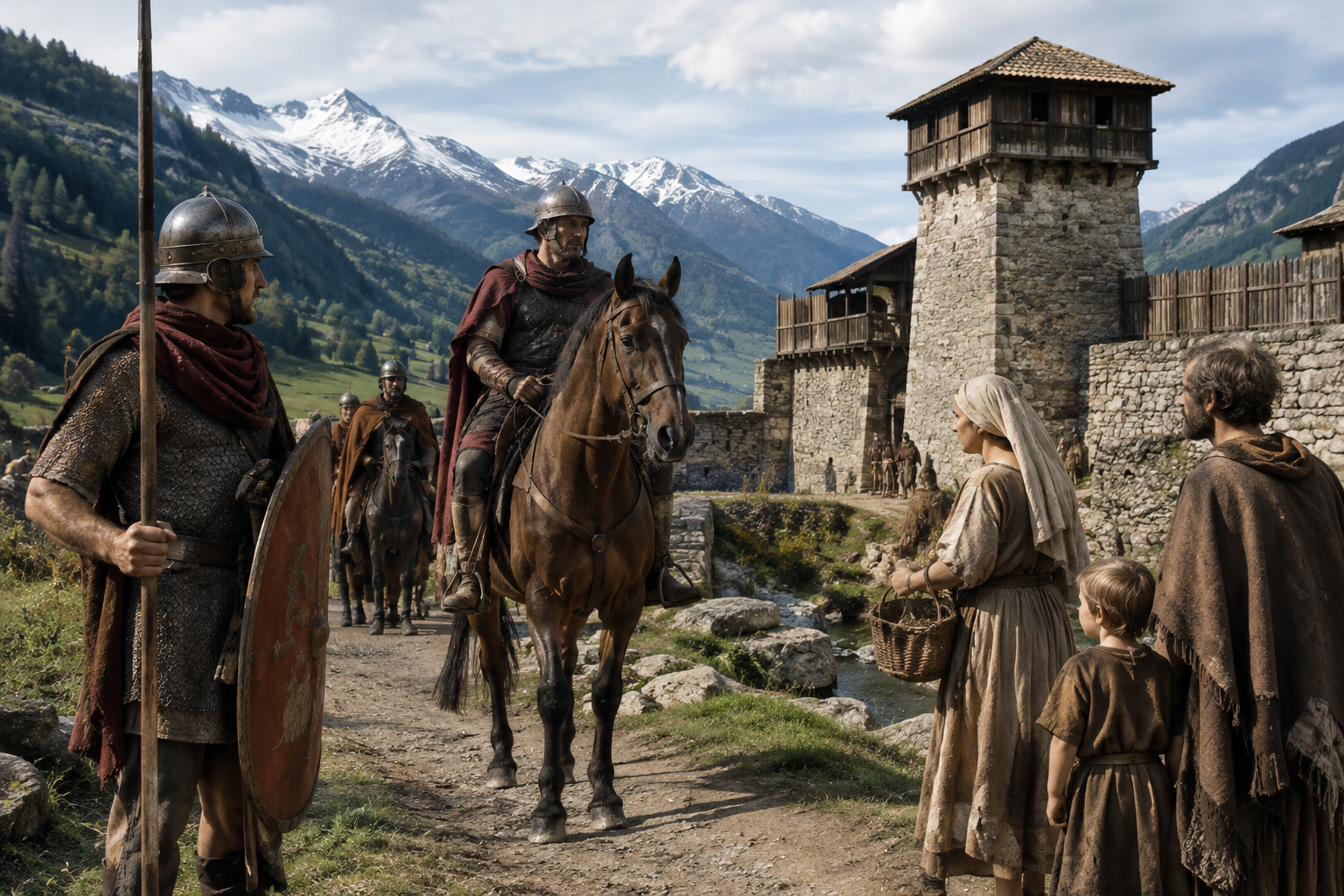
At Malles Burgusio Santo Stefano in South Tyrol, two Late Roman male individuals dated to around AD 387, sample IDs 2404a and 2404, give us a very particular glimpse of paternal ancestry in the Alpine world of the fading Roman Empire. That setting matters. South Tyrol was not a remote backwater, but a corridor: a place where routes through the Alps tied northern Italy to the provinces beyond, and where soldiers, officials, traders, farmers, and families could all end up sharing the same landscape.
These two men are associated here with the Y-DNA haplogroup R1b1a2a1a2b1c2. That is a very narrow paternal label inside the much larger R1b family, and it is worth keeping the scale clear. Y-DNA traces one direct male line only - father to son across generations - so it does not describe a person's whole ancestry, language, or social identity. Even so, when the same branch appears in a Late Roman Alpine context, it becomes historically interesting precisely because it sits inside a region known for movement, administration, and long-term continuity all at once.
The site name itself places these individuals in a frontier-shaped world. Malles Venosta, in today's upper Adige valley, lies close to passes linking Italy with Raetia and the wider northern provinces. By the late 4th century AD, this was still Roman territory, but it was a Roman world under pressure: militarized, administratively busy, and increasingly shaped by mobility through mountain corridors.
That is why samples 2404a and 2404 are useful even with sparse personal detail. They anchor haplogroup R1b1a2a1a2b1c2 not in abstract distribution maps, but in an actual Late Roman cemetery context in the Alps. We are not looking at a mythic founder or a dynastic pedigree here. We are looking at ordinary ancient men whose burials help show how paternal lines persisted within one of Europe's great transit zones.
An ancient DNA study examining Alpine populations near the region of the Tyrolean Iceman brought together evidence from multiple periods and helps place these later Roman individuals into a broader regional frame of continuity and change in mountain communities: research published on ancient genomes from the Alps.
R1b1a2a1a2b1c2 is not the same thing as the whole of R1b, one of western Eurasia's best-known Y-chromosome macro-lineages. The longer name matters because each added branch narrows the paternal line further. A man assigned to this subclade belongs to one very specific twig on a much larger tree, and the history of that twig cannot simply be replaced with every grand claim ever made about R1b in general.
In practical terms, that means caution and usefulness at the same time. Caution, because a narrow branch found in Late Roman South Tyrol does not by itself prove a tribal identity, a language, or a single migration route. Usefulness, because it can still connect modern testers to a documented ancient setting: Roman-period Alpine communities living at a strategic crossroads between the Italian peninsula and transalpine Europe.
The paired appearance of 2404a and 2404 is modest evidence, but real evidence. It suggests that this paternal branch was not represented by a lone outlier in the cemetery record. That matters in archaeology because one individual can always be unusual; two from the same place and period begin to look more like part of the local human fabric, even if we cannot leap from that to claims of close kinship or lineage dominance.
And that, in turn, fits the historical character of the Late Roman Alps rather well. Frontier provinces and mountain valleys are often imagined as mere passageways, but they were also lived-in places with rooted communities. Imperial roads, tax systems, military supply, and Christian institutions all depended on local populations who stayed, married, worked, and buried their dead there.
There is a temptation, whenever ancient DNA turns up in a Roman-period cemetery, to tell a story of dramatic newcomers. Sometimes that is justified. But the Alpine evidence is often more interesting than a simple tale of invasion or replacement. Regions like South Tyrol could preserve deep local continuity while also absorbing movement from several directions over many centuries.
By the late 4th century, this area stood within a world transformed by Rome yet never entirely remade by it. Indigenous Alpine populations had long since been folded into Roman political and economic systems. Veterans might settle, merchants might relocate, and provincial families might maintain local roots across generations. A Y-line such as R1b1a2a1a2b1c2 appearing here therefore belongs to that mixed reality: not a pure badge of one people, but a paternal thread inside a thoroughly historical landscape.
This is one reason the Alpine finds resonate with broader Roman-period genetic work. Across the empire, ancient DNA has repeatedly shown that local continuity and mobility coexisted, often in the same cemetery. South Tyrol makes excellent sense in that pattern, especially because mountain corridors are precisely where empires depend on both movement and settlement.
A date around AD 387 places these men in a century of strain, reform, and regional adaptation. This was after the high imperial zenith, but before the formal end of the Western Roman Empire. Administration remained active, Christianity was increasingly prominent, and the Alpine routes still linked armies and provinces. In other words, these were not postscript burials at the end of civilization. They belonged to a functioning, if changing, Roman world.
That timing gives the haplogroup its best historical meaning. Rather than tying R1b1a2a1a2b1c2 to some vague prehistoric origin story, the Malles evidence places it in a documented late antique community. For descendants exploring the branch today, that is far more tangible: a paternal line present in the lived reality of Roman South Tyrol, among the people who inhabited one of the empire's most strategic mountain regions.
The most distinctive thing about haplogroup R1b1a2a1a2b1c2 in this case is not royal glamour or a heroic migration legend. It is its appearance in two Late Roman men from Malles Burgusio Santo Stefano, in the Alpine hinge between Italy and the northern provinces. That is a small but solid historical foothold: a direct paternal line present in a real community at a time when the Roman world still bound the mountains together.
If this is your branch, the best-supported takeaway is that your paternal line can now be pictured in a concrete late antique setting - Roman South Tyrol, around AD 387, in a region where continuity, mobility, and imperial history met on Alpine ground.






Comments