Haplogroup L1a2
– 5 min read


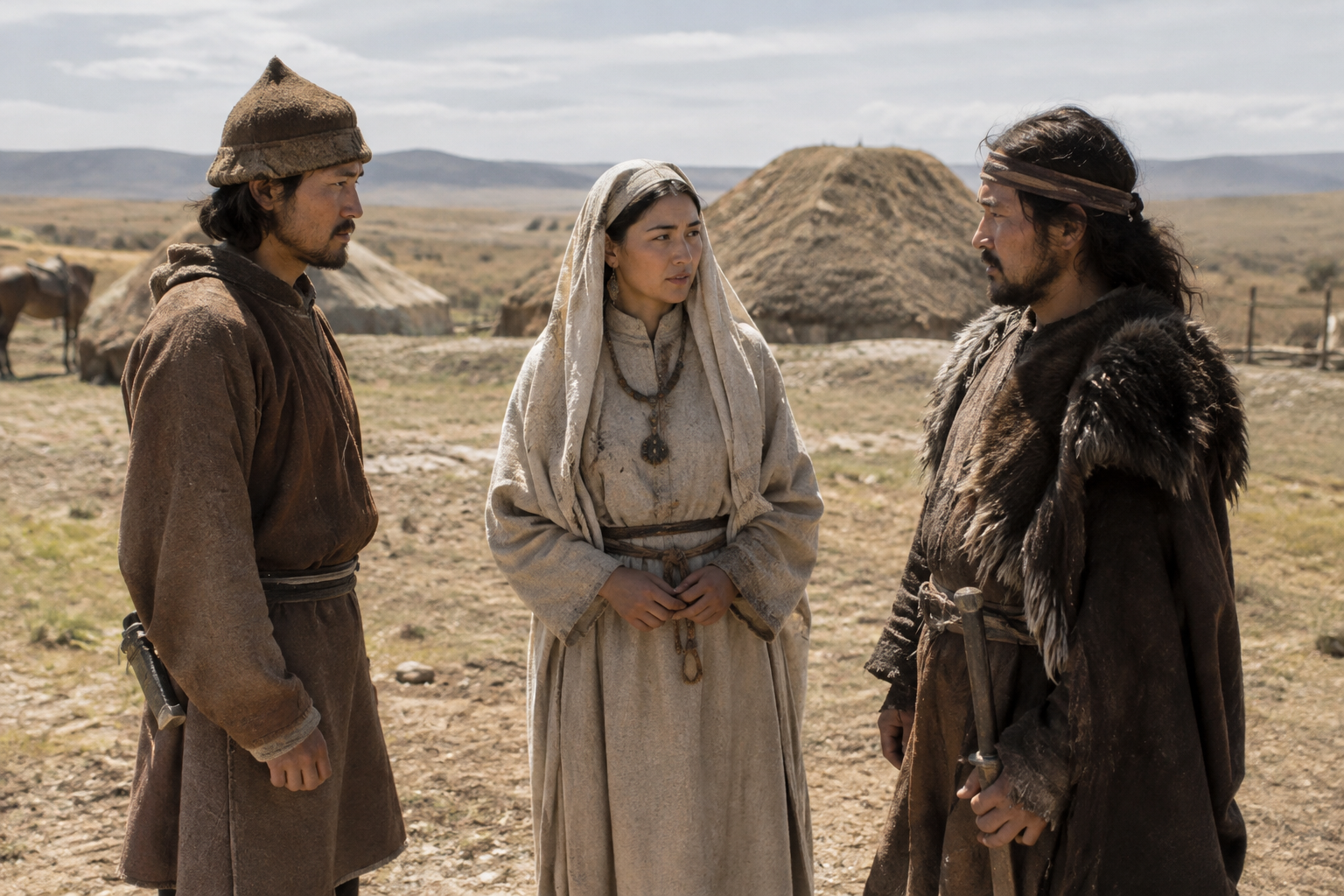
At Konyr Tobe, part of the Otyrar oasis in southern Kazakhstan, one ancient male labeled KNT005 brings the Y-DNA haplogroup L1a2 into unusually clear historical focus. He belongs to a world around AD 300, when the great river-fed settlements of Central Asia were not remote outposts at all, but busy points in the traffic of the steppe, Iran, and the Silk Road towns further east. A paternal line like L1a2 appearing here is interesting not because it lets us tell a simple migration story, but because it places a specific male lineage inside one of Eurasia's classic contact zones.
That is really the key to this branch. Y-DNA traces one direct paternal line only, not a person's whole ancestry, language, or identity. But when the same broad line appears in more than one Iron Age and later Central Asian context, it begins to suggest something historically useful: that L1a2, or at least lineages associated with it, were part of the male landscape of the eastern Iranian and Central Asian world well before the medieval period.
KNT005 is the most vivid starting point because Konyr Tobe sits in a place historians already take seriously. The Otyrar region, near the Syr Darya corridor, linked settled agricultural communities with caravan movement and steppe exchange. By about AD 300, this was a zone shaped by long interaction rather than isolation, and that makes any surviving paternal lineage there more revealing than a stray point on a map.
We should be careful about overstatement. The sample name tells us the cultural context, site, and approximate date, but not a cinematic biography. We do not know his profession, rank, or family story. What we can say is that a male line assigned here to L1a2 was present in a settlement sphere deeply entangled with broader Central Asian history.
A genetic study of populations across Inner Eurasia, published in Science Advances, helps frame why such finds matter. Research on this region has repeatedly shown that Central Asia was formed by mixtures of steppe, oasis, and more southerly populations over long stretches of time. KNT005 fits that larger archaeological reality: not a lone anomaly, but one datapoint in a landscape where lineages could persist, move, and recombine through trade, marriage, and political change.
The earlier evidence is especially valuable because it pushes the story of this paternal branch back into the early 1st millennium BC. Two males, I10523 from Iron Age Katelai and I12988 from Iron Age Loebanr, both dated around 900 BC, suggest that related paternal ancestry was already present in the wider zone reaching toward the mountain and frontier regions of ancient Central and South Asia.
These samples matter precisely because they are not medieval, and not modern. They belong to the era when older Bronze Age worlds had already fractured and new Iron Age societies were taking shape across the Iranian plateau, the Indus borderlands, and the Central Asian corridors between them. If L1a2 is associated with these two men at that early date, then the branch has time depth in the region that cannot be reduced to some late historical intrusion.
There is also a methodological lesson here. Ancient Y-DNA assignments are sometimes reported at different levels of resolution depending on coverage and analytical method. That means the safe historical reading is not that every movement of haplogroup L is now solved, but that this particular paternal branch, or closely related upstream ancestry, was already present among Iron Age males in more than one context. That is a stronger and more interesting claim than any grand theory built from one sample alone.
Haplogroup L is generally associated with parts of South Asia, Iran, and neighboring regions, but that broad parent history should not simply be pasted onto L1a2 as though every sub-branch had followed the same route. The narrower label matters. A subclade can have its own pattern of survival and spread, and ancient DNA often shows that local histories are far more tangled than neat textbook arrows on a migration map.
For that reason, L1a2 is best understood here as a paternal thread visible in the ancient populations of the Iranian-Central Asian interface. Konyr Tobe gives it a foothold in a settled oasis world around AD 300. Katelai and Loebanr hint at deeper Iron Age roots. Together they place the branch in a region where farmers, herders, traders, and frontier polities were constantly reshaping one another.
It is tempting to describe Central Asia merely as a bridge between bigger civilizations. Archaeology shows something more substantial. Oasis towns and riverine settlements developed their own durable communities, while still absorbing influences from nomadic confederations, Iranian-speaking populations, and eastern networks tied to the Silk Roads. A lineage like L1a2 could therefore persist locally even while the cultural labels around it changed.
That is why the spread of a Y-lineage cannot be equated with a single people. Around 900 BC, the men represented by I10523 and I12988 lived in Iron Age societies that were already products of earlier Bronze Age interaction. By AD 300, KNT005 stood in a political and economic environment transformed again. The paternal line continues, but the historical setting around it is different each time.
One useful comparison comes from research on connected regions where ancient DNA keeps uncovering similarly mixed backgrounds in populations once treated as ethnically simple. A preprint examining Central and adjacent Asian ancient populations, available here, reflects that broader trend: ancient lineages often appear in contexts shaped by repeated admixture and mobility rather than clean replacement.
So the importance of L1a2 is not that it identifies one empire, one tribe, or one language community. Its value lies in showing continuity of a male line within a region famous for movement, exchange, and layered ancestry.
On their own, ancient samples can be frustratingly modest. One individual tells us only that one man, at one time, carried one paternal line. But three finds spread across roughly twelve centuries, and across related parts of Inner Asia, begin to build a pattern. The pattern is not huge, but it is real.
I10523 and I12988 suggest an Iron Age presence for this paternal ancestry well before the great late antique and medieval transformations of Central Asia. KNT005 shows that such ancestry was still present in the oasis world of southern Kazakhstan many centuries later. That combination points toward persistence within a connected regional network rather than a single brief episode.
For people researching their own paternal ancestry, that is often the most valuable kind of ancient evidence. Not a fantasy of direct descent from a named ruler, but a well-placed signpost: your line belongs to a branch that appears in the archaeological record of Iron Age and late antique Central Asia, especially in zones where Iranian, steppe, and transcontinental contacts overlapped.
L1a2 emerges here as a small but telling paternal signature of the old Central Asian crossroads. The best evidence does not pin it to a single ethnicity or political power. Instead, it places the branch among real ancient men from Iron Age contexts such as Katelai and Loebanr, and later in the Otyrar cultural world at Konyr Tobe. For a modern tester, that is a grounded historical clue: this paternal line has an ancient footprint in the interconnected societies between the Iranian world, the steppe, and the routes of Inner Asia.
Comments