Haplogroup L1a1b3a

– 4 min read


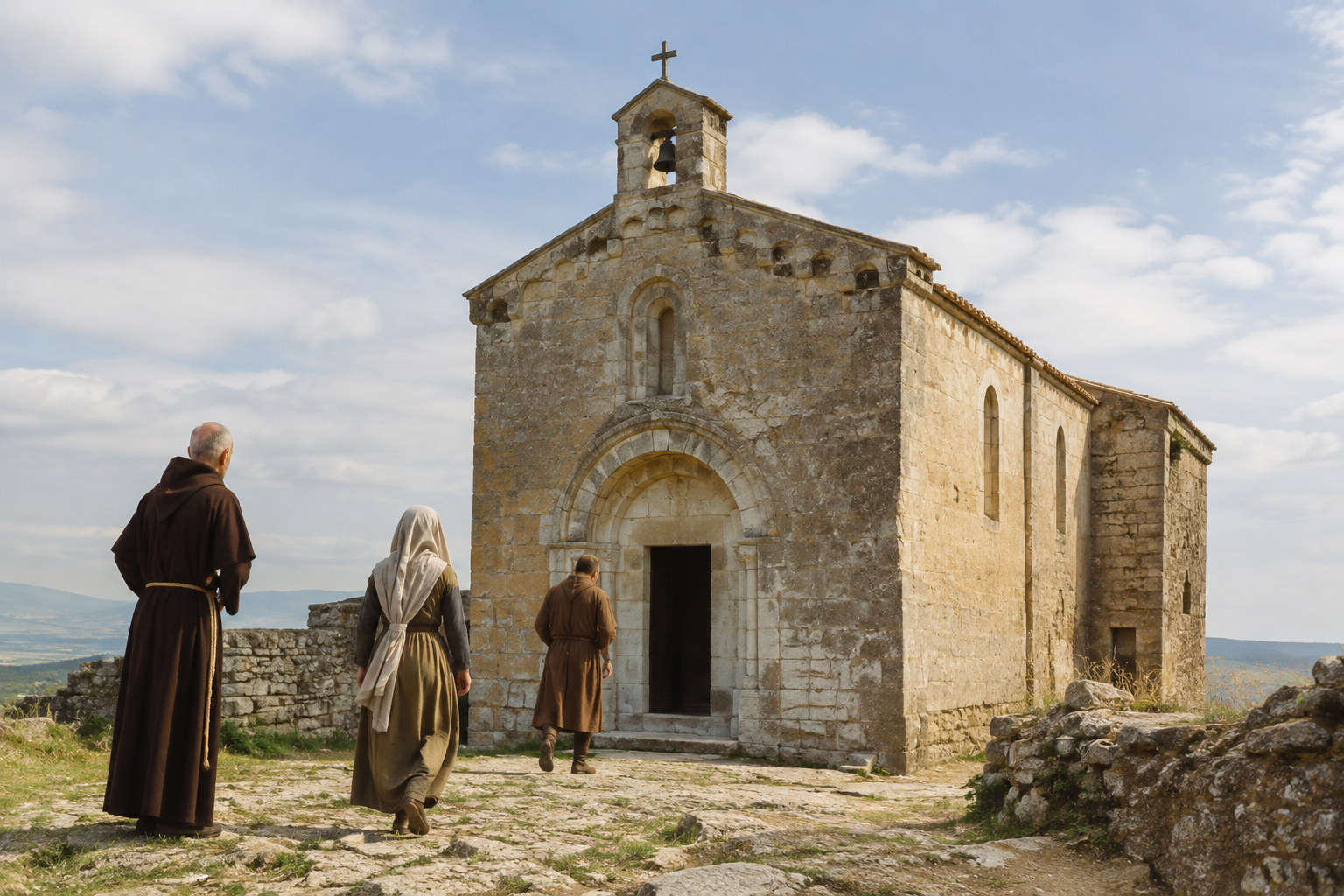
At Cancarro Church near Foggia in southern Italy, one medieval man has become unexpectedly important for the study of paternal ancestry. He is known simply as VK538, dated to around AD 1150, and reported in connection with the Y-DNA haplogroup L1a1b3a. That is a striking result, not because one skeleton can tell us everything, but because this branch is far less commonly discussed in medieval European contexts than the headline-making lineages of kings, raiders, or steppe warlords.
The fascination here lies in the setting as much as the lineage. Twelfth-century Apulia was no isolated backwater. Foggia sat in a region shaped by Byzantine influence, Lombard power, Norman expansion, pilgrimage routes, trade across the Adriatic, and long Mediterranean connections reaching much farther east and south than modern national maps encourage us to imagine. A Y-chromosome line such as L1a1b3a, which traces one direct paternal line only, fits neatly into that more complicated medieval world.
The sample record for VK538 is spare: Medieval Cancarro Church, Foggia, Italy, around AD 1150. Yet even that limited information places him in one of the most connected landscapes in medieval Europe. Apulia was a threshold region. Armies crossed it, merchants sailed from it, and church networks tied it into wider Christian worlds stretching from Rome to the eastern Mediterranean.
That matters because unusual or less frequent Y-chromosome branches in medieval Italy do not need melodramatic explanations. They may reflect long-term local continuity from older Mediterranean population layers, movement during the Roman and post-Roman centuries, or mobility during the medieval period itself. In southern Italy, all three possibilities have to be kept on the table at once.
A research preprint on ancient populations from Italy and surrounding periods is linked with this sample record at https://www.biorxiv.org/content/10.1101/703405v1. Without forcing conclusions beyond the available details, the broader lesson is clear enough: medieval Italian communities were genetically more varied than tidy historical labels suggest.
L1a1b3a is a very specific terminal-style label, and that precision can be misleading if we rush ahead too fast. A narrow branch name sounds like a complete biography, but it is nothing of the sort. It identifies one paternal line among thousands of ancestors a person would have had even a few centuries before his burial.
Still, the branch matters. Haplogroup L as a wider family has a deeper history largely associated with South and Southwest Asia, the Iranian plateau, and adjacent regions, with later dispersals into other parts of Eurasia. But it would be careless to paste the full history of parent haplogroup L directly onto L1a1b3a in twelfth-century Italy as though the route were known in detail. What VK538 really gives us is evidence that one such paternal line was present in medieval Apulia, in a church burial context, by the mid-12th century.
That alone is valuable. Ancient DNA is often most useful not when it confirms our favorite grand narrative, but when it reminds us that real populations were messy, mixed, and mobile. Medieval communities, especially in coastal or near-coastal Italy, were not sealed boxes.
To understand why VK538 is plausible in Foggia, we have to remember what southern Italy had already been through by AD 1150. Long before the Middle Ages, the peninsula had absorbed movements tied to Neolithic farmers, Bronze Age exchanges, Greek colonization in the south, Roman imperial integration, and the shifting demography of Late Antiquity. Then came the early medieval centuries, when Lombards, Byzantines, and later Normans reorganized power without erasing the older population substrate.
That is why a single paternal lineage in Apulia should not be reduced to one ethnic label. A man buried at a medieval church in Foggia might have been locally rooted for generations, descended from older Mediterranean migrants, or part of more recent movement within the Christian, Islamic, or post-imperial worlds of the central Mediterranean. The archaeology of the region consistently points toward contact, not isolation.
Southern Italy is particularly awkward for simplistic ancestry stories because it sat at the overlap of Latin, Greek, and later Norman political worlds. Ports, monasteries, market towns, and ecclesiastical centres all helped move people as well as ideas. Even inland places like Foggia were tied into those wider networks.
There is a tendency, especially in popular genetics, to dismiss a lone ancient sample as merely anecdotal. That is too crude. One sample cannot stand for an entire population, certainly, but it can document something that must then be explained historically. VK538 shows that the paternal branch L1a1b3a was present in a medieval burial from Apulia. That is a real data point, and one worth placing against the region's known history of movement and admixture.
The most responsible reading is not that Foggia was somehow exceptional, but that medieval Italy contained more paternal diversity than national myths or later family legends usually allow. Studies of other parts of Europe have been making a similar point again and again: early and high medieval populations were often locally continuous in some respects, but they also included long-distance ancestry and unexpected lineages. The same tension between continuity and mobility appears across many MyTrueAncestry case studies.
Seen in that light, VK538 is less an anomaly than a reminder. Churchyards were gathering places for ordinary communities, and ordinary communities could be surprisingly cosmopolitan.
By the 12th century, Apulia had become central to Norman southern Italy, yet Norman rule did not create a new population from scratch. It ruled over people whose ancestors reflected centuries of settlement and contact. In this period the region linked the Adriatic, the Balkans, the central Mediterranean, and routes toward the Levant. Pilgrims bound for holy places, clerics, soldiers, traders, and settlers all passed through or settled in the south.
So when a lineage like L1a1b3a turns up in a medieval man from Cancarro Church, the historically sensible response is not surprise for its own sake, but recognition. Medieval Italy, especially the south, belonged to a connected world. Genetic outliers on a modern map may have been unremarkable in communities used to arrivals, departures, and layered ancestry.
If your paternal line falls under L1a1b3a, VK538 offers something modest but meaningful: firm evidence that this lineage, or one reported at that resolution, was present in medieval southern Italy by around AD 1150. It does not prove descent from that individual, and it does not confine the branch to one people or one migration. What it does suggest is that your direct male line belongs to the kind of history that shaped the Mediterranean at its busiest: movement, mixture, and survival across changing empires and languages.


Comments