Haplogroup J2b2a1

– 6 min read


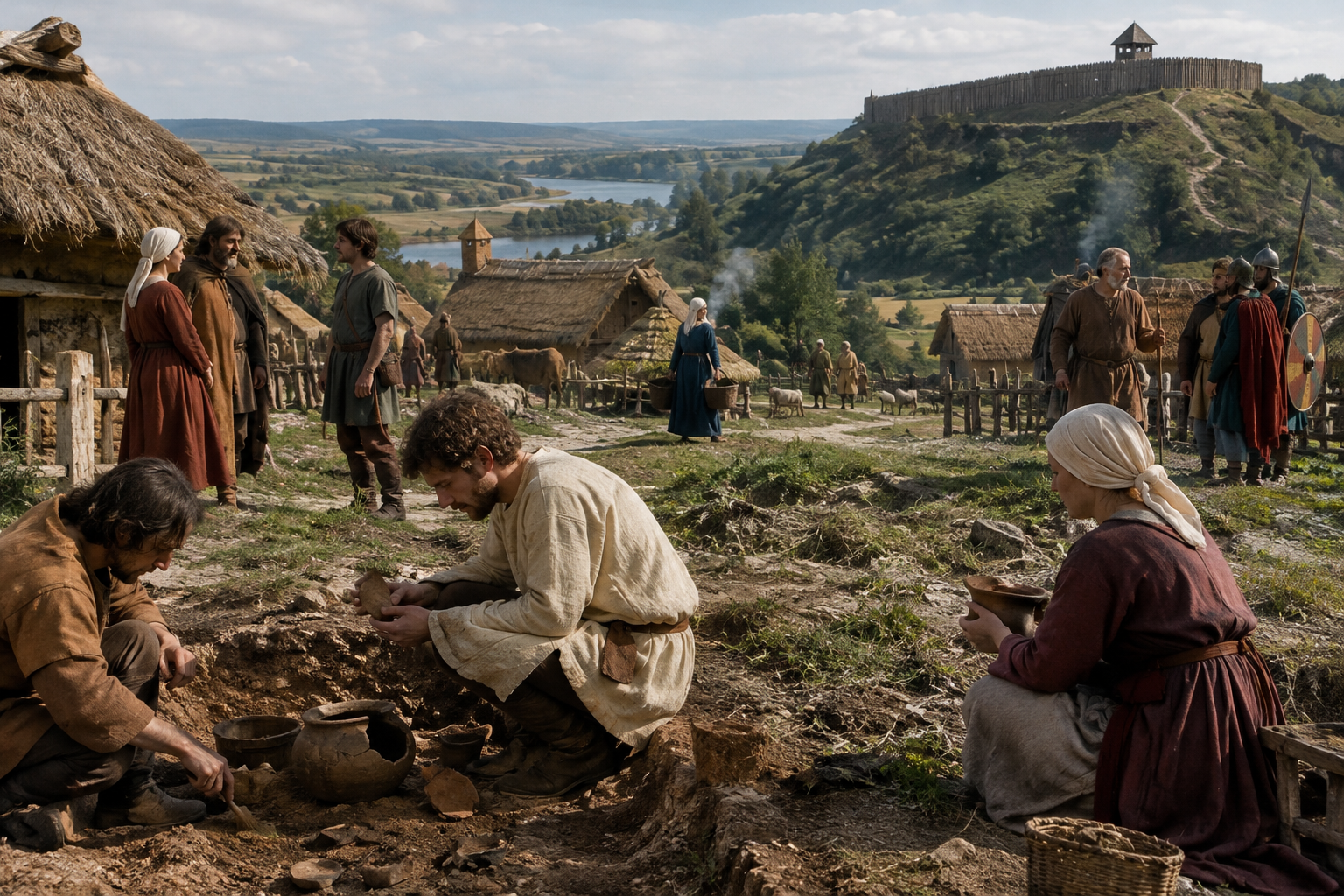
Haplogroup J2b2a1 is the sort of Y-DNA lineage that makes ancient history feel less like a row of sealed museum cases and more like a crowded harbor. It appears in places that mattered enormously to the old Mediterranean and Balkan worlds: Sicily, Greece, the Adriatic, the Roman frontier, and later medieval communities far beyond its likely earlier centers of strength. Not because one tidy people marched everywhere carrying a single paternal marker, but because men moved through trade, war, colonization, marriage, empire, slavery, service, and settlement.
That is exactly why this haplogroup is interesting. J2 is a major branch of the Y-chromosome tree often discussed in connection with the eastern Mediterranean and western Asia, but a subclade such as J2b2a1 needs more caution. A downstream branch does not automatically inherit every grand historical claim made about its parent haplogroup. What Y-DNA can do is trace one direct paternal line among many lines in a person's ancestry. It does not describe a whole population, a whole ethnicity, or a person's complete genetic background. Still, when ancient DNA turns up the same paternal branch in Bronze Age Greece, Iron Age Croatia, Punic Sicily, Roman Pompeii, post-Roman Pannonia, and medieval Sicily, we are clearly looking at a lineage with a long and very mobile history.
The earliest supplied evidence for this branch points toward a world that linked the Balkans, the lower Danube, and the Aegean. One especially striking sample is I10206, from Early Bronze Age Moldova Yamnaya Crihana-Veche Cahul District, dated to 2500 BC. On its own, that does not prove that J2b2a1 was a "Yamnaya haplogroup" in any sweeping sense, but it does show that this paternal line could already be present in steppe-connected settings north of the Balkans during the early Bronze Age.
Then the trail sharpens around the Adriatic and Aegean. In Bronze Age Croatia, we find I19025 from the Cetina Valley dated to 1800 BC and I19029 from the same region dated to 1700 BC. In Mycenaean Greece, there are four individuals from Mygdalia, Achaean Greece - MYG001, MYG005, MYG006, and MYG008 - all dated to 1500 BC. That is not a random scatter. It suggests that paternal lines within this branch were established in societies at the very heart of Bronze Age southeastern Europe.
This pattern fits a broader picture in which lineages related to J2b2 appear particularly at home in the Balkan-Aegean zone, even as some of their descendants moved widely. It is a reminder that the old map of Europe was never neatly divided into "Mediterranean people here, steppe people there." Bronze Age communities were already mixtures, crossroads, and local societies with far-flung contacts.
Explore Prehistoric Aegean DNA
By the Iron Age, J2b2a1 appears in an even broader set of archaeological worlds. In inland Croatia, we have I5723 from an Iron Age Hillfort Croatia Kriz Brdovecki Sava Valley dated to 450 BC, and I24345 from Iron Age Croatia Velim-Kosa dated to 500 BC. In Albania, I16254 comes from an Ancient Illyrian Albania Cinamak Kukes District burial dated to 500 BC. These are the kinds of finds that make J2b2a1 look thoroughly at home in the western Balkans.
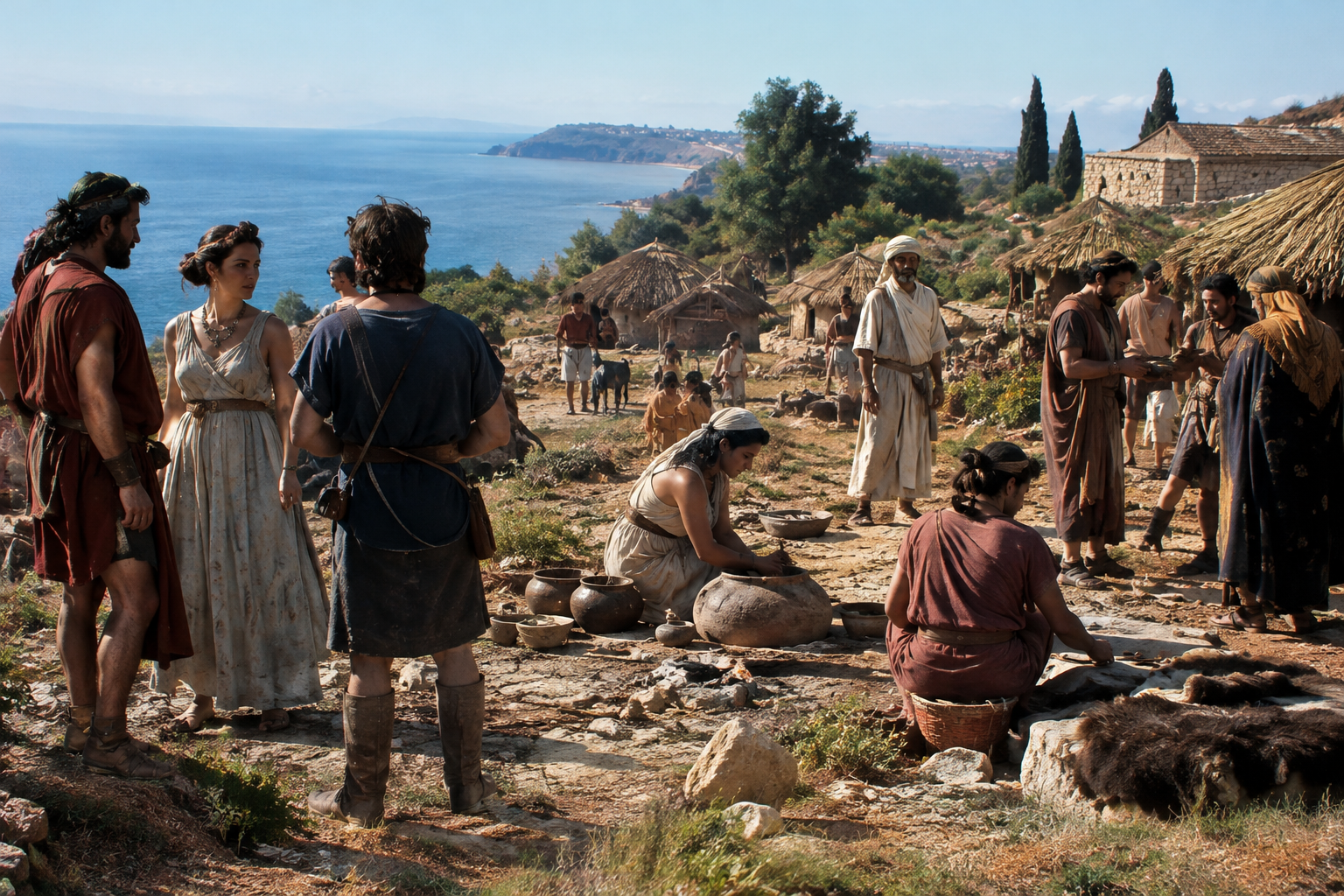
But then the same paternal branch appears in maritime and urban settings too. I4798, from Carthaginian Era Italy Sicily Motya, dated to 492 BC, places it in one of the great Phoenician-Punic entrepots of the western Mediterranean. R11753 from Phoenician Kerkouane Tunisia, dated to 410 BC, extends the picture into North Africa. ORD014 from Daunian Herdonia Apulian Foggia Italy, dated to 500 BC, and CSN004 from Casenovole Etruscan Iron Age Italy, dated to 400 BC, show it among Italic populations too. And ORC007 from Nuragic Interior Sardinia, dated to 1140 BC, hints that the western Mediterranean had been drawing in and redistributing such paternal lines for a very long time.
What all this suggests is not one single migration event, but a durable presence in the interconnected worlds of the Balkans and Mediterranean. Ports, colonies, upland strongholds, farming communities, and regional elites all seem to have shared in that complexity.
Discover Ancient Italian Islands
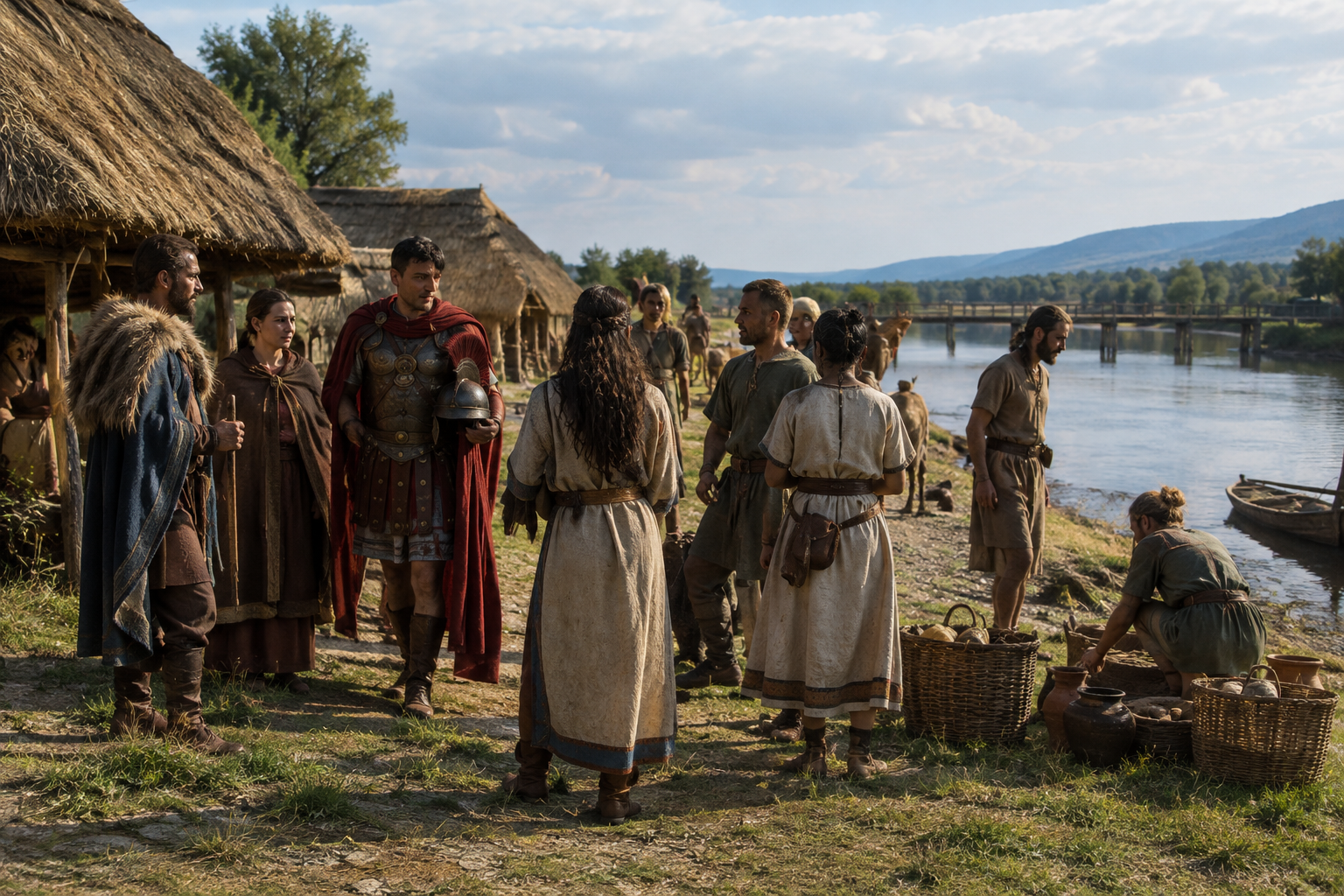
The Roman period makes the story busier still. I3690 from Roman Pompeii Vesuvius Victim House of the Cryptoporticus, dated to 79 AD, gives us a vivid urban snapshot: a man living in a Roman town at the instant Vesuvius sealed his world. Far to the east and north, R2040b from Imperial Roman Period Croatia Sisak Pogorelec dated to 245 AD, and I15547 from Late Imperial Roman Serbia Timacum Kuline Ravna Village dated to 395 AD, show the lineage within provincial Roman settings in the Balkans.
Then come the frontier zones where Roman and post-Roman identities blur. In Pannonia and neighboring regions we find a remarkable run of samples: GYS025 and GYS031 from Arrabona Szechenyi Square Hungary dated to 425 AD; Hacs_24 from Post Roman Empire Pannonia Hungary Hacs dated to 450 AD; SZL077 and SZL004 from Savaria Szeleste Barbaricum Hungary dated to 525 AD; HMU036 from Scarbantia Hegyko Barbaricum Hungary dated to 525 AD; and KMU008 from post Roman Period Pannonia Arrabona Kony Barbaricum Hungary dated to 550 AD. STRAZ_I_88 from Late Roman Frontier Straubing Azlburg Germany, dated to 400 AD, pushes the evidence onto the upper Danube frontier.
These finds matter because they show paternal continuity and movement across one of the most unstable periods in European history. Roman soldiers, provincial families, federate groups, Germanic-speaking newcomers, and long-rooted local communities were all mingling in these regions. The presence of PCA0113 from Goth Maslomecz dated to 300 AD is a useful warning against simplistic ethnic labeling: a Y-DNA lineage found in a Goth-associated cemetery is not therefore a "Gothic haplogroup." It means real communities were mixed, and paternal lines crossed cultural boundaries with ease.
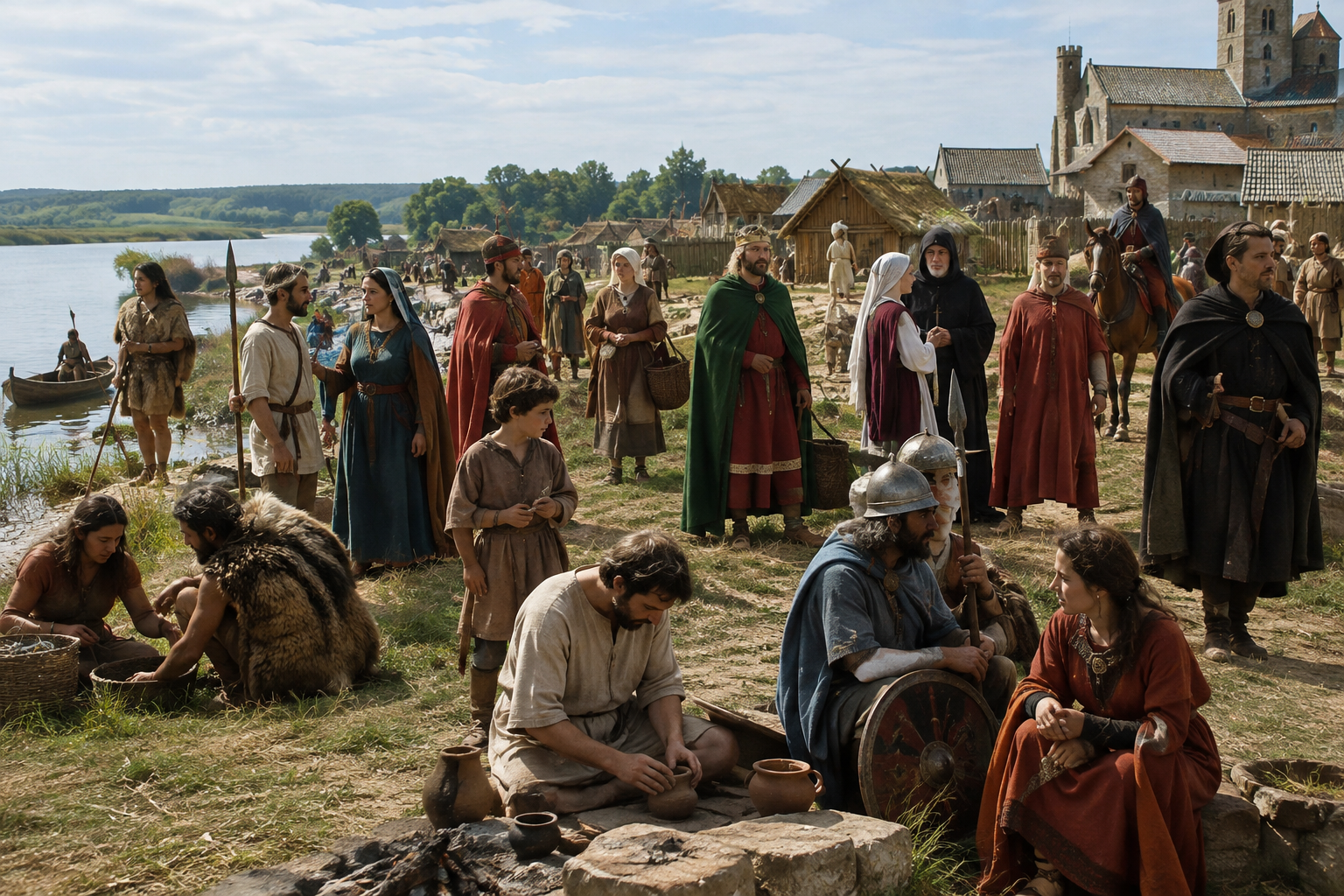
By the Middle Ages, J2b2a1 had certainly not vanished into antiquarian mist. It appears in SGBN5, from Medieval Sicily Segesta Muslim Grave dated to 1200 AD. Sicily is the perfect place to find such complexity: Greek, Punic, Roman, Byzantine, Arab, Norman, and later Latin Christian worlds all layered one upon another. A paternal lineage found there in a Muslim grave does not tell us one simple origin story; it tells us Sicily remained a place where older Mediterranean lineages persisted within changing religious and political frameworks.
The branch also turns up far to the northwest in England, with ATP_PSN_113 from Medieval England Cambridge St Johns Hospital dated to 1209 AD and ATP_PSN_264 from the same site dated to 1250 AD. There is also I20384 from Post Roman Spain Girona Sarria de Ter Pla de lHorta dated to 511 AD, VEN006 and VEN013 from Early Medieval Venosa Italy dated to 711 AD and 722 AD, ELW032 and ELW038 from Post Medieval Plague Victim Ellwangen Germany dated to 1550 AD, and even IVLS09KT from Late Medieval Livonia dated to 1585 AD. That is a remarkable span. It shows how one paternal branch, likely strongest earlier in southeastern Europe and the Mediterranean, could become part of communities across medieval and early modern Europe.
If you want a broader look at this especially layered island world, the MyTrueAncestry community article on medieval Sicily is a natural companion.
There is no usable noble-family data supplied here, so it would be irresponsible to invent dynastic links, castles, or heraldic lineages for J2b2a1. And that restraint matters. One of the common temptations in genetic history is to leap from a haplogroup to a famous surname, a royal house, or a fortress on a hill. Sometimes documentary genealogy and DNA can genuinely meet. Very often, though, the honest answer is that ancient DNA gives us context rather than pedigree.
For J2b2a1, that context is already rich enough. This is a paternal lineage found in Bronze Age Moldova, Bronze Age Croatia, Mycenaean Greece, Iron Age Balkan hillforts, Illyrian Albania, Punic Sicily, Phoenician Tunisia, Roman Pompeii, the late Roman frontier, post-Roman Pannonia, medieval Sicily, medieval England, and later parts of Germany and Livonia. That distribution makes sense if we imagine not a single people but a chain of connected regions: the Balkans, the Aegean, southern Italy, Sicily, the Danube corridor, and the wider Roman and post-Roman worlds.
In other words, J2b2a1 is a fine example of what Y-DNA does best. It can highlight stubborn lines of paternal continuity across drastic cultural change. It can show us that the men buried in a Mycenaean landscape, a Roman townhouse, a Pannonian cemetery, or a medieval hospital may belong to the same deep branch of the human family tree without being close genealogical relatives in the everyday sense. And it reminds us that ancient history was full of movement long before passports, surnames, or nation-states.
If your own Y-DNA belongs somewhere under J2, or if your autosomal DNA points toward the Balkans, Italy, Greece, or Sicily, MyTrueAncestry can help place those results beside real archaeological individuals. That comparison may reveal striking ancient connections, even though it cannot by itself prove direct descent from any one ancient person or historical family.
Comments