Haplogroup J2a1h

– 5 min read


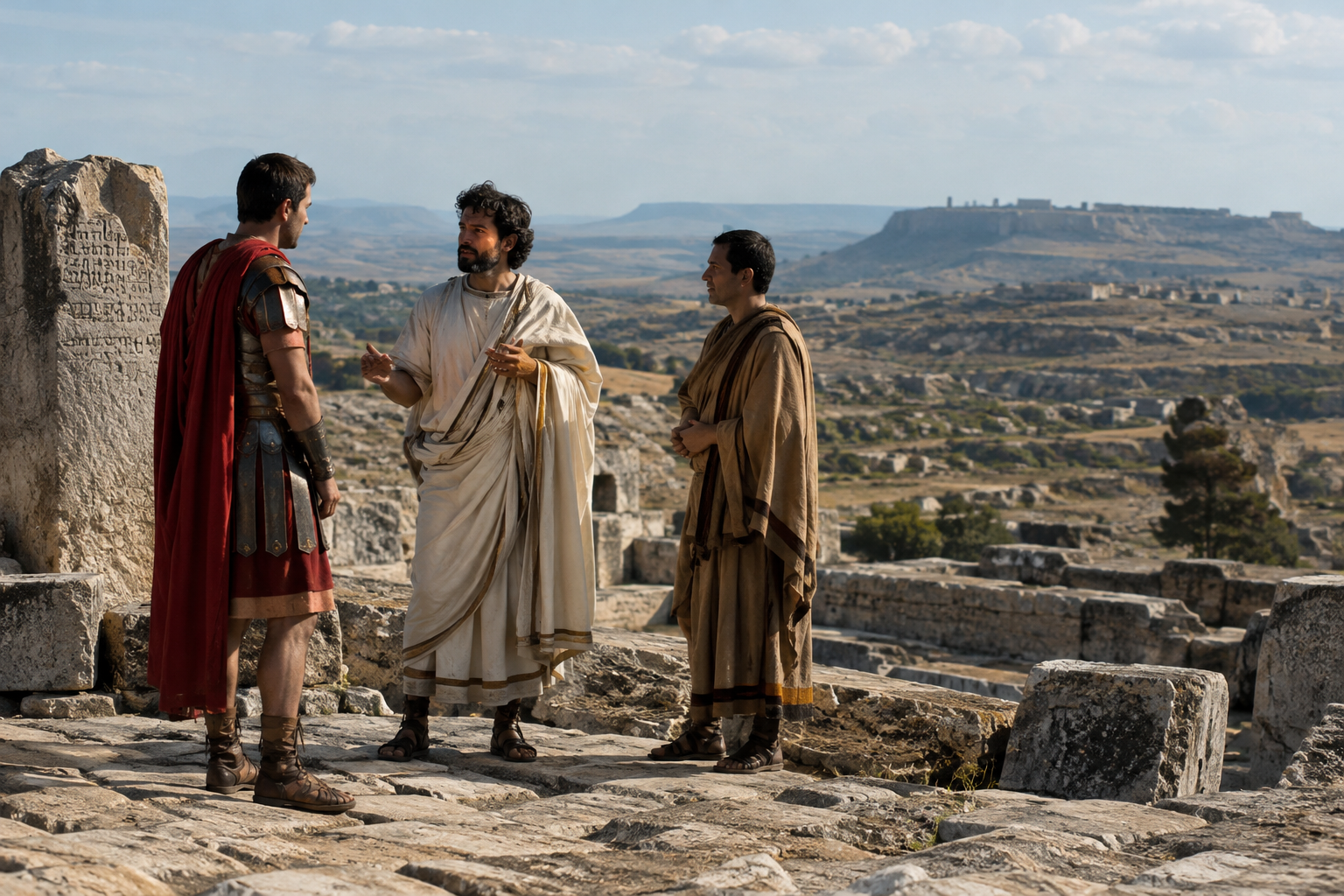
At Bogazkale in central Anatolia, the ancient city better known to many as Hattusa, one male individual from the Imperial Roman period offers a small but telling clue to the long history of paternal lines in the region. The sample is BOG020, dated to around AD 225, from Roman-era Galatia. He is associated here with the Y-DNA haplogroup J2a1h, a sub-branch within the wider J2 paternal family that appears again and again in the history of the eastern Mediterranean and western Asia.
What makes this find interesting is not that one man can stand in for all of Anatolia - he cannot - but that he turns up in a place with an extraordinarily deep past. Bogazkale had been important long before the Romans arrived. By the 3rd century AD, the old Hittite heartland was part of an empire knitted together by soldiers, merchants, officials, farmers, and local families whose roots often ran much deeper than imperial rule itself. A direct paternal lineage such as J2a1h traces only one ancestral line out of many, yet in a site like this it can still tell us something very human: some male lines endured through successive political worlds.
Bogazkale sits in a landscape layered with history. The place is famous above all for Bronze Age Hattusa, capital of the Hittite empire, but the Roman-period dead buried in this district belong to a much later chapter. By the time of BOG020, central Anatolia had passed through Hittite, Phrygian, Persian, Hellenistic, Galatian, and Roman phases. That matters because it warns us against simplistic storytelling. A Roman-era Y chromosome from Anatolia is not "Roman" in any exclusive ethnic sense, nor does it have to represent a newcomer from Italy.
Instead, the likely significance lies in continuity and mixture. Roman Anatolia was deeply local and broadly connected at the same time. The empire did not erase earlier populations; it reorganized them. In regions like Galatia, people might live under Roman law, use Greek in inscriptions, carry local ancestry, and belong to paternal lines with much older eastern Mediterranean histories.
An ancient DNA study on Roman Anatolia and surrounding populations, published in Current Biology, helped sharpen this wider picture by showing how mobility and local continuity could coexist in the same imperial landscape. That is exactly the sort of setting in which a lineage like J2a1h becomes historically interesting: not as a badge of one people, but as part of the durable male ancestry of an interconnected region.
J2a1h is a downstream branch of the broader haplogroup J2, a lineage widely associated in ancient and modern populations with parts of the Near East, Anatolia, the Caucasus, the Aegean, and the Mediterranean world. That broad context is useful, but the narrower label matters. One should not casually pour the whole history of J2 into J2a1h, as if every sub-branch followed the same route at the same time.
With BOG020, the safe point is more modest and more valuable. This branch, or an assignment associated with it, was present in central Anatolia during the Imperial Roman period. That anchors J2a1h in a real excavated individual from a historically rich region, rather than leaving it floating as a purely modern test result.
For family historians, this is often the crucial distinction. A haplogroup is not an ethnicity, a language, or a complete ancestry profile. It is one paternal thread. But when that thread appears in ancient Anatolia, at a site as historically resonant as Bogazkale, it places that paternal line within a landscape shaped by long-term settlement, imperial incorporation, and repeated cultural change.
The name Galatia can mislead modern readers because it calls to mind the Celtic-speaking groups who entered central Anatolia in the Hellenistic age. They were certainly important, and their arrival left political and cultural marks strong enough for the region to keep their name under Rome. Yet Roman Galatia was not a sealed Celtic island in Asia Minor. It was a mixed province, full of older Anatolian communities, Hellenized towns, military movement, and links running outward to Syria, the Aegean, and beyond.
That makes a lineage such as J2a1h entirely plausible in this setting. The genetic history of Roman provinces is often less about replacement than about accumulation. Men carrying local or regionally established paternal lines could become thoroughly Roman in law, language, military service, religion, or daily life without changing that Y-chromosome inheritance.
So BOG020 is best read not as a token representative of one named tribe, but as evidence that central Anatolia in the Roman period still contained paternal lines deeply at home in the eastern Mediterranean world. This fits a broader ancient DNA pattern in which provincial populations under Rome often preserve substantial local ancestry even while participating in imperial networks.
One sample can be frustratingly small. Archaeologists and geneticists would always prefer a larger cemetery, more radiocarbon dates, clearer kinship links, and multiple well-resolved paternal assignments. Yet single individuals matter when they come from places that sit at historical crossroads. Bogazkale is one of those places.
Its significance lies in the sheer depth of occupation around it. To recover a Roman-era male line there is to glimpse the later life of an Anatolian heartland that had already seen empires rise and fall for more than a millennium. That does not mean BOG020 descended directly from Hittite elites, or from any specific ancient dynasty; no such claim would be responsible. But it does mean that J2a1h belongs comfortably within the long demographic story of Anatolia rather than appearing as an implausible late intrusion.
Ancient DNA works best when it is allowed to be specific. In this case, the specificity is the point: one Imperial Roman man, in central Anatolia, at Bogazkale, associated with J2a1h. Sometimes that is enough to shift a lineage from abstraction into history.
Anatolia is often described, correctly, as a bridge between continents. But bridges are not only for passing over. People also live on them. That is why the genetic history of the peninsula can look both mobile and stubbornly local at once. Trade routes, armies, deportations, colonization, and pilgrimage all moved people across the region, while villages, towns, and family lines persisted for centuries.
For J2a1h, BOG020 speaks to that double reality. The broader J2 family has strong associations across the Near East and Mediterranean, and Roman Anatolia sat right inside those worlds. Yet this particular evidence point is fixed in place: a man buried in Galatia in the 3rd century AD. He was part of the Roman Empire, but also part of a central Anatolian population with older regional roots.
This is one reason Roman-period ancient DNA has become so valuable. It complicates old textbook divisions between "local" and "foreign." People in imperial provinces were often both: local in family depth, imperial in political belonging, and connected to much wider cultural worlds.
The most responsible reading of J2a1h, based on the evidence here, is not grandiose. It is better than grandiose. It is concrete. This paternal line is attested in an Imperial Roman individual from Bogazkale in Galatia, around AD 225, placing it within the lived population history of central Anatolia under Rome. For someone researching this haplogroup today, that does not promise descent from a famous house or a single ancient people. It does something more useful: it shows that one branch of your paternal story belongs in the real and complicated human landscape of Roman Anatolia, where older local histories and imperial identities met every day.
Comments