Haplogroup J2a1a1b2a1b1b3a2b
– 5 min read


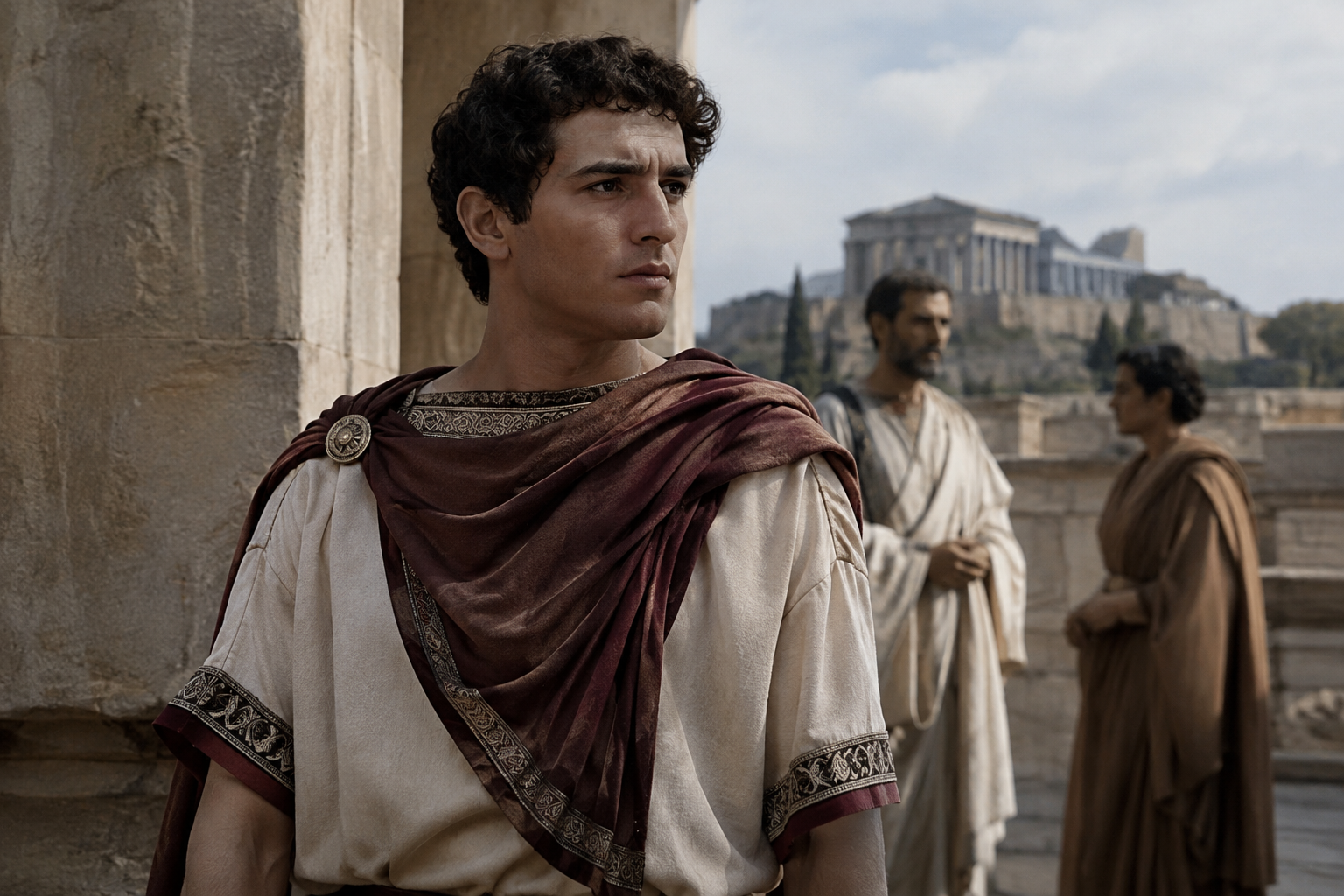
One of the more intriguing clues for the Y-DNA haplogroup J2a1a1b2a1b1b3a2b comes from a single late Roman-era individual: R136, identified here as Hellenic Roman Marcellino and dated to around AD 400. That date matters. It places the lineage not in the neat, textbook world of the high Roman Empire, but in the far messier centuries when imperial institutions still existed, cities still functioned, and yet identities around the Mediterranean were being reworked in real time.
With a lineage this specific, caution is essential. A very narrow Y-DNA label like J2a1a1b2a1b1b3a2b describes one direct paternal line only, not the whole ancestry or cultural identity of the man who carried it. Still, when such a branch appears in a late antique Hellenic-Roman context, it points us toward one of the most historically important zones for haplogroup J2 as a broader family: the eastern Mediterranean world of cities, trade, military movement, and long-lived male lines.
The designation "Hellenic Roman" is itself a useful reminder that the eastern Roman Empire was not somehow less Roman because Greek language and local traditions were strong there. By around AD 400, many communities in the empire's eastern provinces lived in a world that was administratively Roman, often linguistically Greek, and deeply connected to older regional histories stretching back into the Hellenistic and pre-Hellenistic past.
That is the historical setting in which R136 becomes interesting. We are not looking at a prehistoric founder or a conquering dynast. We are looking at a man from a society where paternal lines could have persisted locally for centuries while the political labels above them changed repeatedly: Greek, Hellenistic, Roman, Christian, provincial, urban. The fascination of J2a1a1b2a1b1b3a2b here is precisely that it turns up in a world where continuity and mobility existed side by side.
A broader ancient DNA study of the Mediterranean and surrounding regions, published in Science, helped establish just how much population movement shaped the Roman world. One of the major lessons from that body of work is that the empire was never genetically static. Yet neither was it simply a great melting pot that erased local structure. Some lineages moved widely; others endured regionally for long periods.
The deeper parent haplogroup J2, and especially its branch J2a, is well known in studies of West Eurasia and the Mediterranean. It appears frequently in discussions of the Near East, the Aegean, Anatolia, and the long history of maritime and overland exchange linking those regions. That larger background makes a Hellenic-Roman example entirely plausible.
But this is where good archaeology has to restrain enthusiasm. The very precise branch name in this article should not be projected backwards automatically into the Neolithic, Bronze Age Greece, or the first city-builders of the Levant. Those are stories about the broader haplogroup family, not necessarily about this exact terminal subclade. What R136 securely gives us is a late antique witness to that paternal tradition in a Greek-speaking Roman context.
In other words, the branch belongs to a much older tree, but the individual evidence here is late Roman. That distinction matters for anyone trying to connect personal DNA results with history. A branch can be ancient in origin, yet the first securely observed ancient carrier in your evidence may belong to a very specific and much later society.
Around AD 400, the Mediterranean was still knitted together by shipping, taxation, military service, pilgrimage, and urban life, even as imperial power was under heavy strain. A man with a paternal line like J2a1a1b2a1b1b3a2b could have belonged to a family long rooted in the Aegean or eastern Mediterranean. He could also have descended from earlier migrants who had already become entirely local by the time he lived. Late Roman archaeology often forces us to think on both scales at once.
This is one reason the label "Hellenic Roman" is more informative than it first appears. It suggests not a contradiction, but a layered identity. In the eastern empire, Roman citizenship and governance sat atop older Greek civic traditions and regional populations whose paternal lines may have been circulating in the same landscapes for many generations. Y-DNA is especially good at illuminating that sort of continuity, because it follows one male line through changes in language, religion, and empire.
Recent MyTrueAncestry coverage of late Roman and post-Roman genetic evidence has shown similar complexities elsewhere in Europe: communities could be locally continuous and yet genetically diverse, or outwardly transformed while preserving older lineages underneath.
One sample does not define a population. Still, a lone late antique carrier can be valuable when the broader historical landscape is already well understood. In the eastern Mediterranean, paternal lineages associated with the wider J2 family fit a world of old farming populations, Bronze and Iron Age connectivity, colonization, commerce, and repeated reshaping under empires from the Hellenistic kingdoms to Rome and Byzantium.
That does not mean R136 can be assigned to a named ancient people simply because of geography or haplogroup. He was not "a Mycenaean survivor" or "a Phoenician descendant" by default, and serious history resists that temptation. What he does represent is a direct male line embedded in a region where such lineages often reveal long-term entanglements between the Aegean, Anatolia, and the Near East.
For readers with similarly eastern Mediterranean-leaning matches, that is often the more useful insight. Ancient DNA is strongest when it shows pattern and setting. The setting here is not a single tribe or dynasty, but the durable social world of the eastern Roman Mediterranean.
There is another reason this sample matters. Greek-speaking communities are sometimes imagined as culturally continuous in a literary sense but genetically simple or static. Ancient DNA has steadily made that picture less tidy. The Aegean and adjacent regions show both persistence and mixture, sometimes over very long periods. That is exactly the sort of background in which a branch like J2a1a1b2a1b1b3a2b can survive without needing a dramatic migration story attached to every generation.
Research on ancient and historical populations from Greek regions has repeatedly underlined this balance between local continuity and wider interaction. If you want a wider frame for that eastern Mediterranean story, MyTrueAncestry's discussions of Greek-connected populations are especially helpful in showing how language, identity, and genetics overlap only imperfectly.
For now, the most grounded historical picture for J2a1a1b2a1b1b3a2b is modest but meaningful. It is attested here in a late antique Hellenic-Roman individual, R136, living around AD 400 in the eastern Mediterranean cultural sphere. That places the lineage within one of the great corridors of continuity and movement in Old World history: the Greek and Roman east, where families could remain rooted for centuries even while states, languages of administration, and religious life evolved around them.
For someone researching this paternal line today, the strongest clue is not a promise of descent from a famous house, but a connection to that eastern Mediterranean historical zone itself. It is the world of late Roman cities, Greek-speaking communities, and inherited male lines carried forward through one of antiquity's most complicated centuries.
Comments