Haplogroup J2a1a1b2a1b1b3a

– 5 min read


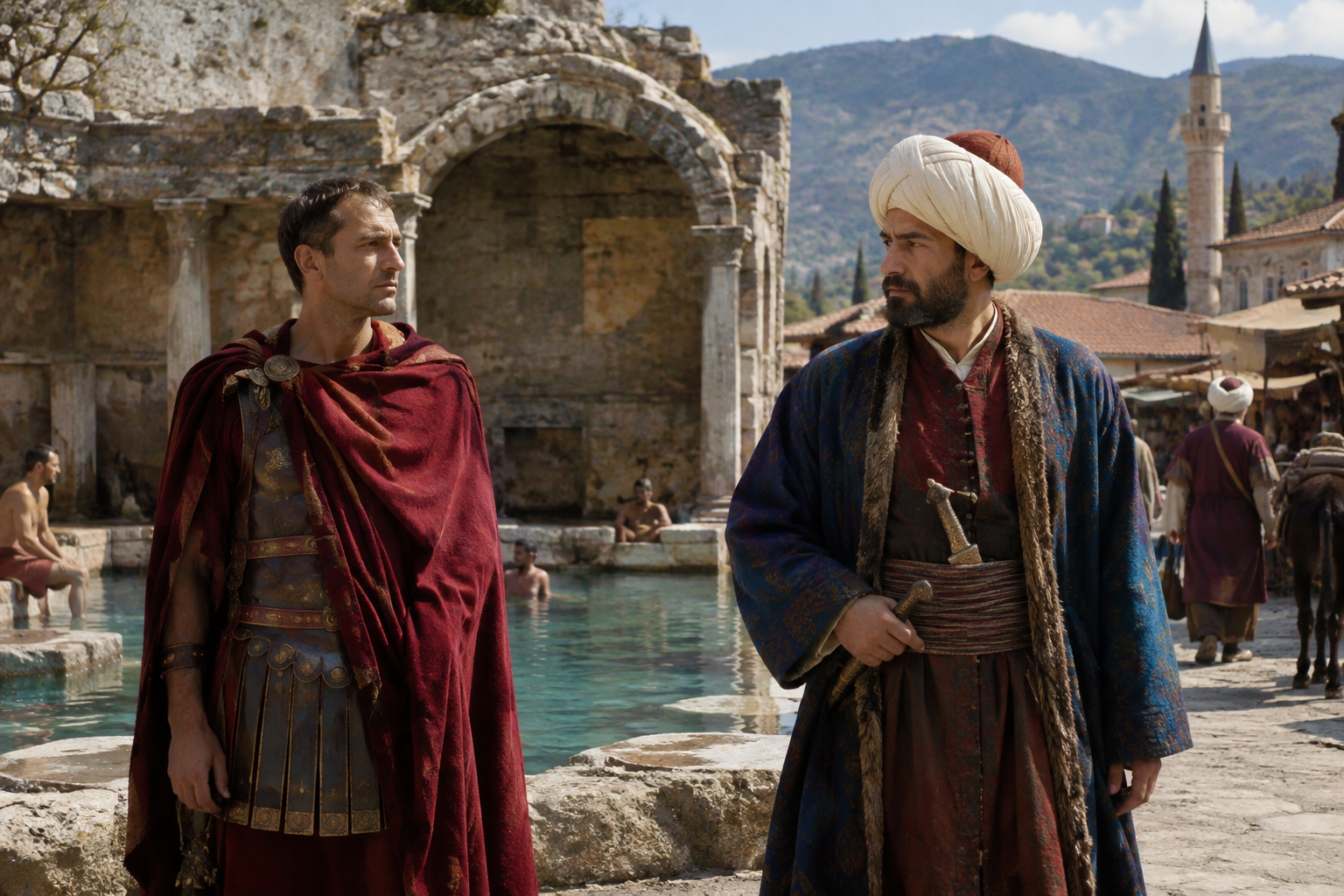
At Aquae Calidae on the Black Sea side of modern Bulgaria, a man buried in the Late Roman era, around AD 350, carries one of the clearest clues in this article's trail: sample I41195, associated here with the Y-DNA haplogroup J2a1a1b2a1b1b3a. That may look forbiddingly technical, but the setting is wonderfully concrete. Aquae Calidae was not a remote village; it was a long-used thermal site in a strategic zone where imperial roads, local Balkan communities, soldiers, traders, and pilgrims could all cross paths.
That is exactly why this lineage is interesting here. J2 is a broad paternal haplogroup often linked, in very general terms, with populations of the eastern Mediterranean and western Asia, but this article's branch is much narrower than J2 as a whole. The value of J2a1a1b2a1b1b3a is not that it tells us a simple ethnic label. It tells us that one direct male line connected to the wider J2 family was present in two very different historical worlds represented by the evidence here: Late Roman Bulgaria and medieval western Anatolia.
Aquae Calidae had a long life before and after Rome, but by the 4th century AD it belonged to a very connected imperial landscape. Roads tied the Balkans to Constantinople, the lower Danube, and the Aegean. Ports and inland routes pulled in merchants and military personnel, while thermal springs made certain places persistent magnets for settlement and reuse. A paternal line found here therefore sits in a setting where mobility is historically unsurprising, even if the exact biography of the man in grave I41195 remains unknown.
That matters because readers are often tempted to make ancient Y-DNA do too much. Y-DNA follows one direct paternal line only. It does not equal a person's whole ancestry, language, or identity. In a Late Roman site especially, that caution is essential: an individual might have local roots, family ties from elsewhere in the empire, or a mixture of both. The archaeological interest lies in the fact that a branch associated with J2a1a1b2a1b1b3a appears in a region where Roman administration and Black Sea connectivity met older Balkan population history.
Late Antique Bulgaria has been especially revealing in recent archaeogenetic work because it refuses tidy categories. Communities in the region could include people with different ancestral backgrounds living under the same imperial framework. That broader point is well illustrated by MyTrueAncestry's discussion of mixed origins in Late Antique Bulgaria, where genetics and archaeology together show just how varied these populations could be.
The full label J2a1a1b2a1b1b3a names a very specific twig on a much larger paternal tree. In popular ancestry terms, it is best understood as a precise male-line signature nested inside the broader J2 haplogroup. Broad J2 has a long history around the Mediterranean, Anatolia, the Caucasus, and parts of the Near East, but we should not lazily project that whole sweep onto this exact subclade without direct evidence.
What the present evidence does show is a pattern of historical plausibility. One ancient carrier appears in a Late Roman Balkan setting; another appears in medieval Anatolia under Ottoman rule. That does not mean these two men belonged to one recent family, or that the branch "belongs" to a single people. It means this paternal line was moving through, or persisting within, the eastern Mediterranean and Balkan worlds where empire, trade, warfare, and settlement constantly reshaped populations.
The second ancient individual is I20572, dated to around AD 1375 and described as Medieval Ottoman Mugla Yatagan Aegean Turkey. This is a striking contrast with Aquae Calidae. We are no longer in the Late Roman Balkans but in southwestern Anatolia, in the period when Ottoman power was expanding across a landscape that had already been shaped by Byzantine rule, Turkic migrations, older Anatolian populations, and Aegean exchange.
A single male line appearing in this context should not be reduced to a slogan like "Roman" or "Turkish." Medieval western Anatolia was a contact zone in the deepest sense: villages, military households, towns, and frontier communities could draw ancestry from multiple earlier layers. A Y-line such as J2a1a1b2a1b1b3a fits comfortably into that history of continuity mixed with change. The paternal lineage may have been present in the region for centuries, or it may reflect more recent movements within the Byzantine-Ottoman transition. On the evidence given here, either is possible, and neither should be overstated.
That larger Anatolian-to-Mediterranean story is explored from another angle in MyTrueAncestry's piece on Anatolian genetic influence in the Roman world. It is a useful reminder that people from Anatolia were not peripheral to Mediterranean history; they were central to it.
If we place these two samples side by side, the most interesting point is geographical as much as genetic. The corridor from the Balkans into the Aegean and Anatolia is one of the great connective tissues of Eurasian history. Armies marched through it, merchants worked across it, pilgrims crossed it, and empires repeatedly reorganized it. A paternal branch turning up on both sides of that zone is not surprising; what is valuable is having dated individuals anchoring the pattern.
For the Late Roman sample, the context invites comparison with the cosmopolitan eastern half of the empire. For the medieval Anatolian sample, the context belongs to a world where Byzantine legacies and Ottoman expansion overlapped. Neither sample, by itself, can define the history of the haplogroup. Together, though, they suggest that this branch belongs in the long history of eastern Mediterranean mobility rather than in any simplistic one-origin legend.
Research on population movement around the Roman and post-Roman Balkans continues to sharpen this picture. A recent ancient DNA study of the region, available as a preprint on bioRxiv, reflects the growing effort to place Balkan individuals into finer local and imperial contexts rather than treating the area as a mere frontier blur.
It is tempting to think of the Roman world as imposing sameness, but ancient DNA keeps showing something subtler. Roman power created roads, armies, towns, legal structures, and trade networks that allowed very different families to end up in the same cemeteries. In that sense, a lineage like J2a1a1b2a1b1b3a is historically at home in Roman-period evidence: not because it proves one ethnic category, but because it belongs to the kind of connected, mixed, mobile world the empire fostered.
This is also why Roman-era evidence from other provinces is useful background. MyTrueAncestry's article on Roman Hispania's genetic legacy makes the same wider point from the far western Mediterranean: Roman rule often preserved local continuity while also introducing new lines of movement and mixture.
For the eastern Mediterranean specifically, broader genomic work has also shown how entangled these regions were in antiquity. One important study in Science helped demonstrate just how much mobility and ancestry exchange characterized Rome's wider world. Even where a paper does not revolve around one narrow subclade, it helps set the historical stage in which lineages like this one circulated.
So what should someone with J2a1a1b2a1b1b3a take from these ancient matches? Not a promise of descent from one famous people, and certainly not a neat single homeland story. What the current evidence supports is something more historically interesting: this direct paternal line appears in documented individuals from a Late Roman Balkan crossroads and a medieval Aegean-Anatolian setting, both regions shaped by long continuity and repeated movement.
In other words, this haplogroup fits a world of bath towns, ports, marching roads, and frontier provinces rather than a sealed-off tribe. It points toward the eastern Mediterranean, the Balkans, and Anatolia as meaningful arenas in its recorded ancient history. That is a modest conclusion, but a strong one because it rests on real people, real places, and datable archaeological contexts.

Comments