Haplogroup J2a1a1b2a1b1b3

– 5 min read


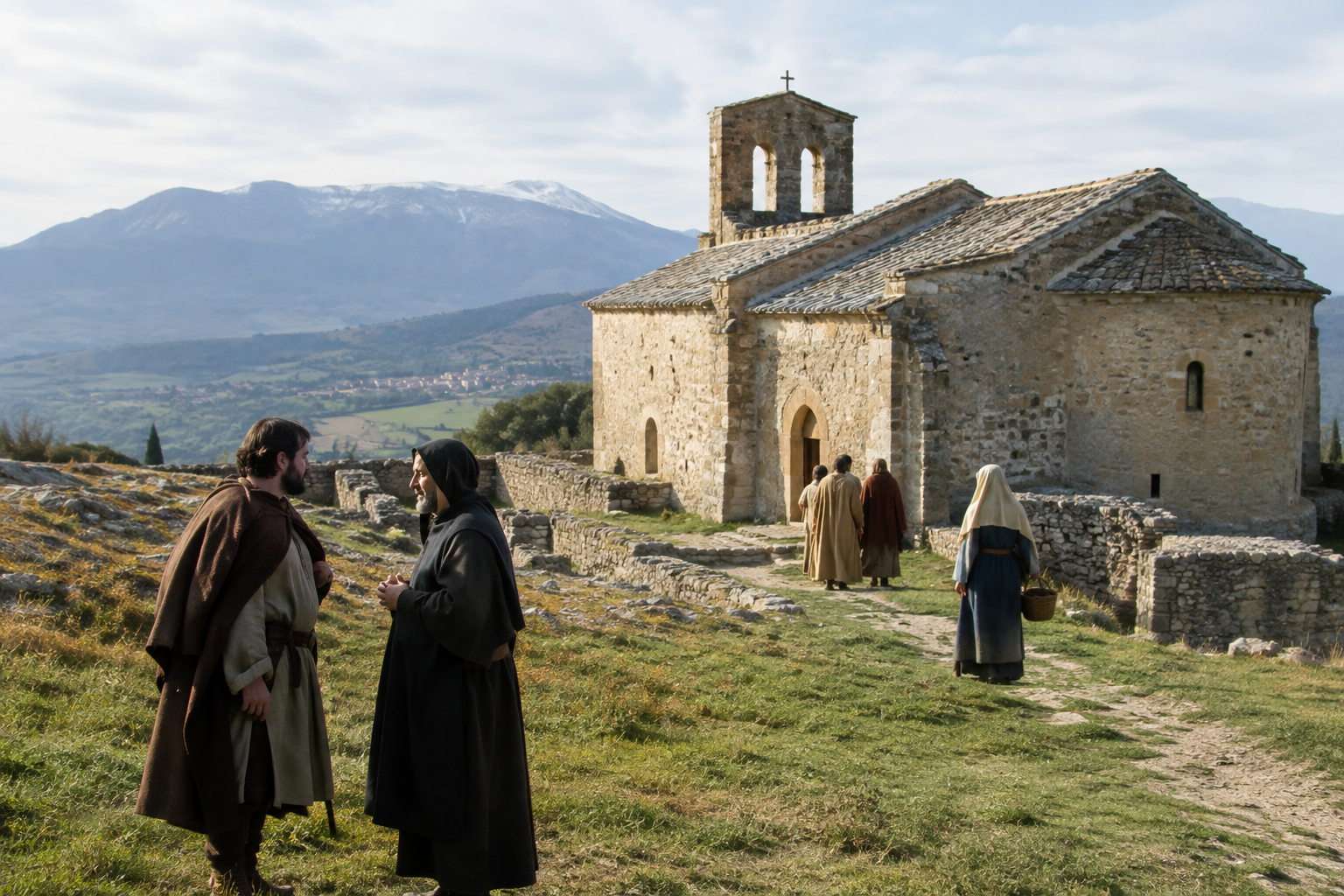
At Amiternum in Abruzzo, an early medieval man identified as ASM_S38 offers one of those wonderfully stubborn pieces of evidence that refuse to fit neat historical boxes. Dated to around AD 800 and buried at Santa Maria in Civitate, he belongs to a period when central Italy was living through the long afterlife of Rome: Lombard power, Christian institutions, older local communities, and wider Mediterranean connections all overlapping in the same landscape. Reported in connection with the Y-DNA haplogroup J2a1a1b2a1b1b3, he gives us a small but very real glimpse of a paternal line present in the Apennines at the start of the medieval period.
That is the right scale on which to read this evidence. Y-DNA traces one direct paternal line rather than a person's whole ancestry, but that single line can still be historically revealing when it appears in a documented archaeological setting. In this case, the interest lies not in turning one man into a grand migration myth, but in seeing how a branch within the wider J2 family appears inside an Italian community shaped by centuries of movement, empire, and local continuity.
Amiternum was no backwater. Founded in the Sabine country and later drawn firmly into the Roman world, it sat in a region where roads, political authority, and cultural loyalties shifted repeatedly across late antiquity and the early Middle Ages. By about AD 800, when ASM_S38 lived, the old Roman urban framework had changed dramatically, yet places like Amiternum still preserved settlement, memory, and burial landscapes that linked medieval people to a much older past.
That matters for a lineage such as J2a1a1b2a1b1b3. The broader haplogroup J2 is often associated with the Mediterranean and the Near East in deep prehistory and later history, but one must be careful here: the presence of this exact subclade in early medieval Abruzzo does not by itself prove when or how that paternal line first arrived in Italy. What it does show is that by the Carolingian age, a man carrying this branch was part of the human community at Amiternum.
An ancient DNA study focused on this region, research published on the population history of ancient Amiternum, is especially relevant because the site spans the Roman-to-medieval transition so well. Even without turning one burial into a sweeping conclusion, the setting lets us ask a bigger question: how much of early medieval Italy was made from newcomers, and how much from the reshaping of older local populations?
The first useful point is scale. J2a1a1b2a1b1b3 is not the same thing as haplogroup J2 in general, still less as "eastern Mediterranean ancestry" in some broad cultural sense. It is a much narrower paternal branch nested within that larger family tree. So when we speak about its presence in early medieval Italy, we are talking about a specific male-line descent pattern, not a ready-made ethnic label.
That distinction is especially important in Italy, where paternal lines from different periods may sit side by side inside the same cemetery. Roman expansion, long-distance trade, military service, slavery, marriage, ecclesiastical networks, and ordinary mobility all helped move people around the peninsula. A branch like this one may have reached central Italy long before AD 800, or it may reflect later movement inside the Roman and post-Roman Mediterranean. With the evidence at hand, the honest answer is that the burial anchors the branch in place and time, but does not license a more precise route than that.
Readers sometimes imagine the centuries after Rome as a succession of replacement populations: Romans out, then "barbarians" in. Archaeology and ancient DNA keep spoiling that tidy story. Cemeteries from Italy and the western Mediterranean increasingly show that post-Roman communities could be locally rooted, mixed in origin, and socially varied all at once. A burial ground is not a tribal badge.
ASM_S38 sits squarely inside that more complicated picture. His reported association with J2a1a1b2a1b1b3 suggests that paternal lines often linked with older Mediterranean worlds remained part of the population of inland Italy into the early medieval period. That does not make him Roman in a political sense, Lombard in a legal sense, or anything else by Y-DNA alone. It does, however, underline a point historians of Italy have long suspected from texts and material culture: the centuries around AD 800 were full of continuity as well as change.
Abruzzo can look remote on a modern map if one stares only at mountains. Historically, that would be a mistake. Central Italy was tied by roads, ecclesiastical administration, seasonal movement, and political alliances to the Adriatic, the Tyrrhenian, and beyond them to the wider Mediterranean. Inland communities were never sealed boxes.
That broader geography helps explain why a J2-derived paternal line in Amiternum should not surprise us. The peninsula had absorbed centuries of contact with Greece, the Balkans, Anatolia, and the eastern Mediterranean under a variety of regimes and circumstances, from prehistoric farming dispersals to Roman imperial circulation. None of those processes can be pinned specifically on ASM_S38, but they form the background against which such a lineage in early medieval Italy becomes historically intelligible rather than anomalous.
The same caution applies in reverse. It would be tempting to treat this single branch as proof of one dramatic eastern origin story. Yet the more useful historical lesson is subtler: central Italy retained and recombined many paternal histories over a very long time. Ancient DNA keeps revealing that the making of medieval Europe was often an accumulation of older layers, not a clean break from them.
One sample is not a population, but one sample from a well-placed site can still be valuable. ASM_S38 matters because he is not floating in abstraction: he comes from a named site, a known region, and a historically charged period. That turns a long technical haplogroup label into something more tangible - a paternal line carried by a real man living in post-Roman Italy.
It also reminds us how archaeogenetics works best. The power of ancient DNA does not lie only in kings, elite tombs, or spectacular migrations. Sometimes the most revealing evidence comes from ordinary burial grounds where the categories of textbook history blur. In such places, genetic data can illuminate the persistence of local families, the survival of older Mediterranean lineages, and the mingling that produced medieval populations.
Greek-linked continuity in Italy
For someone exploring the haplogroup J2a1a1b2a1b1b3, the clearest supported insight here is that this paternal line appears in central Italy by around AD 800, in the burial record of Amiternum at Santa Maria in Civitate. That places the branch within the lived world of early medieval Italy: a society built from Roman inheritances, regional persistence, and long Mediterranean entanglements. It is a precise historical foothold, not a fantasy pedigree - and that is exactly what makes it useful.




Comments