Haplogroup J2a1a1b1a
– 5 min read


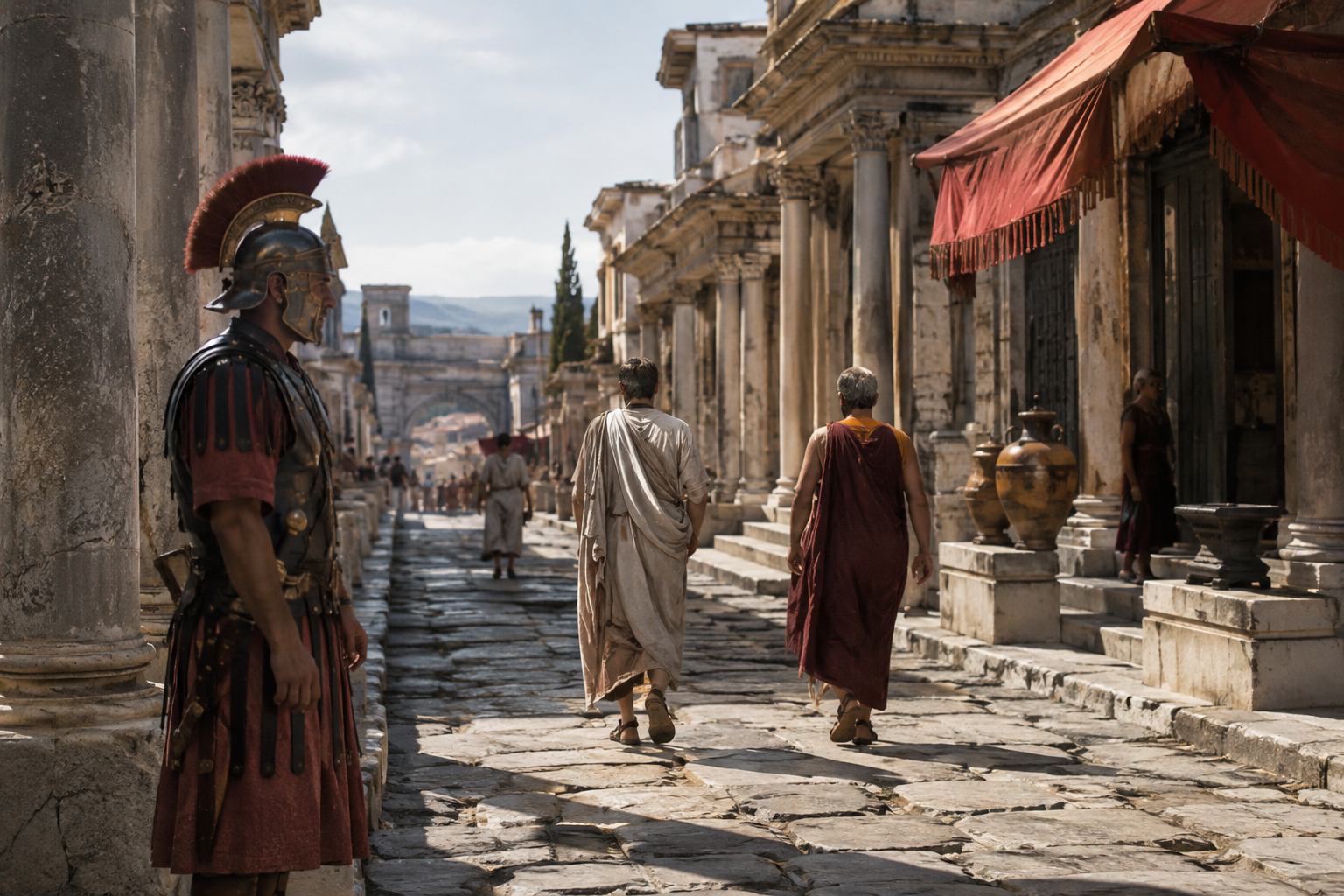
A man labelled R76, buried at Viale Rossini in Roman Anatolia around AD 100, gives us a rare and very grounded way into haplogroup J2a1a1b1a. We are not dealing here with a legendary founder or a castle pedigree, but with something much better for archaeology: an actual ancient individual from the Roman world, set in a place where empire, migration, and local continuity all met.
That matters because J2 in its broader sense is one of the lineages most often associated with the long human history of the eastern Mediterranean, Anatolia, and neighboring regions. But this article is about the narrower branch J2a1a1b1a, not the whole of J2, and that distinction is essential. A Y-DNA haplogroup traces one direct paternal line only. It does not tell us a person's whole ancestry, language, or identity, but in the right archaeological setting it can illuminate how male lines moved through historical landscapes.
The most concrete evidence here is the Viale Rossini individual R76, dated to about AD 100 and classified as Anatolian Roman. Even from that spare description, the historical setting is rich enough. Roman Anatolia was not a remote frontier. It was one of the empire's most densely connected regions: full of old cities, military roads, ports, tax routes, and long-established local communities that had already lived through Hellenistic and earlier imperial phases before Rome took control.
So when a paternal line like J2a1a1b1a appears in a Roman-period Anatolian context, the interesting question is not whether it is somehow "Roman" in a simple ethnic sense. It is whether we are seeing continuity from deeper eastern Mediterranean populations, movement within the imperial world, or both at once. In Roman provinces, those possibilities constantly overlap. Men moved as soldiers, traders, craftsmen, sailors, administrators, and slaves; just as importantly, many families stayed where they were while imperial rule changed above them.
A landmark ancient DNA study of Rome and the wider Mediterranean helped make that larger picture clear by showing how strongly connected the imperial population could be, especially with the eastern Mediterranean. That does not mean the paper specifically proves every detail of R76's biography, but it does support the broader historical context in which an Anatolian Roman man carrying a J2-related paternal line is entirely plausible.
The wider haplogroup J2 is often linked, at a broad level, with populations of the Near East and eastern Mediterranean, including regions shaped by early farming, Bronze Age exchange, Greek expansion, and the great imperial systems of later antiquity. But one must not lazily pour all of that history into a much narrower branch like J2a1a1b1a. A terminal or near-terminal subclade has its own, usually later and more specific, branching history.
In practical terms, that means R76 is valuable not because he lets us tell a grand fairy tale about "the origin" of all J2a1a1b1a men, but because he anchors this branch in a real archaeological horizon: Roman Anatolia in the early imperial period. If your paternal line falls within this haplogroup, that does not make you a Roman, a Greek, an Anatolian, or anything else by itself. What it does suggest is that one branch of your direct male line was present in the eastern Roman world by the early second century AD.
That is already historically meaningful. Anatolia was one of the great meeting grounds of Eurasian history. Hittite states, Achaemenid rule, Hellenistic kingdoms, Roman administration, and later Byzantine power all passed through the same landscapes. A paternal lineage surviving there in the Roman period may have much older roots in the region, or roots in nearby connected zones of the Aegean, Caucasus, Levant, or Mesopotamia, followed by movement under empire. The key point is connection, not a single neat origin myth.
One of the most misleading habits in popular history is to imagine Roman identity as if it erased earlier populations. It did not. In Anatolia especially, Roman rule sat on top of very old urban and rural societies. Local families continued, intermarried, adopted imperial customs unevenly, and participated in a world that was both provincial and international.
That is the proper setting for understanding R76. His Y-DNA branch may represent a line rooted in Anatolia long before Rome, or a line that arrived through the dense traffic of the eastern Mediterranean before or during Roman rule. Archaeology repeatedly shows that these are not rival explanations but often parts of the same story. Roman provinces were full of continuity wrapped in mobility.
This is why eastern Mediterranean lineages in Roman contexts are so informative. They remind us that empire was not simply a matter of Italians spreading outward. It was also a system that drew people inward, sideways, and across the sea lanes linking Anatolia, the Levant, Greece, Egypt, and Italy. The paternal line in J2a1a1b1a belongs comfortably inside that world.
Eastern Mediterranean in Roman DNA
Although our named ancient sample here is from Anatolia, the broader Mediterranean record gives useful context for why a branch like J2a1a1b1a turns up in Roman-era populations. Genetic work from Roman and post-Roman Italy has repeatedly shown that the peninsula was no sealed biological unit. Movement from the eastern Mediterranean left a visible mark, especially in urban and connected environments.
That does not let us assign R76 to a particular migration event. But it does tell us that the Roman world created and preserved exactly the sort of human network in which a lineage like this could persist across several regions. The sea between western Anatolia and Greece, or between Aegean ports and Italy, was not a barrier in Roman history. It was a highway.
The same caution applies in the other direction too. It would be easy, but wrong, to assume every J2a1a1b1a line in later Europe must descend from a single Roman movement. Some may; some may reflect earlier Greek and Anatolian links; others later Byzantine, Jewish, Levantine, Caucasian, or Islamic-era mobility. The archaeology of the Mediterranean very rarely rewards one-cause explanations.
There is a temptation, when only one clearly named ancient sample is available, to dismiss it as too little. In one sense, yes: one man is not a population. But archaeology is full of cases where a single well-placed burial sharpens the entire discussion. R76 shows that this paternal branch, or a classification associated with it, had reached the documentary visibility of ancient DNA in Roman Anatolia by about AD 100. That is not everything, but it is not trivial either.
It gives a chronological anchor. It places the line in one of the most historically connected regions on earth. And it fits a broader pattern in which eastern Mediterranean paternal ancestry appears within the highly mobile societies of classical and Roman antiquity. For members of J2a1a1b1a today, this is the sort of evidence that turns abstract haplogroup labels into lived history.
It also encourages a better historical imagination. Not the fantasy of a single heroic ancestor marching across a map, but the more interesting reality: generations of men living through changing empires, carrying forward one paternal line while languages, loyalties, and political masters shifted around them.
The strongest evidence here is simple and solid: haplogroup J2a1a1b1a is represented by the Roman Anatolian individual R76 from Viale Rossini, around AD 100. That places this paternal line, or a closely associated reported branch, in the eastern Roman world where local continuity and long-distance movement constantly overlapped. For someone researching this haplogroup today, the most responsible takeaway is not a claim to one ethnicity or dynasty, but a connection to the deeply entangled history of Anatolia and the Mediterranean.




Comments