Haplogroup J2a1a1a2b2a3b1a1b1

– 5 min read


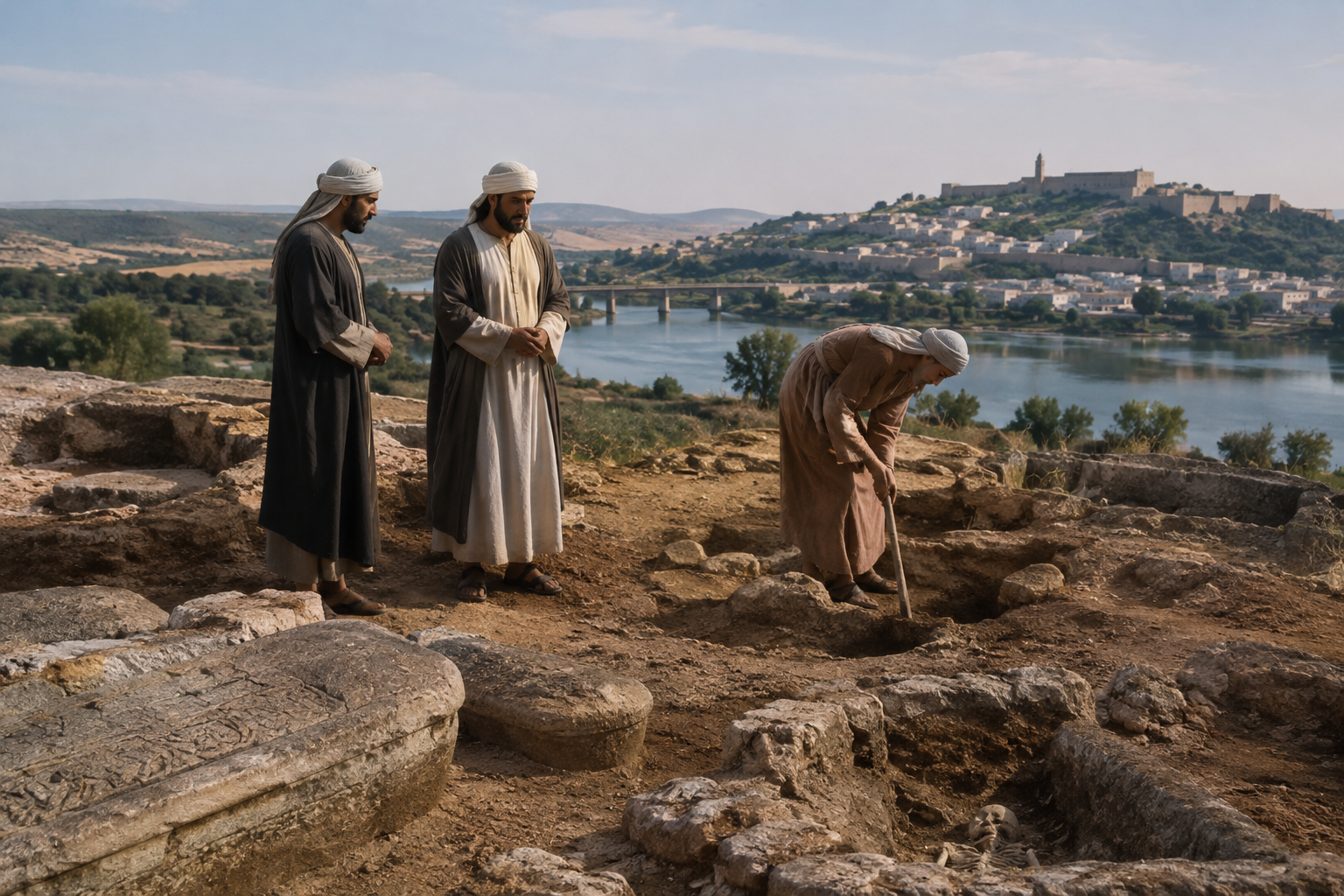
In the necropolis at Santarem in medieval Portugal, one man from about AD 950 has become unexpectedly important for the history of a very particular paternal line. He is recorded as LP114_15, an individual associated with Umayyad-period Santarem, and his Y-DNA has been linked to the branch J2a1a1a2b2a3b1a1b1. That is a highly specific label, but the setting itself is the real point of interest: an Islamic-period burial ground in western Iberia, in a town that sat at the frontier of several worlds at once.
Santarem was not some remote outpost. In the 10th century it belonged to al-Andalus, tied politically to the Umayyad Caliphate of Cordoba and connected by trade, administration, religion, and movement of people across Iberia and beyond. A Y-chromosome result from this context does not tell us everything about LP114_15's ancestry or identity; Y-DNA follows only one direct paternal line. But it does give us a sharp little thread to follow through a famously mixed medieval landscape.
Medieval Santarem, on the Tagus corridor, was strategically placed between the Atlantic-facing west and the interior of Iberia. Long before modern borders, this was a zone of Roman settlement, post-Roman transformation, Islamic rule, and later Christian conquest. By AD 950, a burial there belonged to a society shaped by Arabic-speaking elites, local Iberian populations, converts, migrants, soldiers, merchants, and families whose histories may have crossed the Mediterranean more than once.
That is why LP114_15 matters. A lineage such as J2a1a1a2b2a3b1a1b1 sits within the broader haplogroup J2, a major West Eurasian paternal clade often discussed in connection with the Mediterranean, the Near East, and parts of southern Europe. But one must be careful here: the broad history of J2 is not the same thing as the history of this exact sub-branch. What the Santarem evidence gives us securely is not a grand origin myth, but a documented appearance of this paternal line in 10th-century western Iberia, in an Islamic funerary context.
One ancient sample is never a whole population, and no responsible reading should pretend otherwise. Yet single individuals can be historically illuminating when they come from a well-chosen place and time. Santarem in the Umayyad period is precisely that kind of place: a frontier town, but also a node in a larger political system that linked Iberia to North Africa and the wider Islamic world.
In practical terms, LP114_15 shows that this paternal branch was present in a community living under Islamic rule in Portugal by the mid-10th century. That may reflect local continuity from earlier Mediterranean movements, movement within al-Andalus itself, or ancestry connected with North African or eastern Mediterranean networks. The crucial point is that the burial belongs to a period when Iberian populations were not neatly separable into modern national boxes. Medieval Portugal was already genetically and culturally layered.
An ancient DNA study of the region, published in Genome Biology, helps frame this wider context by examining population change and continuity in medieval Iberia. Even without forcing LP114_15 into an overly tidy migration tale, the research backdrop makes one thing plain: the Islamic centuries in Iberia were not a brief cultural veneer laid over an untouched population. They formed part of a real demographic history.
Broad haplogroup J2 did not first appear in Iberia with the Umayyads. The peninsula had already seen millennia of contact with the wider Mediterranean: Phoenician traders, Roman settlers, imperial soldiers, enslaved people, merchants, and later post-Roman mobility. So when a fine-grained branch like J2a1a1a2b2a3b1a1b1 turns up in medieval Santarem, the historical question is not simply, "How did it arrive?" It is also, "How long had related paternal lines already been circulating in Iberia before this burial?"
That is where archaeology helps restrain fantasy. We should not leap from one 10th-century grave to a single founding ancestor from Arabia, the Levant, or North Africa. Nor should we assume that an Islamic-period burial must represent a recent immigrant. In al-Andalus, political rule, religious affiliation, language, and paternal lineage did not march in lockstep. LP114_15 may have belonged to a family long established in Iberia, or one with more recent roots elsewhere in the Umayyad world; the Y-chromosome alone cannot decide between those possibilities.
Roman Hispania's Genetic Legacy
The temptation with medieval Iberia is to tell the story as a simple contest between Muslim and Christian realms. The archaeology is usually more interesting than that. Towns such as Santarem were places where administration, agriculture, craft production, trade, faith, and family life persisted through changing regimes. Cemeteries preserve that ordinary human reality better than grand chronicles do.
For a paternal lineage, this matters enormously. A Y-chromosome branch can survive political upheaval with surprising ease. Dynasties fall, languages shift, and religious institutions change, while paternal lines continue through men who marry locally, move between provinces, serve in armies, or settle in towns. In that sense, LP114_15 is valuable precisely because he is not a king or a literary figure. He anchors this lineage in the lived world of medieval Portugal.
Research on other Islamic-period Iberian sites has repeatedly shown that these communities could be diverse in biological background as well as culture. That makes Santarem a good fit for a lineage whose broader relatives are spread across multiple Mediterranean and western Asian regions. The result is not a simplistic badge of ethnicity, but evidence of the kind of mixed and mobile society that written sources also suggest.
Diverse Origins in Early Madrid
If you belong to J2a1a1a2b2a3b1a1b1, the Santarem burial offers something better than a vague continental label. It places a bearer of a closely matching paternal branch in a specific historical setting: Umayyad-period Portugal, around AD 950, in a cemetery shaped by the society of al-Andalus. That is concrete, and for family historians it is often more meaningful than sweeping statements about ancient origins.
At the same time, the precision of the haplogroup name can create a false sense of certainty if we are not careful. Deep subclades are genealogically narrow, but the historical interpretation still depends on context, sample coverage, and how securely the ancient assignment is reported. The safest conclusion is that this branch had a place within the male population of medieval Islamic Iberia, and that its history belongs to the broader Mediterranean story of continuity, conversion, migration, and local settlement.
Muslim-Christian Transition in Algarve
The most distinctive thing about J2a1a1a2b2a3b1a1b1 here is not an invented tale of conquest or nobility, but its presence in a documented burial from Santarem at the western edge of the Umayyad world. LP114_15 reminds us that Portugal's medieval past was deeply entangled with the wider Mediterranean, and that paternal ancestry can sometimes preserve those connections in a surprisingly exact form. For anyone researching this line today, the evidence points not to a single romantic origin, but to a real historical landscape in which Iberian, North African, and Mediterranean histories met in the same town, and sometimes in the same family line.

Comments