Haplogroup J2a1a1a2b2a3b1

– 5 min read


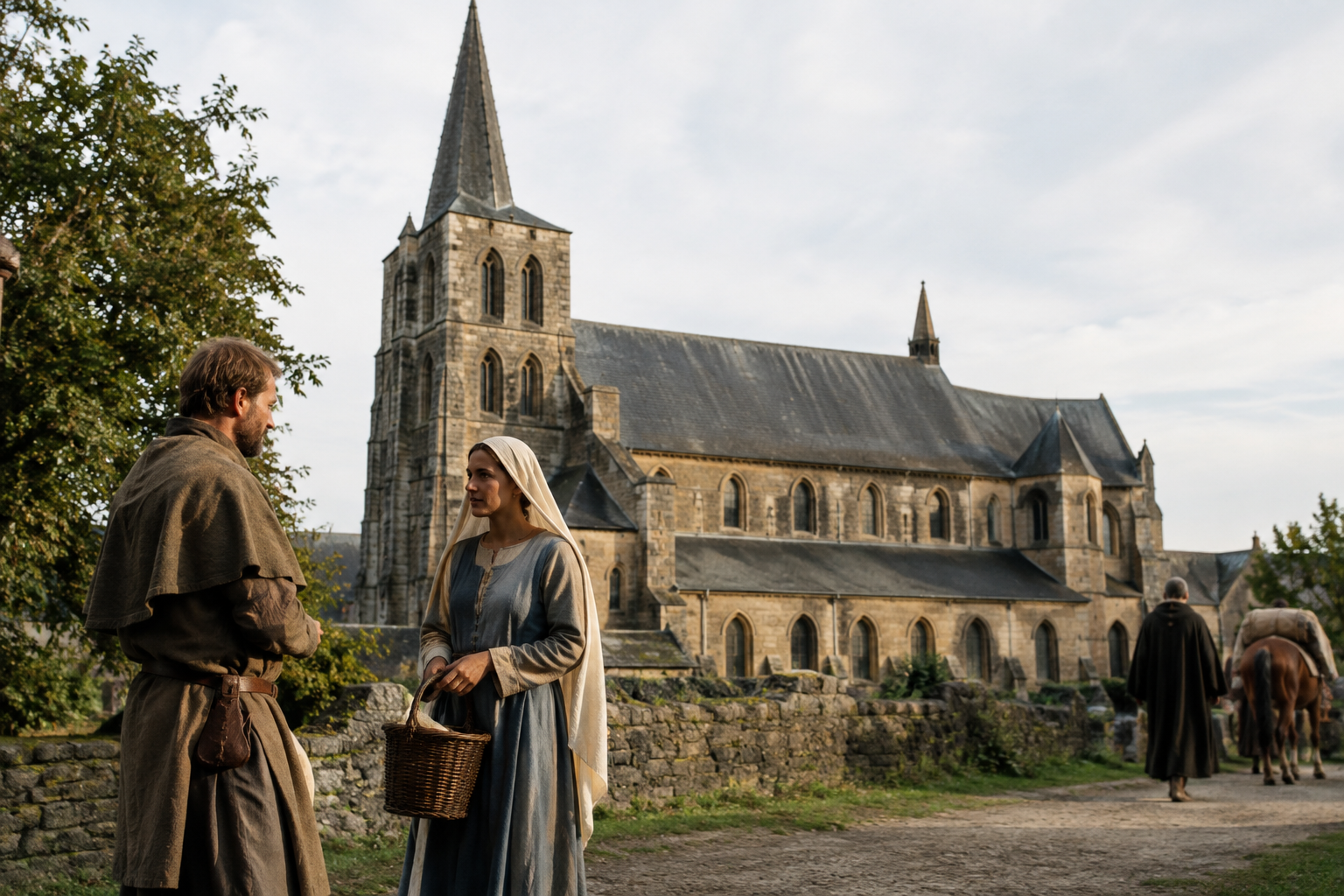
At Sint-Truiden in medieval Belgium, one burial stands out precisely because it complicates the neat picture we often like to tell about early towns. The individual labeled ST1287, dated to around AD 900 and identified in the cemetery of Onze-Lieve-Vrouwekerk, was classed as an outsider in the site's broader genetic study. That makes him an especially interesting starting point for haplogroup J2a1a1a2b2a3b1: not because one man can define a lineage, but because he shows how paternal lines associated more often with the Mediterranean and Near East could appear in a growing town deep in the medieval Low Countries.
This is the right scale on which to think about Y-DNA. A haplogroup tracks one direct paternal line only, not a person's whole ancestry, language, or identity. In the case of J2a1a1a2b2a3b1, the value lies less in grand claims and more in what a securely placed medieval burial like ST1287 tells us about movement, mixture, and urban life in northwestern Europe.
Sint-Truiden was not an isolated village but an important ecclesiastical and urban center in what is now Belgium. By around AD 900, places like this were shaped by pilgrimage, trade, church patronage, labor mobility, and the constant churn of people moving in and out. A lineage such as J2a1a1a2b2a3b1 appearing there is therefore historically plausible without needing any melodrama about crusaders, princes, or lost dynasties.
The useful point about ST1287 is the context: he comes from a church cemetery in a town whose population was being studied not as a legendary elite, but as a real medieval community. Research on these burials, including a genetic study of medieval Sint-Truiden, has drawn attention to urbanization and population structure rather than romantic origin stories. In that setting, an "outsider" classification matters because it suggests that the town incorporated people whose recent family histories differed from the local norm.
That does not mean we can identify ST1287's birthplace from Y-DNA alone. But it does mean that this paternal branch, or a closely reported association with it, had reached a northern European Christian burial ground by the early medieval period. For family historians, that is often the most meaningful sort of evidence: not mythic beginnings, but a real person in a real place.
J2 is a large and historically important Y-chromosome branch with deep roots in western Eurasia, especially in regions linked over millennia by farming, trade, empire, and urban life. Its sub-branches are found in many different historical settings, from the eastern Mediterranean and Anatolia to the Balkans, Italy, the Caucasus, and beyond. But that broad background should not be carelessly collapsed into a biography for the much narrower branch J2a1a1a2b2a3b1.
What we can say more responsibly is that a lineage inside this wider J2 family appears here in a medieval Belgian individual who was not genetically typical of the surrounding burial population. That fits a pattern seen again and again in ancient DNA: towns, ports, frontier settlements, and religious centers tend to preserve people whose paternal lines had traveled farther than local historical narratives sometimes admit.
In other words, ST1287 is interesting not because he "proves" a migration route, but because he belongs to the kind of community where routes converged.
The medieval Low Countries were a contact zone. River systems tied inland towns to coastal exchange; monasteries and churches linked them to wider Latin Christendom; political power shifted among local lords, bishops, and larger kingdoms. In such environments, genetic variety is not an exception to be explained away, but part of the normal fabric of life.
A paternal line like J2a1a1a2b2a3b1 could have arrived through many historically ordinary processes: commerce, craft movement, military service, clerical networks, marriage patterns, or earlier Roman and post-Roman mobility feeding into later town populations. The evidence we have does not let us choose one of those stories for ST1287, and it would be bad archaeology to pretend otherwise. Yet the burial does remind us that medieval Belgium was connected to a much wider world than tidy ethnic labels suggest.
This matters especially because J2 lineages are often discussed as though they belong somewhere else and only arrived in northern Europe as rare curiosities. Medieval cemeteries keep spoiling that assumption. They show that by the early second millennium's threshold, communities in the north already contained men whose paternal ancestry connected them, directly or indirectly, to wider continental and Mediterranean histories.
The label "outsider" deserves a moment's attention. In ancient DNA studies, it usually signals that a person's genome differs noticeably from the local genetic cluster, not that archaeologists uncovered a dramatic stranger from a storybook. Such people may have been first-generation migrants, descendants of recent arrivals, or simply members of lineages uncommon at that site.
For ST1287, the combination of an ecclesiastical burial ground and a non-local genetic signal is particularly revealing. It suggests integration, not isolation. He was buried within the same sacred landscape as others in the community, which tells us something important about how movement worked in the medieval world: people could arrive from elsewhere and still become part of local social and religious life.
This is one of the quiet strengths of archaeogenetics. It shifts our attention from imagined "tribal purity" to the actual business of living communities. The dead from churchyards and town cemeteries do not arrange themselves into tidy historical categories for our convenience.
There is only one ancient individual listed here for J2a1a1a2b2a3b1, and that scarcity should be faced plainly. A single sample cannot map the full history of a subclade, assign it to a people, or tell every modern carrier where his line spent each century. But one sample can do something more disciplined and, in its way, more useful: anchor the branch in a definite archaeological context.
ST1287 shows that this lineage, or a reported assignment tied to it, existed in medieval Sint-Truiden around AD 900. That places the branch in a Christian urban cemetery in the Low Countries during a period of regional consolidation, trade, and population movement. For many readers, that is exactly the kind of evidence worth having: concrete, datable, and historically interpretable.
It also encourages a broader historical imagination. If your paternal line belongs to J2a1a1a2b2a3b1, your deeper ancestry may connect into long networks of movement across Europe and the Mediterranean world, but its medieval history need not have remained in the south or east. By the time of ST1287, such lines were already part of life in northern towns.
The most distinctive thing about J2a1a1a2b2a3b1, on present evidence here, is not royal glamour or prehistoric certainty. It is the sight of a paternal line associated with broader western Eurasian connections turning up in a documented early medieval Belgian burial, in a town where local and non-local histories were meeting in the same cemetery. ST1287 does not stand for everyone with this haplogroup, but he does offer a sober and fascinating clue: your direct paternal line may have been moving through the connected worlds of medieval Europe long before modern records begin.

Comments