Haplogroup J2a1a1a2b2a2b3a2

– 5 min read


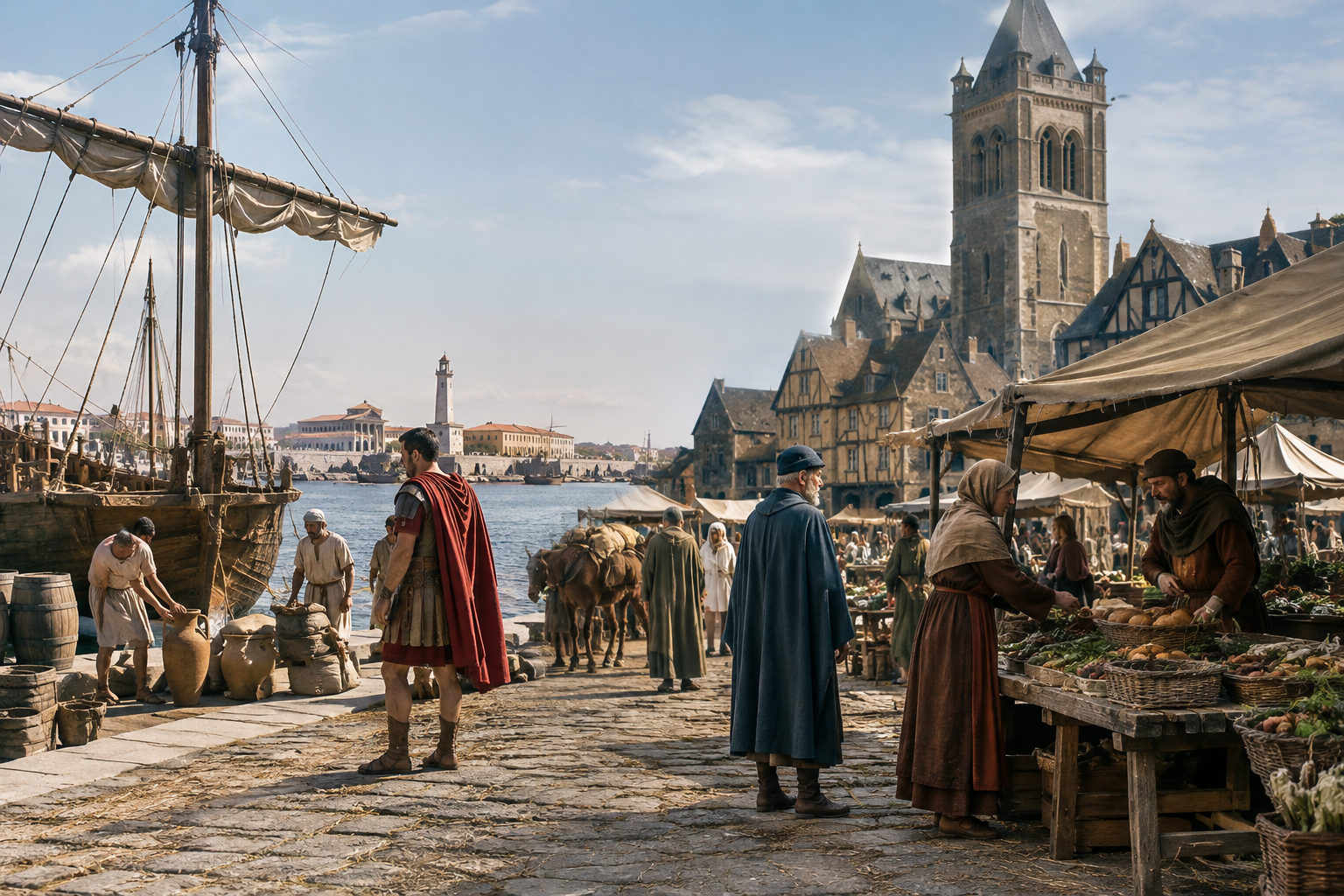
At Sint-Truiden in present-day Belgium, one early medieval burial has become unexpectedly useful for thinking about a very specific paternal line. The individual labelled ST2988, dated to about AD 795 from the Groenmarkt area, belongs to the broad Carolingian world of monasteries, markets, and growing towns. In genetic terms, he has been associated with the Y-DNA haplogroup J2a1a1a2b2a2b3a2, a very narrow branch within the much larger J2 family.
That may sound forbiddingly technical, but the historical point is quite human. A lineage often linked in broad terms with populations of the Mediterranean and Near East turns up here in the northwestern edge of the Carolingian realm. And it does not appear in isolation: the same haplogroup article also points to an earlier individual from the Roman port world of Ostia, sample R11109, from Isola Sacra near Rome, dated to about AD 200. Taken together, these two men do not map a neat dynasty or a simple migration route. They do something more interesting: they show how one paternal line could move through the intensely connected worlds of the Roman Empire and its early medieval successors.
Sint-Truiden was no sleepy backwater. By the late 8th century it stood within a landscape being reshaped by ecclesiastical power, agricultural expansion, and urban growth. The Groenmarkt burials belong to that changing settlement history, where local communities were being drawn into a larger political and religious order dominated by the Carolingians.
Sample ST2988 matters because he places this paternal branch in a northern European town at a moment when the region was becoming more socially and economically integrated. Y-DNA traces one direct male line only, not a person's whole ancestry, but that still makes it valuable. It can show that paternal histories in early medieval towns were not necessarily local in any simple or timeless sense.
A recent genetic study of medieval Sint-Truiden explored exactly this kind of urban population history, asking how mobility and mixing shaped the people buried there. For the wider setting of these burials, see research on medieval Sint-Truiden and urban genetic change. ST2988 fits the broader historical picture of towns as places where lineages met, settled, and were absorbed into new communities.
The challenge with a subclade as specific as J2a1a1a2b2a2b3a2 is that the name looks more precise than the history we can safely write from only two ancient examples. The wider haplogroup J2 is well known in studies of the Mediterranean, the Aegean, Anatolia, and the Near East, and it appears repeatedly in later European populations shaped by trade, empire, and migration. But that broad background should not be lazily projected onto one tiny downstream branch as though everything were already settled.
What we can say is narrower and better. This article's branch appears here in two very different archaeological settings: an imperial port near Rome and a Carolingian-period town in Belgium. That is enough to place the paternal line inside long-distance historical networks. It is not enough, by itself, to claim a single origin story, one ethnic identity, or an unbroken documented route from one burial to the other.
The older of the two ancient men is R11109, dated to around AD 200 from Imperial Rome Isola Sacra Ostia Antica Port. This is a wonderfully specific context. Isola Sacra was part of the harbor system serving Rome, a zone of cemeteries, roads, warehouses, docks, traders, laborers, and families whose lives depended on the capital's appetite for grain, oil, wine, marble, and people.
When a paternal line like this appears at Ostia's port necropolis, the first thing to remember is that Roman harbors were magnets. They drew in soldiers, merchants, freedpeople, craftspeople, sailors, and migrants from across the empire. So the importance of R11109 is not that he lets us label a "Roman type," but that he places this branch in one of antiquity's most cosmopolitan environments.
That matters for interpreting the later Belgian sample. If a branch is visible in the harbor world of imperial Rome by about AD 200, it becomes much easier to imagine how descendants or collateral lines might later appear in provinces far to the north. Not because one skeleton turned into another, of course, but because Roman infrastructure created durable corridors of movement: military service, commerce, colonization, slavery, manumission, and family formation.
The distance between Ostia around AD 200 and Sint-Truiden around AD 795 is not just geographical. It spans the transformation of the Roman Empire, the reorganization of power in western Europe, and the emergence of early medieval Christian polities. Yet this is exactly the sort of long arc where ancient DNA becomes so useful. It catches paternal continuity and mobility that written sources almost never record for ordinary men.
Northwestern Europe after Rome was not cut off from the Mediterranean. On the contrary, many post-Roman communities inherited Roman roads, Christian institutions, trade habits, and older settlement patterns. In some places, new elites arrived; in others, local populations adapted within changing political structures. A paternal lineage associated with a Roman port appearing later in a Carolingian burial ground is therefore historically plausible without needing any melodrama attached to it.
For a parallel discussion of how Roman-period ancestry could leave a lasting imprint in the western provinces, there is a useful MyTrueAncestry piece on Roman Hispania's Lasting Genetic Legacy. The Belgian and Ostian samples belong to a different geography, but the broader lesson is similar: Roman connectivity outlived Roman rule.
It is tempting to think that only huge sample sets count. In fact, small numbers can still be historically revealing when the contexts are good and the comparison is sharp. Here the contrast is excellent: a man from the imperial port system near Rome and a man from an early medieval urbanizing center in the Low Countries. Those are not random dots on a map. They are two nodal points in European history.
The Isola Sacra context suggests circulation within the Mediterranean engine of empire. The Sint-Truiden context suggests settlement within the reshaped social world of the Carolingian north. Put together, they give J2a1a1a2b2a2b3a2 a historically intelligible profile: not a lineage confined to one narrow homeland in the surviving evidence here, but one present within connected, mobile, institution-rich societies.
Research on ancient Rome and its surrounding populations has increasingly emphasized exactly this diversity and movement. A broader ancient DNA investigation touching Roman-period Italy and related populations is available at this study of ancient Italian population history. Even where one cannot use a paper to make claims beyond the evidence in hand, the wider picture is clear enough: Roman and post-Roman Europe were full of people whose family histories crossed regions.
So what is distinctive here? Not royal glamour, not a named dynasty, and not a miraculous single-route migration tale. The value of J2a1a1a2b2a2b3a2 in the present evidence is that it appears in two strongly connected but very different historical settings: the harbor machinery of imperial Rome and the urbanizing landscape of Carolingian Belgium. That combination suggests a paternal line at home in the traffic of empire and its aftermath.
For someone researching this haplogroup today, the sensible takeaway is that your direct male line may belong to a history of movement through Mediterranean and western European networks rather than to one tidy modern national story. Ancient DNA cannot tell you everything about one family, but in cases like this it does something just as valuable: it puts a paternal branch back among real places, real dates, and the bustling human worlds where history actually happened.






Comments