Haplogroup J2a1a1a2b2a1a1a2

– 5 min read


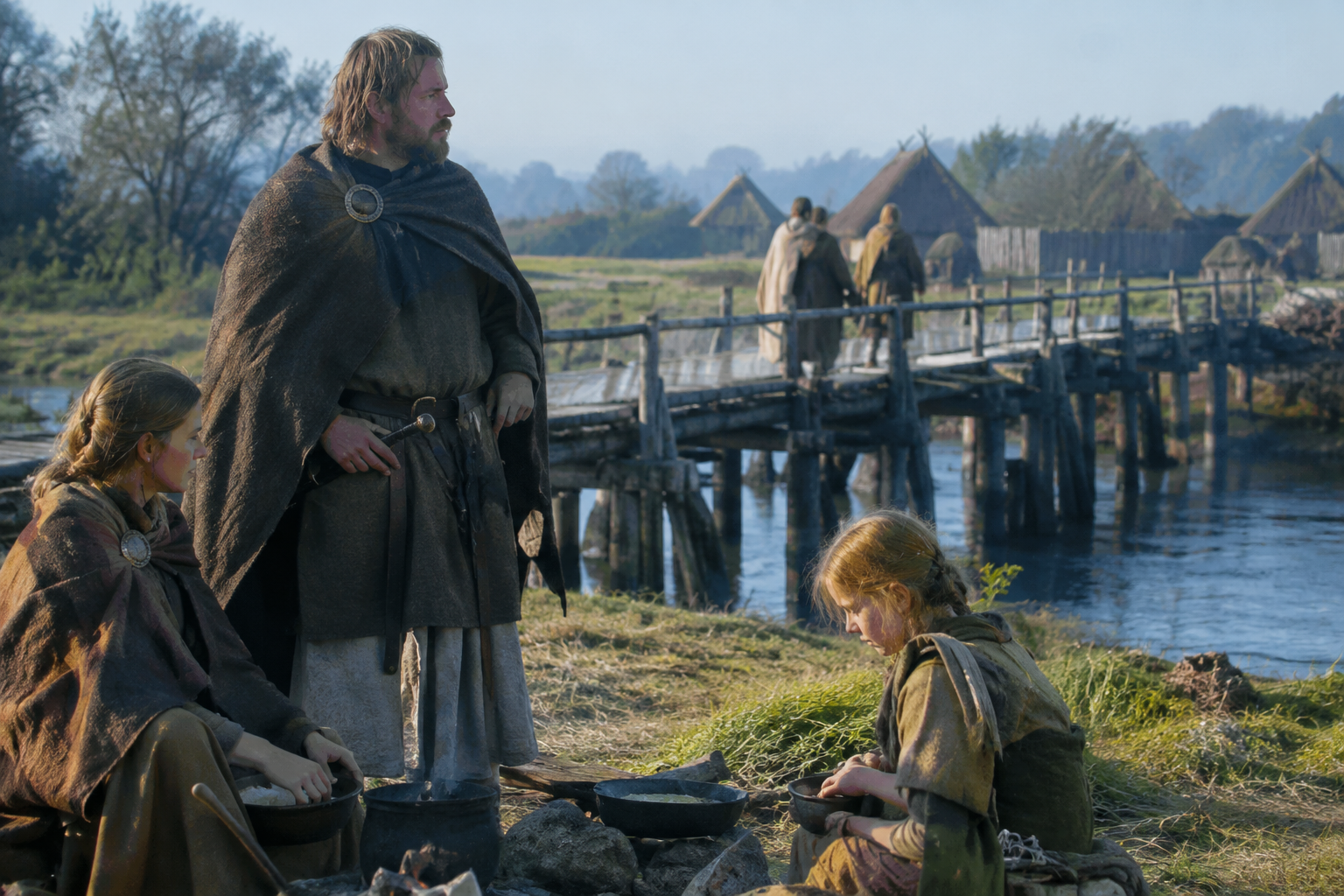
Around AD 500, in Saxony-Anhalt at Bruecken, one man now known by the laboratory identifier BRC051x was buried in a world being remade. Roman power had collapsed in the West, old frontiers were dissolving, and central Germany had become one of the places where post-imperial Europe was being assembled from many local and long-distance threads. What makes BRC051x especially interesting for MyTrueAncestry members is that he is associated with the Y-DNA haplogroup J2a1a1a2b2a1a1a2.
That matters because J2 is a lineage better known, in broad terms, from the Mediterranean, the Balkans, Anatolia, the Caucasus, and parts of the Near East than from early medieval northern Europe. A single Migration Period man in Germany does not rewrite the map. But it does offer a sharp reminder that paternal lines could travel surprisingly far, and that the communities forming in post-Roman Europe were often more mixed than older, simpler stories allowed. Y-DNA traces one direct paternal line only, not a person's whole ancestry, but even one line can illuminate a very large historical question.
The dating of BRC051x to about AD 500 places him in the Migration Period, a label historians use with some caution because it compresses many different local experiences into one dramatic phrase. In central Germany, this was not merely an age of wandering peoples. It was also an age of settlement, reorganization, inheritance, marriage networks, military service, and regional identities taking new shape after Rome's political withdrawal from much of the north.
Saxony-Anhalt sits in a revealing position for this story. It lies between regions shaped by the late Roman world, Elbe-Germanic traditions, and the routes linking central Europe to the Danube and beyond. A paternal lineage such as J2a1a1a2b2a1a1a2 appearing here in an ancient individual does not by itself tell us whether his father's line had arrived recently or generations earlier. What it does tell us is that the male ancestry present in these communities was not confined to the narrow stereotypes of "native" and "migrant" that once dominated textbook accounts.
Germanic Languages and Genomics
The exact branch name here is very narrow: J2a1a1a2b2a1a1a2. That precision is useful for genetic genealogy, but historically we have to be careful. The deep parent haplogroup J2 has a long and complicated history across western Eurasia, and one should not simply project the entire story of J2 onto this specific terminal branch without direct evidence for every step.
In practical terms, the Bruecken sample shows that a paternal line assigned within this branch, or reported in association with it, was present in early medieval Germany. That is a much smaller and more defensible claim than saying the branch "belongs" to any one ethnic group. Archaeology has taught us, again and again, that language, political allegiance, material culture, and paternal descent are related only loosely. The men buried in Migration Period cemeteries were not walking labels from later history books.
That caution is particularly important in periods such as the fifth and sixth centuries, when identities could be situational and layered. A man might live in a community archaeologists classify one way, speak in a linguistic environment evolving in another direction, and carry a paternal line with a much older geographic history altogether.
At first glance, a J2-derived lineage in Saxony-Anhalt may seem unexpected. But the ancient history of Europe is full of routes by which such a line could have arrived long before AD 500. The Roman Empire moved soldiers, traders, enslaved people, craftspeople, administrators, and families across huge distances. Earlier still, prehistoric and Iron Age mobility had already connected central Europe to the Balkans and Mediterranean worlds through exchange, marriage, and movement over generations.
So the real question is not whether such a lineage could be in central Germany. Of course it could. The more interesting question is what sort of historical setting made it visible in a burial from Bruecken. By the Migration Period, central Europe was not a sealed ethnic box. It was a contact zone where local populations absorbed influences and people from multiple directions, sometimes through dramatic events, often through the ordinary accumulations of kinship and community life.
That broader picture fits well with the increasingly complex results coming from ancient DNA studies of post-Roman Europe. Instead of neatly segregated populations, researchers often find varied ancestry profiles within the same cemetery or region, with individuals linked by culture or burial landscape but not reducible to a single biological origin. For readers who want a wider comparison from the same general era, MyTrueAncestry's discussion of diverse origins at a 7th-century Madrid burial site offers a useful parallel from another post-Roman setting.
One of the most important corrections made by archaeogenetics is to the old habit of imagining whole populations replacing one another in tidy blocks. Sometimes there really were substantial migrations. But the aftermath was usually messier: newcomers mixed with established inhabitants, local elites reorganized power, and old provincial populations did not simply vanish. In that setting, a lineage like J2a1a1a2b2a1a1a2 in Bruecken is not an anomaly to be explained away. It is exactly the sort of detail that makes the period historically real.
Central Germany in late antiquity and the early Middle Ages belonged to a much wider zone of interaction stretching from the Rhineland to the Danube and beyond. Men carrying different paternal lines could be incorporated into the same communities through descent, alliance, fosterage, or migration over several generations. Ancient DNA helps us see this at human scale. It does not make the cemetery speak in complete sentences, but it does stop us from mistaking cultural labels for biological uniformity.
A useful companion to this theme is MyTrueAncestry's piece on Roman-'Barbarian' blending on the German frontier, 400-700 CE, which captures the mixed character of frontier and post-frontier societies remarkably well.
The ancient DNA project associated with these remains is linked through research data archived here, which places BRC051x within the growing body of genomic work on early medieval Europe. Even without overclaiming details not provided in the burial summary, that context matters. It shows that this is not a legendary attribution or a surname tradition retrofitted onto the past, but part of the hard-won archaeological science that now lets us test old historical assumptions against excavated human remains.
The result also belongs to a wider pattern visible across MyTrueAncestry's coverage of ancient Europe: lineages and ancestry components rarely sit still. They appear in new regions, in new social settings, and under new political regimes. If your own paternal line falls within J2 and especially within a rare downstream branch, the lesson from Bruecken is not to force a single grand migration tale, but to think in terms of layered histories - prehistoric dispersals, Roman connectivity, and early medieval community formation all at once.
BRC051x does not found a dynasty in our records, and he does not stand for all of Migration Period Germany. But he is valuable precisely because he is specific: one excavated man, from one region, at one turning point in European history, carrying the paternal lineage J2a1a1a2b2a1a1a2. For anyone exploring that haplogroup today, the strongest supported insight is not a romantic claim of ethnic purity or royal descent. It is something more interesting: your direct paternal line belongs to the sort of history that crossed boundaries, survived political collapse, and turned up in places where older narratives would never have expected to find it.

Comments