Haplogroup J2a1a1a2b1b2a1

– 5 min read


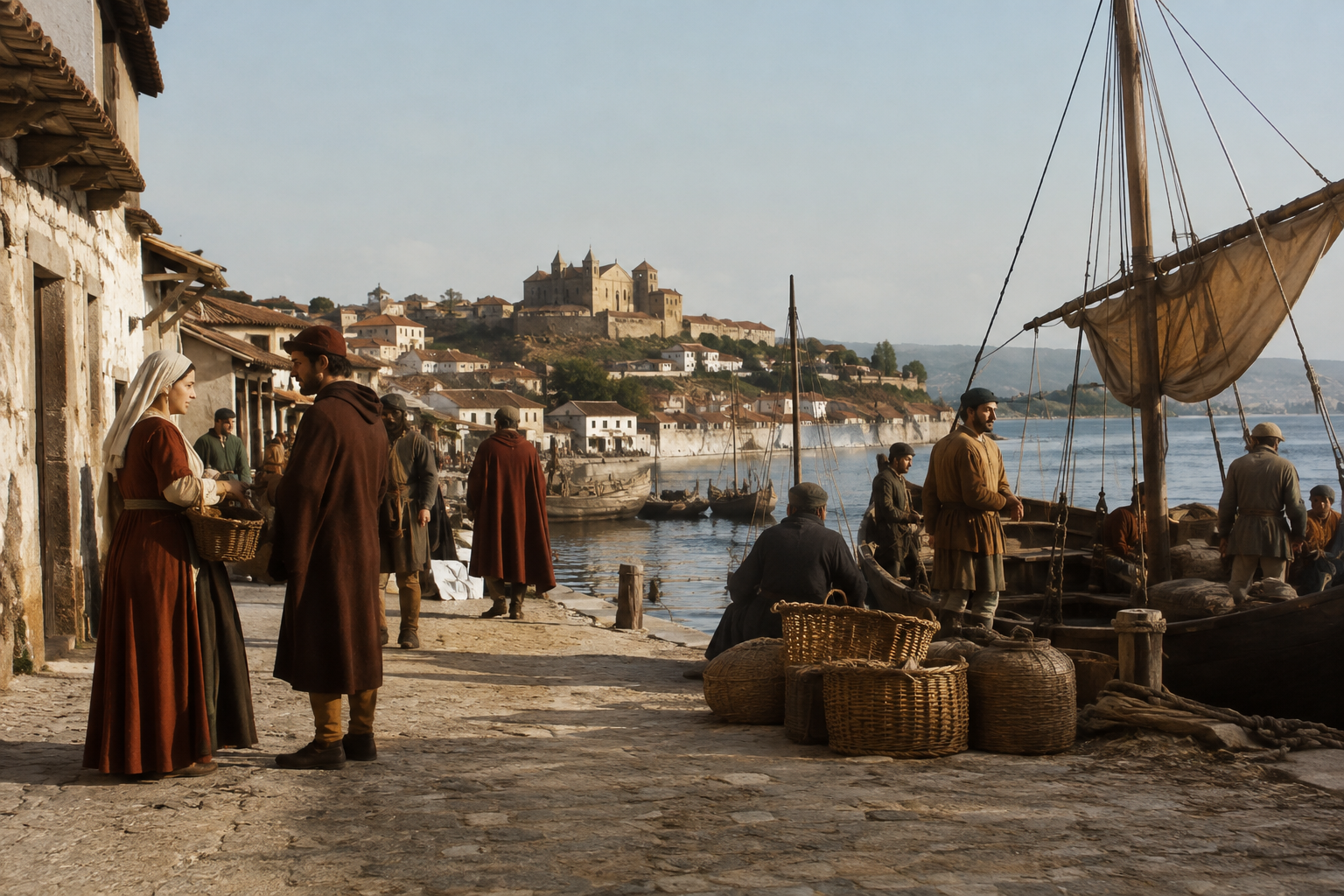
In around AD 1300, a man buried at Rua dos Barcos in Santarem entered the record not through a charter or a chronicle, but through ancient DNA. His sample, LP113_4, comes from medieval Portugal at a time when Santarem was already an old and heavily layered town: Roman, Islamic, and then Christian again after conquest. The striking point here is that his paternal line has been associated with the Y-DNA haplogroup J2a1a1a2b1b2a1, a very specific sub-branch within the much wider J2 family.
That matters because Santarem is exactly the sort of place where paternal lineages can illuminate history without simplifying it. A Y-chromosome line traces one direct male line only, not a person's whole ancestry, but in a river town shaped by trade, conquest, settlement, and religious change, even one male line can tell us something about how deep Mediterranean connections remained in medieval Iberia.
Santarem sits above the Tagus, in a position that has made it important for a very long time. Long before the 14th century, it had been part of the Roman world; later it belonged to al-Andalus; by the High Middle Ages it was securely within the Portuguese kingdom. That is a great deal of political turnover for one place, but towns do not empty out and refill like stage sets. Their populations shift, mix, persist, and absorb newcomers at different tempos.
So LP113_4 is most interesting not as an isolated medieval curiosity, but as one thread in that urban continuity. A man carrying a branch linked to J2a1a1a2b1b2a1 in Santarem around AD 1300 fits a wider Iberian pattern in which some paternal lines associated with Mediterranean and eastern Mediterranean histories appear within later Christian-period communities as well. That does not tell us his language, status, or religion by itself. It does suggest that the male-line history of Portugal was never simply local in a narrow sense.
J2a1a1a2b1b2a1 is a fine-grained descendant branch of haplogroup J2, a paternal lineage widely discussed in the archaeology of the Mediterranean, the Near East, and parts of Europe. At the broad J2 level, one often encounters connections with the spread of farming populations, later urban societies, and the intense mobility of classical and post-classical worlds. But the caution is important: those are patterns for the larger family tree, not a license to assign every tiny branch the same route and date.
For this article's branch, the secure point is narrower. We have a medieval Portuguese individual, LP113_4, associated with J2a1a1a2b1b2a1. That is evidence for the branch's presence in western Iberia by the 14th century. It is not enough, on its own, to say whether this line arrived in Portugal in Roman times, in the Islamic period, through Jewish or merchant diasporas, through older Mediterranean movements, or through several of these processes at once in different related lines.
That may sound frustrating, but it is actually where ancient DNA is at its most useful. It narrows the field. Instead of vague talk about "southern ancestry," we can point to a real man at a real site in medieval Santarem and say: this paternal branch was there.
The Iberian Peninsula is famous for historical labels that can become far too tidy: Roman, Visigothic, Islamic, Christian. Real communities, of course, were messier than that. Portugal in the Middle Ages inherited biological legacies from prehistoric farmers, Iron Age populations, Roman-era mobility, late antique change, and the centuries of Islamic rule that linked Iberia to North Africa and the wider Mediterranean.
That makes a lineage like J2a1a1a2b1b2a1 especially plausible in context. Santarem was not a remote upland hamlet but a connected place. Men carrying lineages of varied geographic depth could become part of the local population over generations, leaving descendants who were by any ordinary social measure entirely Portuguese, while still preserving a paternal signature with older Mediterranean associations.
A broader ancient DNA study of Portugal and its historical populations, including work published in research on ancient and historical genomes from the region, has helped sharpen that picture of continuity mixed with arrivals. Even without overclaiming what any single paper says about one subclade, the larger lesson is clear enough: Iberian history was built through repeated episodes of contact, not through sealed populations.
Once one sees J2a1a1a2b1b2a1 in medieval Santarem, the obvious temptation is to pin it to a single famous episode. Was it Roman? Was it brought by settlers from the eastern Mediterranean? Did it arrive with Muslim-era movements linking Iberia and North Africa? Could it reflect Sephardic Jewish male lines present in Iberian towns before expulsion and conversion? These are all historical possibilities in the abstract, and that is precisely why we must resist choosing one without direct evidence.
What can be said more responsibly is that Santarem sat within networks capable of carrying such lineages. The Roman Empire moved soldiers, traders, enslaved people, administrators, and families across extraordinary distances. Islamic al-Andalus did the same within a different political world, tying Iberia into circuits reaching across the Maghreb and beyond. Medieval Christian Portugal, too, was not genetically closed; reconquest did not erase earlier inhabitants, and urban populations continued to absorb diversity.
So LP113_4 is valuable because he stands at the intersection of those overlapping histories. He does not settle the question of origin for the branch. He shows that by about AD 1300, one descendant line of those long Mediterranean entanglements was present in a Portuguese town with deep Roman and Islamic pasts.
There is a bad habit in popular genetic history of turning one male burial into a whole people. We should not do that here. LP113_4 does not represent all medieval Portuguese men, all men of Santarem, or all carriers of J2a1a1a2b1b2a1. Nor does a Y-line tell us whether his autosomal ancestry looked mostly local to Iberia, more mixed across the Mediterranean, or something in between.
But one sample can still be historically powerful when the setting is good enough. Rua dos Barcos offers exactly that sort of setting. Medieval urban cemeteries capture ordinary residents of places where political change and human mobility had been accumulating for centuries. In such places, a paternal lineage is less a badge of identity than a clue to endurance: lines can survive regime change, religious change, and language change while remaining rooted in one town for generations.
This is also why Iberian comparisons matter. Other MyTrueAncestry discussions on medieval Madrid, Islamic Ibiza, and Roman Hispania all point toward the same broad lesson: the peninsula repeatedly produced communities with mixed origins and layered ancestry rather than neat, isolated blocks of population.
If your paternal line belongs to J2a1a1a2b1b2a1, the Santarem individual offers something modest but real: a documented medieval point of presence for this branch in Portugal. That does not make every modern carrier "Portuguese" in origin, still less does it tie anyone to a named dynasty or famous ancestor. What it does suggest is that this line had already become part of the lived history of Iberia by the later Middle Ages.
For family historians, that is often the most useful kind of evidence. It places a precise paternal branch inside a real historical landscape: not an abstract map of migrations, but a medieval town on the Tagus shaped by Roman inheritance, Islamic rule, and Portuguese state formation. J2a1a1a2b1b2a1, in other words, is not just a technical label. In Santarem, it becomes a small but telling piece of Portugal's long human story.

Comments