Haplogroup J1a2a1a2c1a
– 5 min read


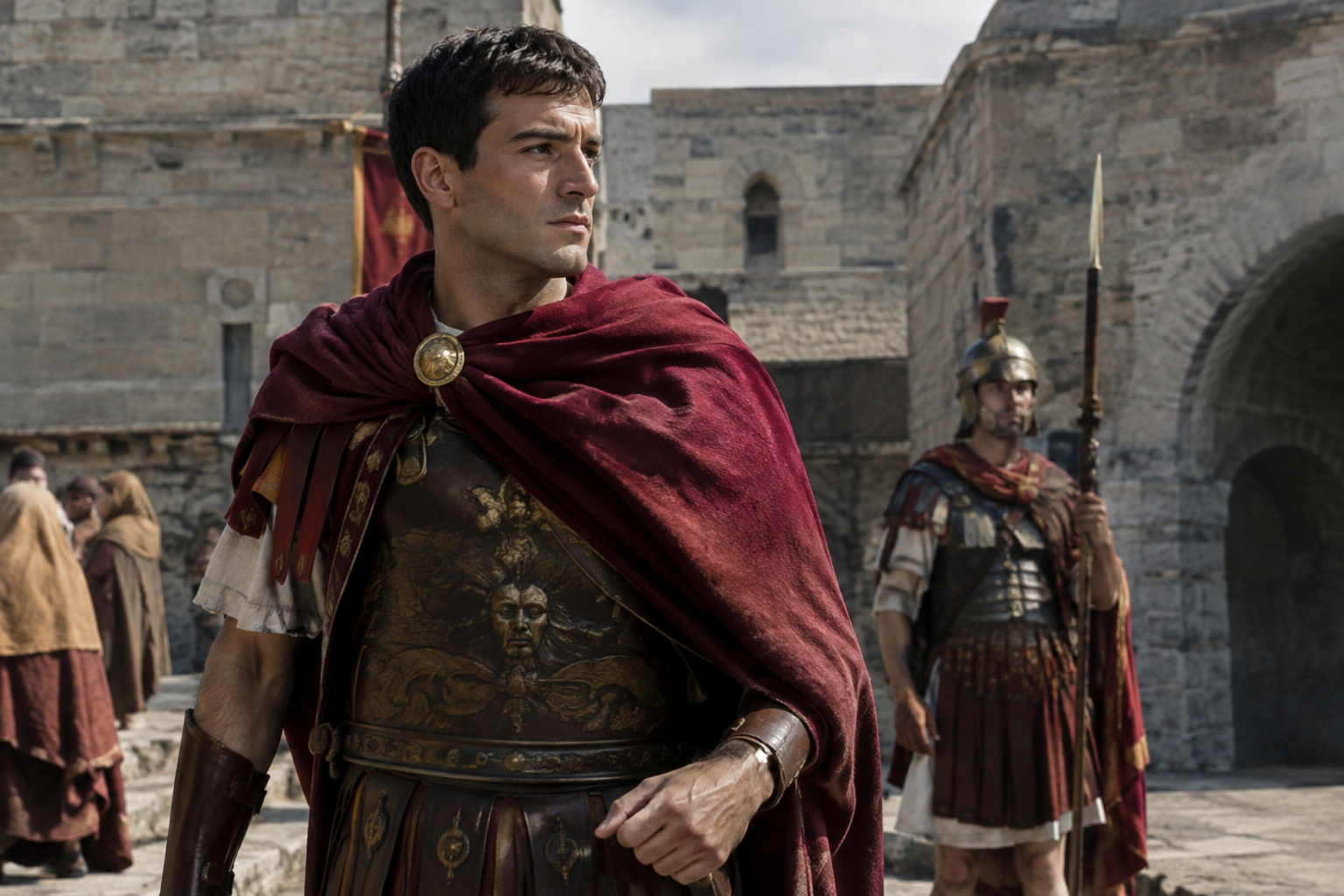
One man, identified as R130 and described as an Anatolian Roman named Marcellino, is the clearest ancient signpost here. He lived around AD 400, at a moment when the Roman world was still recognisably imperial but already changing fast. That matters for the Y-DNA haplogroup J1a2a1a2c1a, because a lineage like this is most interesting not as a badge of ethnicity, but as evidence of how paternal lines moved through the eastern Mediterranean and into Roman society.
With only one directly supplied ancient individual, the story has to be told carefully. R130 does not stand for all Anatolians, all Romans, or all men carrying broader J1 branches. But he does give us something valuable: a documented late Roman presence of a paternal line associated here with J1a2a1a2c1a in Anatolia, one of the great hinge-regions of antiquity, where soldiers, merchants, officials, farmers, and clergy all crossed paths.
Anatolia was never a quiet backwater in Roman history. By the fourth and fifth centuries AD, it was dense with cities, estates, roads, churches, military routes, and coastal exchange. A man buried there in the late Roman period might have deep local roots, or recent family links reaching across Syria, the Aegean, the Balkans, or beyond. That is exactly why a paternal lineage found in Roman Anatolia deserves attention: the region was both stable and mobile at once.
In practical terms, Y-DNA traces one direct paternal line only: father to son to son. It does not tell us a person's whole ancestry, language, status, or identity. What it can do is place one strand of male-line descent inside a historical setting. In the case of R130, that setting is the eastern Roman Empire at a time when older regional populations and imperial networks were deeply entangled.
A widely discussed ancient DNA study on Rome and its wider population history, published in Science, helped underline just how interconnected the Roman world could be, especially around the Mediterranean. Even where a single individual cannot answer every question, the broader archaeological picture makes clear that Anatolia was one of the places where lineages from different backgrounds could meet, persist, and be folded into Roman life.
J1a2a1a2c1a is a very specific terminal-style label, much narrower than the broader haplogroup J1. That distinction is important. Broader J1 lineages are often discussed in connection with Southwest Asia and the Near East, but one should not lazily transfer every large-scale claim about J1 onto this exact sub-branch without direct evidence.
So what can be said responsibly? First, the presence of this lineage in a Roman-period Anatolian individual fits the historical reality that Anatolia sat close to major zones in which J-related paternal lines have long histories. Second, the late Roman date shows that such lineages were not merely prehistoric survivals in the background; they were part of the living human landscape of the empire. Third, the exact subclade still needs to be handled with restraint unless the underlying resolution is explicitly demonstrated at that level in the ancient assignment.
That last point is not pedantry. Ancient Y-DNA calls can vary in precision depending on coverage and publication context. For family historians, the sensible takeaway is that R130 is a meaningful ancient association for this branch, but not a shortcut to a single tribe, nation, or named ancient people.
Around AD 400, Anatolia was not only Roman in administration; it was also post-Hellenistic, deeply Christianised in many areas, and connected to older local traditions that long predated Rome. Inscriptions, settlement archaeology, and burial evidence from the region repeatedly show continuity mixed with movement. People did not need to be dramatic migrants from the other end of the empire to carry varied lineages. Centuries of military service, marriage, resettlement, trade, and urban growth had already done the work.
That is why R130 is more than a dot on a map. He belongs to a period when the empire's eastern provinces were absorbing, preserving, and redistributing populations over generations. If your paternal line falls under J1a2a1a2c1a, this kind of evidence suggests that one plausible chapter in its deeper history may run through the eastern Mediterranean world of Roman Anatolia, where local continuity and long-distance links were both normal.
There is a useful parallel here with other MyTrueAncestry discussions of Roman and post-Roman population complexity in Mediterranean settings. Roman-era identities were civic and imperial as much as ethnic, and DNA keeps showing that burial communities often included people with quite mixed backgrounds.
The label "Anatolian Roman" is helpful, but we should pause over what it actually means. It places Marcellino within a political and cultural world shaped by Rome, not inside a neat biological category called "Roman". Ancient DNA has steadily chipped away at the old fantasy that imperial populations were tidy and homogeneous. They were not. Rome ruled by roads, taxes, law, military force, and local cooperation; naturally, its people were varied too.
That makes a single paternal lineage all the more interesting. A man like R130 could have belonged to a family established in Anatolia for centuries, or to one whose male line had arrived earlier through the many channels open in imperial society. The archaeology of the period often shows continuity of place even when ancestry is mixed, which is a very Roman pattern indeed: people rooted in one town, carrying family histories assembled from several regions.
The same caution applies in reverse. A J1-derived paternal line in Anatolia does not automatically make someone "foreign" in a late Roman context. By AD 400, families with such lineages could be as local as anyone else. The empire had been stitching together populations for generations.
If there is a larger historical lesson in J1a2a1a2c1a appearing in this setting, it is that Anatolia worked as a corridor. It connected the Aegean to inland Asia Minor, the Balkans to Syria, and imperial centres to provincial communities. Lineages could persist there for long periods while also being reshaped by incoming connections. In other words, it was exactly the kind of region where paternal history becomes layered rather than simple.
This is one reason Roman-period Anatolian samples matter so much for genetic genealogy. They help bridge two scales of history at once: the grand movement of populations around the Mediterranean, and the quiet durability of specific family lines. A lineage may have much older roots elsewhere in Southwest Asia or the Near East, but what the late Roman evidence gives you is a documented historical setting in which that line was part of an actual excavated population.
Readers interested in how these mixed frontier and imperial communities continued into the centuries after Rome may find it useful to compare this picture with other regions where identities and ancestry were equally untidy.
For now, the ancient evidence presented here is modest but real: R130, around AD 400, anchors this haplogroup association in Roman Anatolia. That does not give you a heroic founder or a single ethnic origin story. It gives you something better: a historically credible setting in which this paternal line appears among the people of the eastern Roman world, in one of antiquity's great crossroads.
For anyone researching J1a2a1a2c1a, that is the useful clue. Your direct male line may belong to a branch that was already woven into the social fabric of Anatolia by late antiquity, in a region where local ancestry, imperial movement, and long Mediterranean connections all met in the same communities.
Comments