Haplogroup I2a2a2a1a

– 5 min read


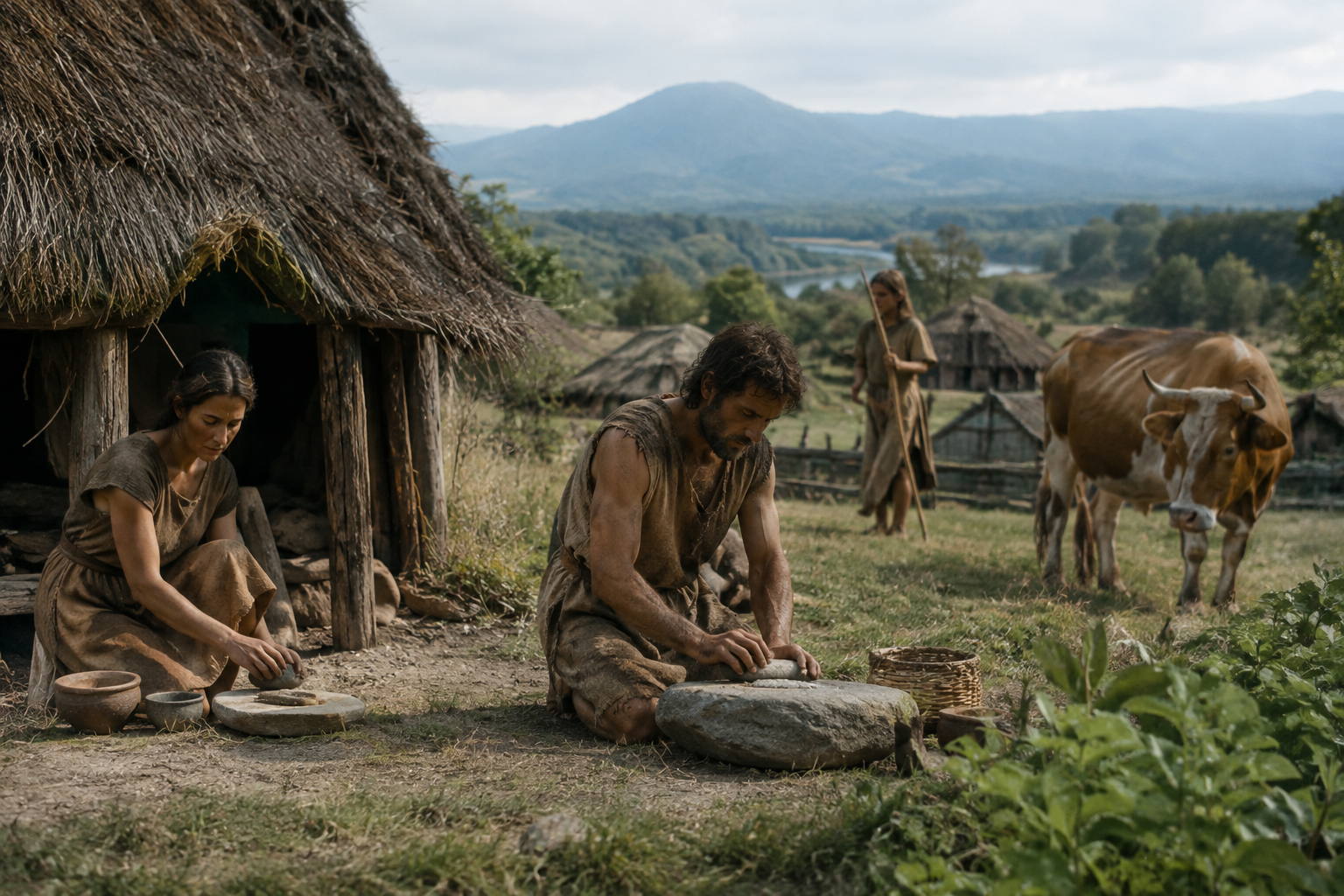
At Unterhautzenthal in Bronze Age Austria, one ancient male identified as UZH044 gives us a rare fixed point for the Y-DNA haplogroup I2a2a2a1a. He is dated here to about 1900 BC, which places him in the Early Bronze Age world of the middle Danube: a landscape of farming communities, emerging metal wealth, and increasingly far-reaching human networks. That matters because a haplogroup is easiest to understand when it is attached to a real person in a real archaeological setting, rather than floating free as a string of letters and numbers.
In this case, the evidence is modest but valuable. I2a2a2a1a is a very specific paternal branch, and Y-DNA traces only one line of descent: father to son to son. It does not tell us a man's whole ancestry, language, or identity. But when a branch turns up in an excavated Bronze Age burial from Lower Austria, it places that paternal line firmly inside one of the most important zones of prehistoric European change.
Unterhautzenthal lies in a region that was anything but isolated by 1900 BC. Lower Austria sat close to major communication corridors linking the Carpathian Basin, the Danube valley, and the uplands farther west. By the Early Bronze Age, communities here were living in a world shaped by new metal technologies, shifting burial customs, and expanding exchange networks. A man such as UZH044 belonged to that world, not to a timeless or static village past.
What makes UZH044 especially useful for readers interested in I2a2a2a1a is that he anchors the branch in a documented archaeological context. We are not dealing with a legendary founder or a later medieval pedigree retrospectively pushed back into prehistory. We have an excavated individual from Bronze Age Austria, and that gives the lineage historical texture.
A related MyTrueAncestry article on the same broader setting is worth reading alongside this one, because Lower Austria has become an unusually informative region for combining graves, kinship, and movement.
Early Bronze Age Lower Austria
The important thing here is scale. I2a2a2a1a is not the whole of haplogroup I, nor even the whole of I2. Those larger branches have deep roots in European prehistory and appear in very different times and places. A narrower subclade such as I2a2a2a1a represents one much more specific paternal thread within that wider story.
That distinction matters because European prehistory was not a neat handover from one lineage to another. It was a continual process of survival, expansion, mixing, and local persistence. In Central Europe, some paternal lines associated with older European populations continued into the Bronze Age even as new ancestry streams and new social formations spread across the continent. A find like UZH044 fits that complicated picture far better than any tidy tale of replacement.
So the interest of I2a2a2a1a is not that it can be turned into a single ethnic label. Rather, it shows that one direct paternal line linked to the wider I2 family was still present among Bronze Age men in Austria at a time when Central Europe was being reshaped by mobility, metallurgy, and expanding regional contact.
The Austrian Bronze Age is increasingly visible through ancient DNA because cemeteries there preserve not just individuals, but patterns: kinship, local continuity, outsider connections, and sometimes the biological traces of epidemic disease. The research landscape around this period has widened beyond simple ancestry labels. Scholars now ask who was local, who moved, how families were structured, and what risks communities faced.
One research lead associated with this broader Austrian Early Bronze Age setting is this study of Early Bronze Age Austrian burials in their cultural-historical context. It is particularly useful not because it turns every grave into the same story, but because it reminds us what was happening around these communities: biological stress, long-distance connections, and the sort of regional entanglement that makes a single paternal lineage historically meaningful.
That is the right backdrop for UZH044. Even where one sample's own grave details are limited in a short record, the regional archaeology tells us he lived in a society already tied into much larger systems. Bronze Age Austria was not marginal. It was one of the hinges of prehistoric Europe.
It is easy to be sniffy about a haplogroup article built around a single securely named ancient individual. But archaeologically, one well-placed sample can do a great deal. UZH044 shows that the branch identified here was present in Early Bronze Age Lower Austria, and that is already a sharper historical statement than many broad modern frequency maps can offer.
Modern distributions can be misleading because they reflect later migrations, social bottlenecks, and sheer luck in which male lines expanded. Ancient DNA works differently. It catches a lineage in the act of being lived. UZH044 was not a theoretical ancestor; he was one man buried in a particular place at a particular time, carrying one paternal line among many.
That also helps correct a common misunderstanding. When people see a lineage from the wider I2 family, they often leap either to Mesolithic hunter-gatherers or to much later ethnic identities. Both moves are too fast. Between those points lie millennia of demographic change. A Bronze Age Austrian case like this one belongs in that middle ground, where old European paternal lines could persist inside communities that were culturally and genetically mixed in complex ways.
By around 1900 BC, Central Europe had already passed through the enormous transformations of the Neolithic and the third millennium BC. Farming had long since spread. Steppe-related ancestry had entered much of Europe. New burial traditions and social hierarchies had emerged. Yet none of that means earlier paternal branches simply vanished. Some continued, sometimes quietly, inside later populations.
That is one reason this branch deserves attention. I2a2a2a1a, as represented here by UZH044, stands as evidence for continuity within change. The Bronze Age was full of novelties, but real populations are never made only of newcomers. They are built from layers of descent, marriage, inheritance, and survival.
For readers following the bigger linguistic and population questions of later Europe, the Central European Bronze Age is also a key background to debates about how prehistoric populations set the stage for later cultural landscapes.
Central Europe and Celtic Origins
If your paternal line falls under I2a2a2a1a, the most responsible historical takeaway is not a grand claim about tribe or dynasty. It is something subtler and, in a way, more interesting. This branch is now visible in at least one man from Early Bronze Age Austria, meaning your direct paternal line belongs to a European story that was already established in the Danube world nearly four thousand years ago.
That does not make every bearer of the haplogroup "Austrian" in any simple sense, and it certainly does not collapse all later history into one burial. But it does place the lineage inside a documented prehistoric society at a moment when Central Europe was becoming one of the great meeting grounds of ancient peoples, technologies, and families. UZH044 gives I2a2a2a1a a human face: not a legend, but a Bronze Age man in Lower Austria.

Comments