Haplogroup I2a2a1b1

– 5 min read


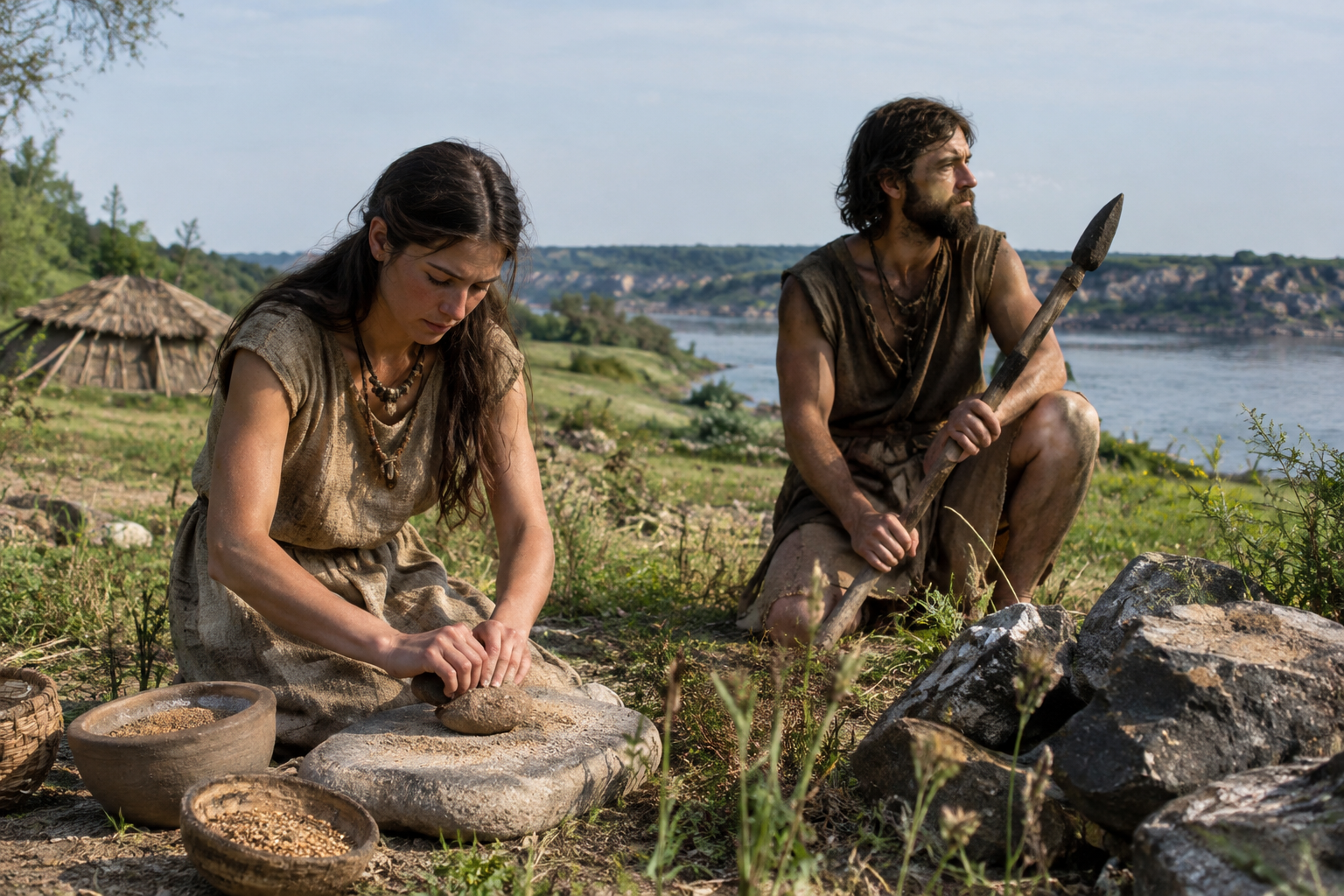
At Vilnianka in the Zaporizhia region of Ukraine, one ancient male sample stands out for anyone interested in the paternal line I2a2a1b1. The individual is catalogued as I3715 and dated to around 5576 BC, placing him in the Neolithic world of the North Pontic zone, at a moment when foragers, early farmers, and mobile communities were interacting across the river corridors north of the Black Sea. That is already enough to make him interesting. He belongs to a landscape where Europe's population history was not neat or uniform, and where Y-DNA lineages could persist across big cultural changes.
That matters because I2a2a1b1 is a very specific paternal branch within the larger I2 family. Y-DNA follows only one line of descent, father to son, so it tells us about one ancestral thread rather than a whole identity. Even with only two ancient examples here, the pattern is revealing: one very early occurrence in Neolithic Ukraine, and another much later one in Early Bronze Age Bulgaria. Together they place this lineage in southeastern Europe and the western Black Sea world across a very long span of prehistory.
Sample I3715 comes from a region that has become increasingly important in ancient DNA studies of Europe's frontier between steppe, forest-steppe, and farming zones. The Neolithic in this area did not look exactly like the early farming societies farther west in the Balkans or central Europe. Communities north of the Black Sea often combined local traditions with outside influences, and their cemeteries and settlements can reflect long contact networks rather than a single simple origin.
In that setting, the appearance of I2a2a1b1 is a useful reminder that some paternal lines associated with Europe's deeper prehistory remained present while economies and material culture changed around them. The larger I2 family is often linked with hunter-gatherer ancestry in Europe, but that broader background should not be lazily collapsed into a claim about every later branch or every later man. What I3715 shows, more carefully, is that a lineage on this branch was already present in the North Pontic region in the sixth millennium BC.
A genetic study focused on this wider region, using ancient genomic data from the North Pontic zone, has helped place such individuals into a much bigger picture of movement and continuity between 5600 and 2500 BCE. Even without turning one sample into a grand origin myth, I3715 fits the now familiar archaeological lesson: the Black Sea hinterland was a contact zone, not a sealed box.
It is tempting, when faced with an ancient Y-DNA result, to treat it as a flag for a people, a language, or a migration route. Archaeology is much messier than that. One man with I2a2a1b1 at Vilnianka does not mean that all men there had the same paternal line, still less that everyone sharing this branch today descends from one locally continuous community in Zaporizhia.
But it does tell us something solid. By the Neolithic, this branch or a classification associated with it was already present in the broad northern Black Sea world. That anchors I2a2a1b1 in a region crucial to later European population history. For modern testers, that makes the haplogroup especially interesting because it appears in the archaeological record before the major social and genetic transformations of the third millennium BC.
The second ancient example is I2175, dated to around 3100 BC in Bulgaria. This is a very different setting from Neolithic Vilnianka. By the Early Bronze Age, the Balkans had already experienced millennia of farming, exchange, social differentiation, and repeated interaction with populations from the steppe and the Aegean worlds. To find the same named Y-DNA branch, or a reported association with it, in Bulgaria shows that this paternal line was not confined to one narrow local pocket.
Bulgaria in the late fourth and early third millennia BC sat at a crossroads. The Balkans were absorbing and reshaping influences from north of the Black Sea, from Anatolia, and from older southeast European farming traditions. A paternal lineage appearing there in this period should therefore be understood in context: not as proof of a single migration event, but as part of a population history made up of overlapping contacts and survivals.
Research circulated on ancient Balkan and neighboring prehistoric genomes, including a study released on bioRxiv examining ancient population change in the region, has helped underline just how dynamic this world was. Even when a lineage persists, the people carrying it may belong to communities with quite different ancestry profiles, lifeways, and historical circumstances.
Put I3715 and I2175 side by side and a geographical pattern begins to emerge. Both sit in the wider zone running from the North Pontic steppe and forest-steppe into the Balkans. This is one of the great arteries of Eurasian prehistory. Goods moved through it, ideas moved through it, and of course people moved through it too.
That does not mean I2a2a1b1 should be labelled a "steppe haplogroup" or a "Balkan haplogroup" in any narrow sense. The evidence here is thinner and more specific than that. What can be said is that ancient carriers associated with this branch are already visible in two connected prehistoric regions where local continuity and outside contact were constantly entangled.
For archaeologists, this is exactly the kind of pattern worth noticing. Prehistoric Europe was never a board game of total replacement. Some paternal lines vanished; some expanded dramatically; others seem to have endured quietly through changing archaeological cultures. I2a2a1b1, at least on present evidence, looks like one of those lines that can appear in more than one setting without announcing itself as the star of the whole period.
For someone who carries I2a2a1b1 today, these ancient results offer something modest but valuable: a prehistoric anchor in southeastern Europe and the Black Sea borderlands. The lineage is attested in a Neolithic individual from Ukraine and again in an Early Bronze Age individual from Bulgaria, suggesting that this paternal branch was part of the human landscape of the region across a long stretch of time.
That is not a royal pedigree and not a shortcut to ethnicity. It is better than that, in a way. It places one direct paternal thread inside the real archaeological complexity of prehistoric Europe: early communities north of the Black Sea, later Bronze Age societies in the Balkans, and the long continuity of male lines through worlds that were always changing.
So the distinctive insight of I2a2a1b1 is not sheer quantity of samples, but position. Even in this small record, it appears in exactly the kind of places that mattered enormously to European prehistory: the North Pontic zone and the Balkans. If this is your Y-DNA line, your paternal ancestry belongs to a very old and very complicated human story, one rooted in contact zones rather than tidy borders.






Comments