Haplogroup I2a1b1a2b1a2b1

– 5 min read


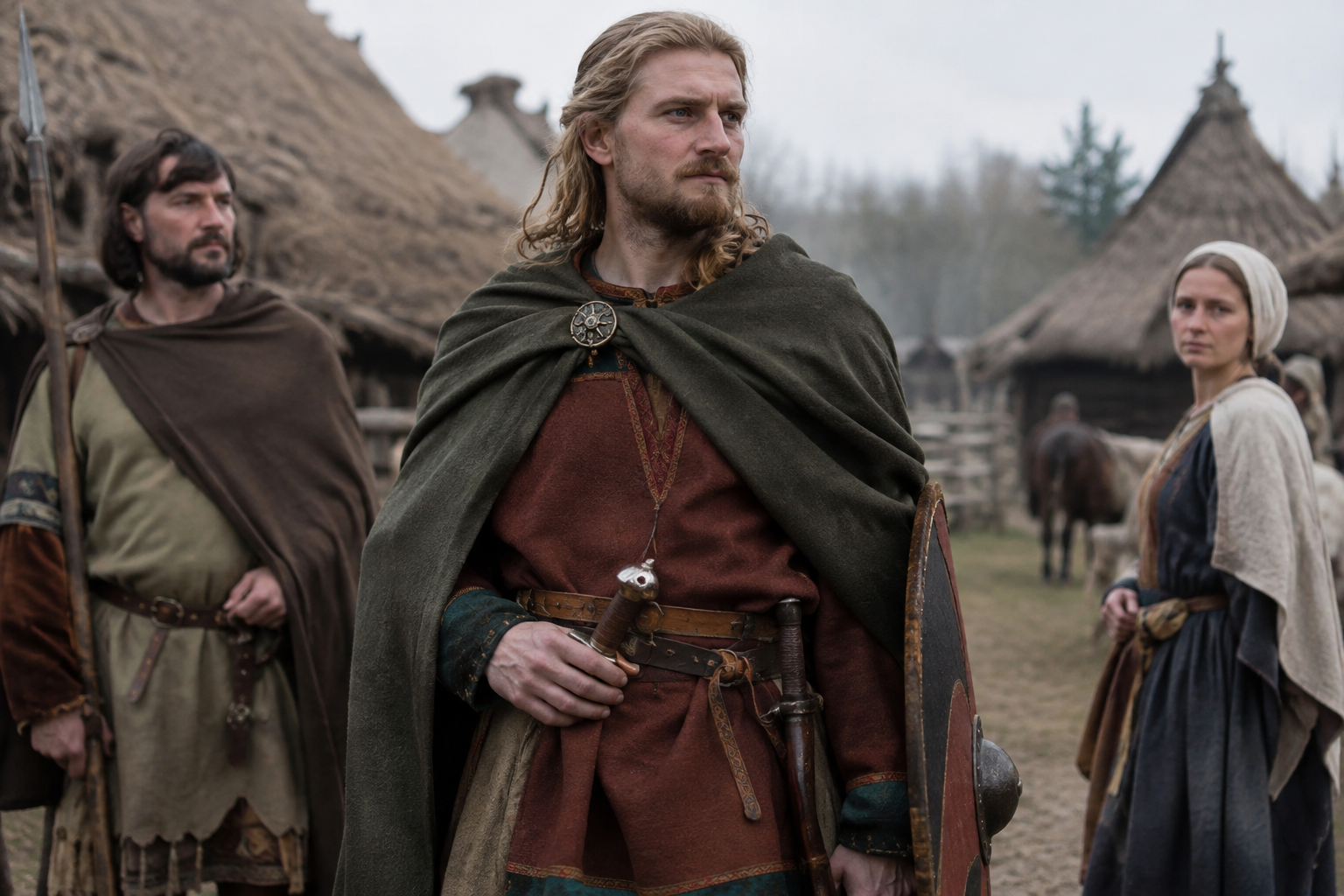
At Szolad in present-day Hungary, one early medieval burial has become unexpectedly important for anyone tracing the Y-DNA haplogroup I2a1b1a2b1a2b1. The individual known as SZ3, dated to around AD 590 and identified as part of the Germanic Lombard cemetery there, offers a rare fixed point: not a legend, not a surname tradition, but a real man buried during the unsettled decades after the fall of the Western Roman Empire.
That matters because this is exactly the sort of period in which written labels can mislead us. "Lombard" is a historical and archaeological category, while I2a1b1a2b1a2b1 is a very narrow paternal lineage. They are not the same thing. Y-DNA follows one direct male line only, but in a cemetery like Szolad it can still tell us something valuable about how particular paternal lines moved within a much wider and more mixed early medieval world.
Szolad is one of the key early medieval cemeteries for understanding the Lombards in the Carpathian Basin. The people buried there lived in a time of movement, alliance, and resettlement. By the later 6th century, Lombard groups had already passed through central Europe and then, famously, entered Italy in AD 568 under King Alboin. Yet not every Lombard community moved in exactly the same way, and not every burial ground tells the same story.
SZ3 belongs to this historical horizon. The significance of the sample is not that one man can stand in for an entire people; plainly he cannot. It is that he places the haplogroup I2a1b1a2b1a2b1 inside a documented Migration Period context associated with a Lombard cemetery in Pannonia, the Roman name for much of this region.
An ancient DNA study examining these burials helped show that cemeteries linked with Lombard-era populations could include people of varied ancestry and probably varied life histories as well, rather than a neat, biologically uniform "tribe" marching intact across Europe. That broader research context can be found in this study of early medieval Szolad and related cemeteries.
Germanic languages and genomics
The haplogroup name here is extremely specific: I2a1b1a2b1a2b1. That is a fine-grained twig on the larger Y-DNA tree of haplogroup I, one of the long-established paternal lineages of Europe. But this is where people often rush too fast. A narrow branch cannot simply inherit every grand claim ever made about the whole of I2, still less every claim made about Iron Age, Roman, or medieval populations in general.
What we can say more carefully is this: by around AD 590, a man associated with this branch was present in a Lombard-period cemetery at Szolad. That places the lineage within the population reshuffling of post-Roman central Europe. It does not prove that the branch was uniquely Lombard, that all Lombards carried it, or that every modern bearer descends from a single famous migration event.
This distinction is worth making because early medieval identity was layered. People could belong to military followings, households, local communities, and political confederations that were not reducible to one paternal line. Archaeology and ancient DNA together are most useful when they let us see that complexity instead of flattening it.
The location is not incidental. Sixth-century Hungary sat in one of Europe's great historical crossroads. Roman administration had weakened or vanished, but Roman roads, settlements, and landscapes still shaped where later communities lived and buried their dead. Into that world came groups identified in the sources as Lombards, Gepids, Avars, and others, all operating in a zone where imperial frontiers had become something more fluid and unpredictable.
That is why a sample like SZ3 is so informative. A Y-DNA lineage found here was not sitting in isolation at the edge of history. It was present in a region where former Roman provinces, Germanic-speaking elites, local populations, and new political powers met face to face. In other words, this haplogroup enters the record not in some timeless ethnic homeland, but in a busy and contested landscape.
For readers interested in the wider genetic setting of this region after Rome, the Carpathian Basin has become one of the most revealing laboratories in ancient DNA research, because cemetery archaeology and historical chronology line up unusually well there.
Any discussion of Lombard-period burials eventually runs into Italy. The great historical movement associated with the Lombards is their entry into the peninsula in the late 6th century and the creation of a kingdom there. Szolad belongs to the generation just around that turning point, which makes every individual from the cemetery especially tantalising.
Still, one must be disciplined. The presence of SZ3 at Szolad does not show that this particular man, or his direct male descendants, travelled into Italy. Nor does it prove that I2a1b1a2b1a2b1 became established there through Lombard expansion alone. But it does place the branch in the right historical theatre: the migration corridor between central Europe and the Italian peninsula during one of the most transformative episodes of the early Middle Ages.
That is often how ancient DNA works best. It rarely gives us a tidy saga. Instead it pins a lineage to a place, a date, and a community, and by doing so it makes the historical landscape sharper. In this case, the landscape is that of a mobile Lombard-associated population just before, during, or very near the great reordering of Italy.
It is easy to be sniffy about a haplogroup article built around a single ancient individual. But in fact, one well-placed sample can be more useful than a dozen vague associations. SZ3 is anchored by site, period, and cultural context. He belongs to a cemetery that has become central to debates about mobility, social structure, and the biological diversity of early medieval communities labelled Lombard.
That makes this lineage historically legible. Rather than floating in a modern testing database, I2a1b1a2b1a2b1 appears in a burial ground tied to a known moment of post-Roman transformation. It joins the growing list of paternal lines showing that the so-called barbarian world was neither biologically uniform nor archaeologically simple.
Similar themes appear elsewhere in early medieval Europe: local continuity mixed with newcomers, political identities assembled from varied backgrounds, and burial communities that do not map neatly onto modern ideas of ethnicity. The Rhineland and other frontier regions tell related stories, though in different settings and with different populations.
The most responsible takeaway for I2a1b1a2b1a2b1 is also the most interesting one. This branch is not merely "European" in the abstract; it is attested in a real Lombard-period cemetery at Szolad, in around AD 590, at the heart of the post-Roman reordering of central Europe. That gives the lineage a documented place in the historical drama of mobility, settlement, and identity after Rome.
For someone researching their paternal ancestry, that does not promise descent from kings or from every Lombard who ever crossed a frontier. What it does offer is something better grounded: a glimpse of your direct male line in a community living through one of Europe's great age-of-migration upheavals, where ancestry, culture, and political belonging were already far more entangled than the old textbooks liked to admit.
Comments