Haplogroup I2a1b1a1b

– 5 min read


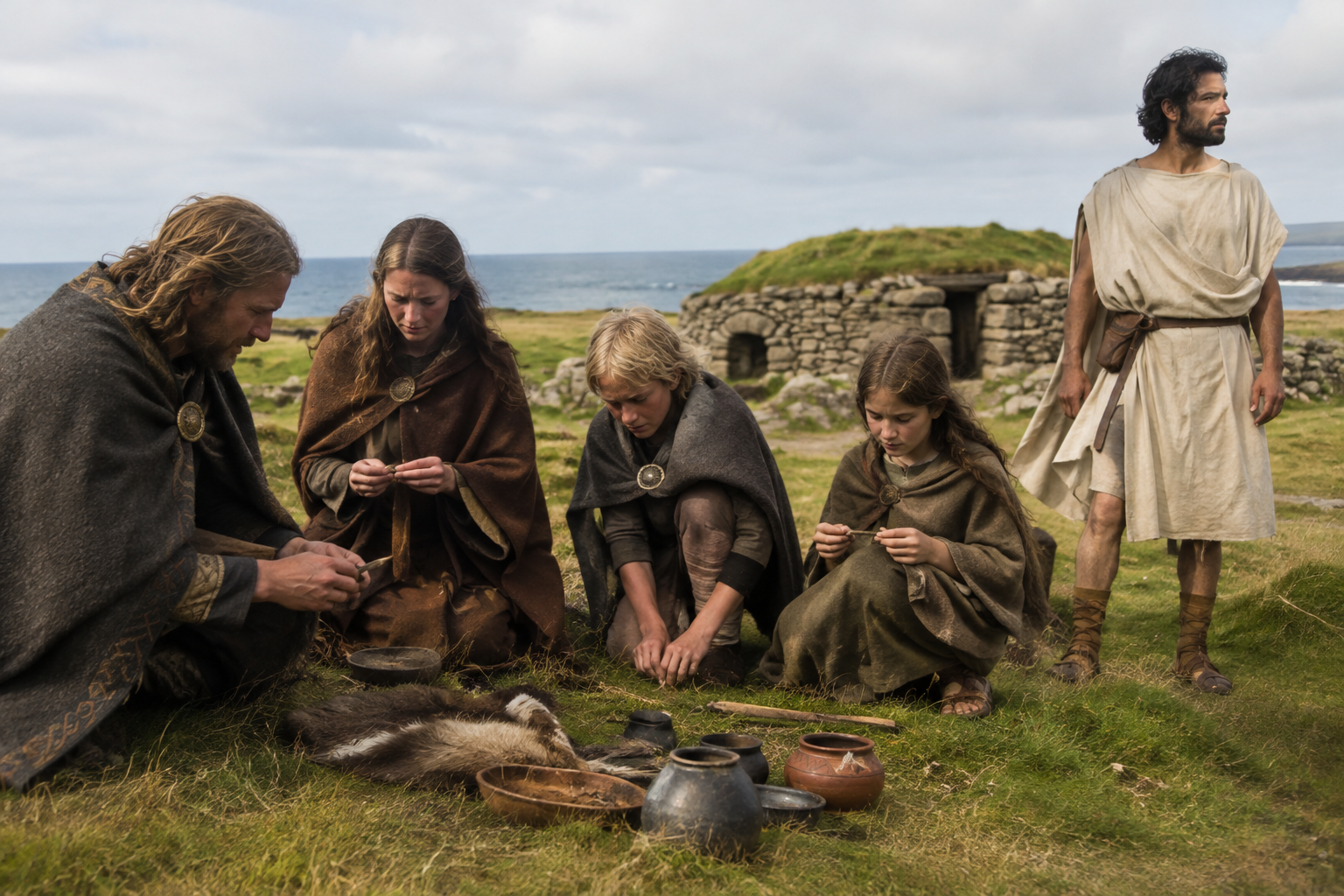
At Links of Noltland on Westray in Orkney, several men buried in the Bronze Age have been associated with the Y-DNA haplogroup I2a1b1a1b. The dates attached to these individuals, including KD059_3, KD059_2, KD006_1b, KD047_4, and KD047_3, cluster around the second millennium BC, roughly between about 1500 and 1300 BC. That is immediately interesting, because it gives us not a lone stray result but a small concentration from one island setting at the northern edge of Britain.
This is the sort of evidence ancient DNA handles particularly well. Y-DNA follows one direct paternal line only, so it does not describe a whole person or a whole community. But when the same branch appears several times at one archaeological site, it can hint at continuity in local male lines, kin structure, or simply the persistence of one paternal ancestry within a settled population.
The strongest pattern here comes from Orkney. Westray's Links of Noltland is already famous archaeologically as a substantial prehistoric settlement landscape, and these burials add another layer to that long story. Five individuals from the site are listed here in connection with I2a1b1a1b: KD059_3, KD059_2, and KD006_1b dated around 1498 BC, and KD047_4 and KD047_3 dated around 1319 BC.
Even without inventing family trees from too little evidence, repetition matters. A single Y-line at one site might tell us very little beyond one man's ancestry. Several men from the same place and broad period associated with the same branch begin to suggest something more local: not a random arrival, but a paternal line that had some staying power in Bronze Age Orkney.
That fits a wider archaeological picture in which island communities could be both connected and distinctive. Orkney was never isolated in the simplistic sense. Its people took part in broad prehistoric networks across Britain and beyond, yet they also maintained strong local traditions over long periods. A repeated paternal lineage at Westray sits comfortably within that kind of world: outward-looking, but rooted.
The label in this article is very specific: I2a1b1a1b. That is not the same thing as talking loosely about all of haplogroup I, or even all of I2. Those larger branches have deep prehistoric roots in Europe and appear in many different times and places. The narrower branch here is only one twig on that much larger paternal tree.
So the careful point is this: the Westray samples do not mean that all Bronze Age Orcadians belonged to I2a1b1a1b, and they do not by themselves map the full origin story of the branch. What they do show is that men associated with this paternal line were present in Bronze Age Orkney, and present often enough to be archaeologically noticeable in the current evidence.
Research on ancient Britain and nearby regions has repeatedly shown that paternal lines can persist even while autosomal ancestry, marriage patterns, and cultural affiliations shift around them. That makes Y-DNA powerful, but also quite narrow. It is a thread, not the whole woven cloth.
An ancient DNA study examining prehistoric Britain and Ireland is linked here as supporting context for the broader landscape in which these Orcadian individuals were studied: https://www.pnas.org/doi/10.1073/pnas.2108001119.
There is another reason the Westray cluster deserves attention. By the middle and later Bronze Age, Orkney was living in the long afterlife of its spectacular Neolithic past. The great chambered tombs and monumental ceremonial sites belonged to an earlier age, but people were still inhabiting, reusing, and remembering these ancient landscapes.
That is important historically because it reminds us not to imagine prehistoric populations as endlessly replaced in neat blocks. Sometimes there is upheaval; sometimes there is remarkable continuity at the local level. A lineage like I2a1b1a1b showing up repeatedly in Bronze Age Orkney may reflect exactly that sort of continuity, whether biological, social, or both.
It also helps explain why northern island archaeology so often feels deceptively calm. Beneath the apparently quiet surface of settlement and burial, communities were maintaining households, inheritance patterns, and relationships to place over generations. A recurring paternal branch fits that picture rather well.
Northern Scotland tomb connections
The other sample attached to this haplogroup is very different in setting and date: ORD019 from Herdonia in Apulia, in Foggia, southern Italy, dated around 500 BC. This is not Bronze Age island Britain at all, but first-millennium BC southern Italy, in a region associated with the Daunians, one of the historically known peoples of ancient Apulia.
That does not create a tidy migration tale from Orkney to Italy, and it would be bad history to pretend otherwise. The significance lies elsewhere. I2a1b1a1b is appearing here in two quite separate archaeological worlds: one in northern Britain during the Bronze Age, another in Iron Age southern Italy. That tells us this paternal branch was not confined to a single remote corner of Europe.
Herdonia itself matters because Apulia was a contact zone. It sat within networks linking the Adriatic, the wider Italian peninsula, and the Mediterranean beyond. A paternal lineage found there may reflect deep regional continuity, movement within Italy, or older European distributions that long predate the classical written record. What it does not do is let us assign a language, tribe, or political identity from Y-DNA alone.
A research preprint associated with ancient Italian island and peninsular population history is linked here as broader comparative context for how ancient DNA is reshaping the history of Italy: https://www.biorxiv.org/content/10.1101/2021.07.30.454498v1.full.
Six ancient individuals are not enough to write a grand saga of I2a1b1a1b across Europe. But they are enough to sketch its archaeological character in a responsible way. So far, the branch appears here in two settings that are both regionally grounded and historically rich: Bronze Age Orkney and Iron Age Apulia.
The Westray concentration is the more distinctive of the two because it shows recurrence at one site across more than one dated point. ORD019, by contrast, expands the geographic frame. Together they suggest a lineage with real antiquity in Europe and a history that cannot be reduced to one famous migration or one later ethnic label.
For MyTrueAncestry users, that is often the most valuable lesson. Some haplogroups arrive wrapped in dynastic legend; others emerge from quieter but more revealing patterns in cemeteries and settlements. I2a1b1a1b, on the present evidence, belongs firmly to that second category.
The most striking thing about I2a1b1a1b in this evidence is not royal glamour or a dramatic conquest narrative. It is the repeated appearance of the lineage among Bronze Age men at Links of Noltland, suggesting that one paternal line had a durable place in the life of prehistoric Orkney, while a later appearance in Apulia shows the branch also belonged to a much wider European world. If this is your Y-DNA haplogroup, the ancient record currently points less to a single famous ancestor than to long-lived local histories embedded in real communities.
Comments