Haplogroup I2a1b

– 5 min read


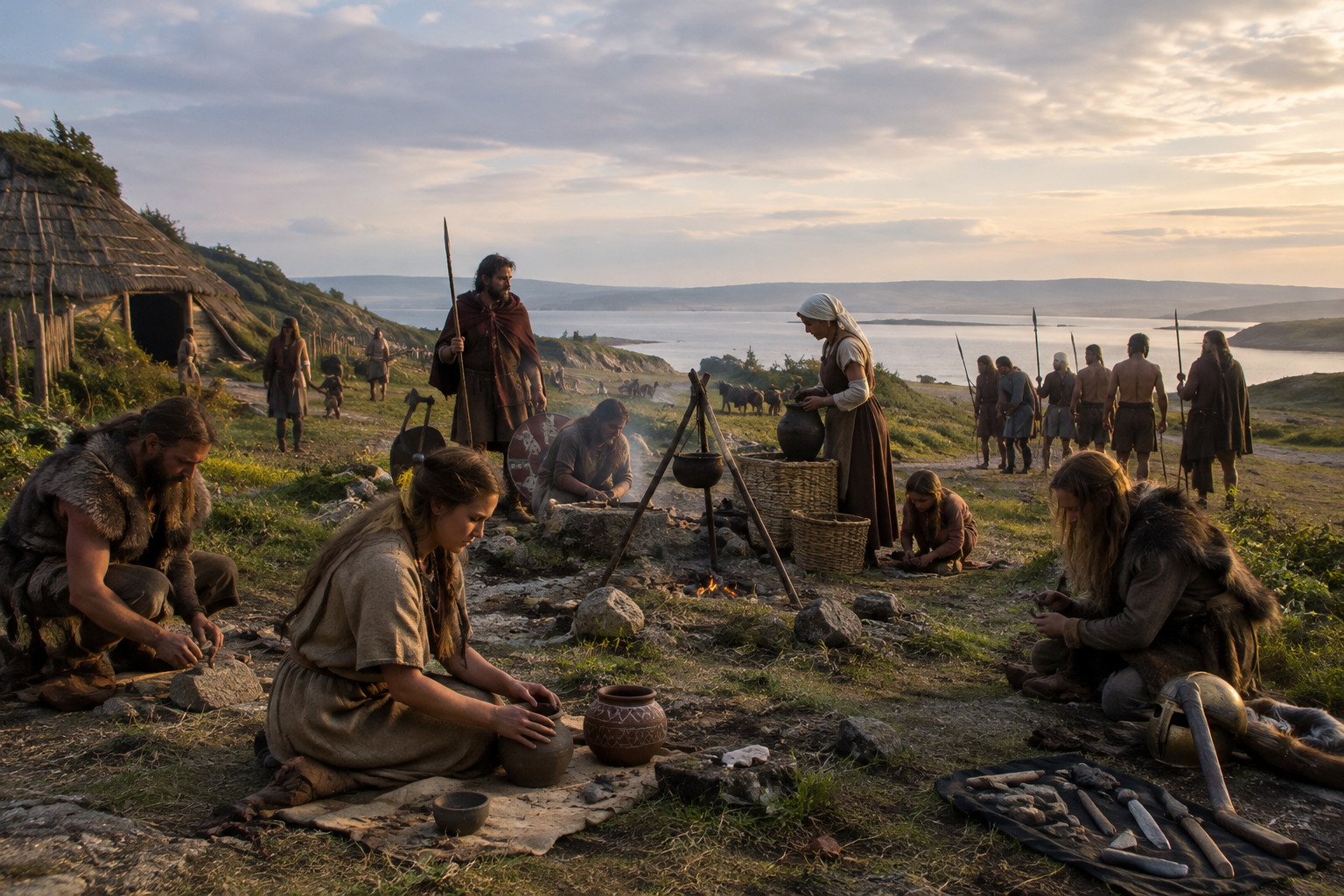
Haplogroup I2a1b is one of those paternal lineages that forces us to think on a very long timescale. Not the timescale of surnames, or even kingdoms, but of post-Ice Age Europe: wetlands, timber halls, megalithic tombs, island communities, battlefields, and later the patchwork of medieval lordships that emerged on the same ground. If you carry this Y-DNA line today, what you are tracing is one direct paternal thread, father to son across the centuries. It is not your whole ancestry, but it can be an unusually revealing one.
In the wider Y-chromosome tree, I2a1b sits within haplogroup I, one of the major paternal lineages long associated with prehistoric Europe. Ancient DNA has made that old general picture much more interesting and much less simple. Rather than belonging to a single "people," lineages in this part of the tree appear in very different settings: hunter-gatherers in northern Europe, early farming communities further south and west, Bronze Age groups from Central Europe to Iberia and Scotland, and even later historical contexts. What matters is not a neat ethnic label, but the way a paternal branch can persist, split, move, and reappear in new cultural worlds.
The story of I2a1b belongs to the great reshaping of Europe after the last Ice Age and through the Neolithic and Bronze Age. Some branches of haplogroup I are deeply tied to European hunter-gatherer populations. But by the time we can observe I2a1b-related lineages in ancient DNA, the picture is already mixed. Men carrying lineages in this zone of the Y-tree were living not only among foragers, but also among farmers, megalith builders, and later Bronze Age communities.
That is precisely why this haplogroup is historically interesting. It shows that paternal lines can survive immense cultural change. A man buried in a Scandinavian wetland, a farmer in Alsace, a burial in Orkney, and a warrior on a Late Bronze Age battlefield may belong to related paternal territory in the Y-tree, while living in very different societies. Ancient DNA does not flatten those differences. It helps us see them.
One of the earliest striking appearances comes from Kanaljorden, Motala, Sweden, where two Neolithic individuals, I0013 and I0017, are dated to 5710 BC. Motala is famous for its extraordinary wetland deposition practices, including human remains placed in a watery ritual setting. These men remind us that paternal lines related to I2a1b were present in northern Europe astonishingly early, in communities that stood close to Europe's Mesolithic and early Neolithic frontier.
Not far away in the broader Baltic world, Ajvide54 from Gotland Battleaxe Sweden, dated to 2790 BC, places the lineage in a later world shaped by the Battle Axe horizon, the Scandinavian expression of the wider Corded Ware phenomenon. That does not mean I2a1b was "the" haplogroup of that culture; it means that this paternal line was part of that changing social landscape.
Further south and west, the lineage appears in early farming contexts. At Lingolsheim, Alsace, samples SX33 dated to 4680 BC and SX29 dated to 4500 BC place it among Early Neolithic communities in a region that was one of Europe's great corridors of movement. Alsace matters because it sits between the Rhine world, Central Europe, and routes toward France. A paternal lineage found there was well placed to travel with people, marriages, and local continuity alike.
Then there is Atlantic Europe. In Scotland, I2634 from Tulach an t Sionnaich dated to 3618 BC, I2932x from Isbister, Orkney Scotland dated to 2463 BC, and I12312 from Ulva Cave, Isle of Ulva, Argyll and Bute Scotland dated to 2870 BC show this paternal presence in the megalithic and island worlds of the north and west. Add KD064_2 from Bronze Age Orkney Westray Links of Noltland dated to 1400 BC, and you can watch the same broad paternal heritage recur in the Northern Isles across very different periods.
Iberia supplies another set of revealing snapshots: por004 from Copper Age Iberia dated to 3100 BC, I10284 from Cova de la Guineu Spain dated to 2950 BC, and I6608 from Bronze Age Camino de las Yeseras Iberia dated to 1890 BC. These samples do not prove a single migration route, but they do show that I2a1b-related paternal history was not confined to one corner of Europe.
By the Bronze Age and Iron Age, the evidence becomes even more varied. S2 from the Bronze Age Hungary Balaton Region Kisapostag Encrusted Pottery, dated to 1980 BC, and I2177 from Early Bronze Age Bulgaria dated to 3200 BC, suggest that this paternal branch was present in the Carpathian and Balkan worlds too. Those are regions where farming legacies, steppe-related ancestry, and local continuity all met.
At the other end of Europe, WEZ24 from the Bronze Age Germany Tollense Valley Battlefield Mecklenburg-Vorpommern, dated to 1250 BC, places the lineage in one of the most dramatic archaeological discoveries of later prehistoric Europe: a large conflict zone with evidence for organized violence. Again, caution is essential. Sharing a haplogroup with a man from Tollense does not make anyone today a descendant of a Bronze Age warrior. But it does show that men from this paternal background could be caught up in the hard realities of Late Bronze Age society.
Later still, I20518 from Iron Age Teplice Czech Republic dated to 280 BC and SZ6 from a Germanic Lombard Grave dated to 590 AD point to continuity into the Iron Age and early medieval period. SFI-35 from Achaemenid Empire Saifi Lebanon dated to 500 BC is especially intriguing, because it reminds us how wide the historical world had become. A paternal lineage with deep European roots could appear far beyond the old core zones of Neolithic and Bronze Age Europe, whether through mobility, mercenary service, trade, imperial entanglement, or more complex local histories.
Here the evidence supplied is telling in a different way: no specific noble families or castles were provided alongside this haplogroup. That absence is actually useful, because it keeps us honest. It would be very easy, and quite wrong, to leap from a prehistoric or Bronze Age Y-lineage to a medieval dynasty and announce a grand ancestral revelation.
What we can say is more measured and more interesting. Many medieval noble houses of Scotland, Scandinavia, Central Europe, or Iberia rose in regions where I2a1b-related lineages had already been present for thousands of years. Castles, clan territories, and dynastic estates often occupied landscapes with much deeper population histories beneath them: older cemeteries, ritual sites, farms, islands, and routeways. Genetics and written genealogy meet here not as identical records, but as different archives of the same land.
So if a later noble family emerged in Orkney, western Scotland, the Baltic world, the Carpathian Basin, or Iberia, ancient DNA may help illuminate the long regional background from which that family's population ultimately came. But broad haplogroup similarity is not proof of direct descent, and certainly not proof that every member of a later house shared the same paternal line.
Discover Northern Scotland Tomb Kinship
I2a1b is a good example of why Y-DNA is both powerful and limited. Powerful, because it can follow one paternal branch across startling distances of time and geography. Limited, because that branch is only one line among thousands in your family tree. Still, when ancient samples from Motala, Lingolsheim, Orkney, Ulva, Iberia, Hungary, Bulgaria, Tollense, Teplice, and a Lombard grave all help frame the history of this haplogroup, you begin to see just how much of Europe's past survives in a single Y-chromosome label.
For MyTrueAncestry members, that is the real excitement. Not a fantasy of belonging to one ancient tribe or one castle-owning bloodline, but the chance to place a paternal lineage into the actual archaeological record. A haplogroup like I2a1b opens onto Neolithic ritual sites, island tombs, Bronze Age battlefields, Iron Age communities, and early medieval migration. It is history at human scale, but across millennia.
If you want to see whether your own DNA shows connections to ancient individuals like I0013, I0017, KD064_2, S2, or WEZ24, MyTrueAncestry can help you explore those comparisons. They do not prove direct descent from a named ancient person or membership in a noble dynasty, but they can offer a fascinating new perspective on where your deeper ancestry fits into the archaeological past.
Comments