Haplogroup I2a1a1a1~

– 5 min read


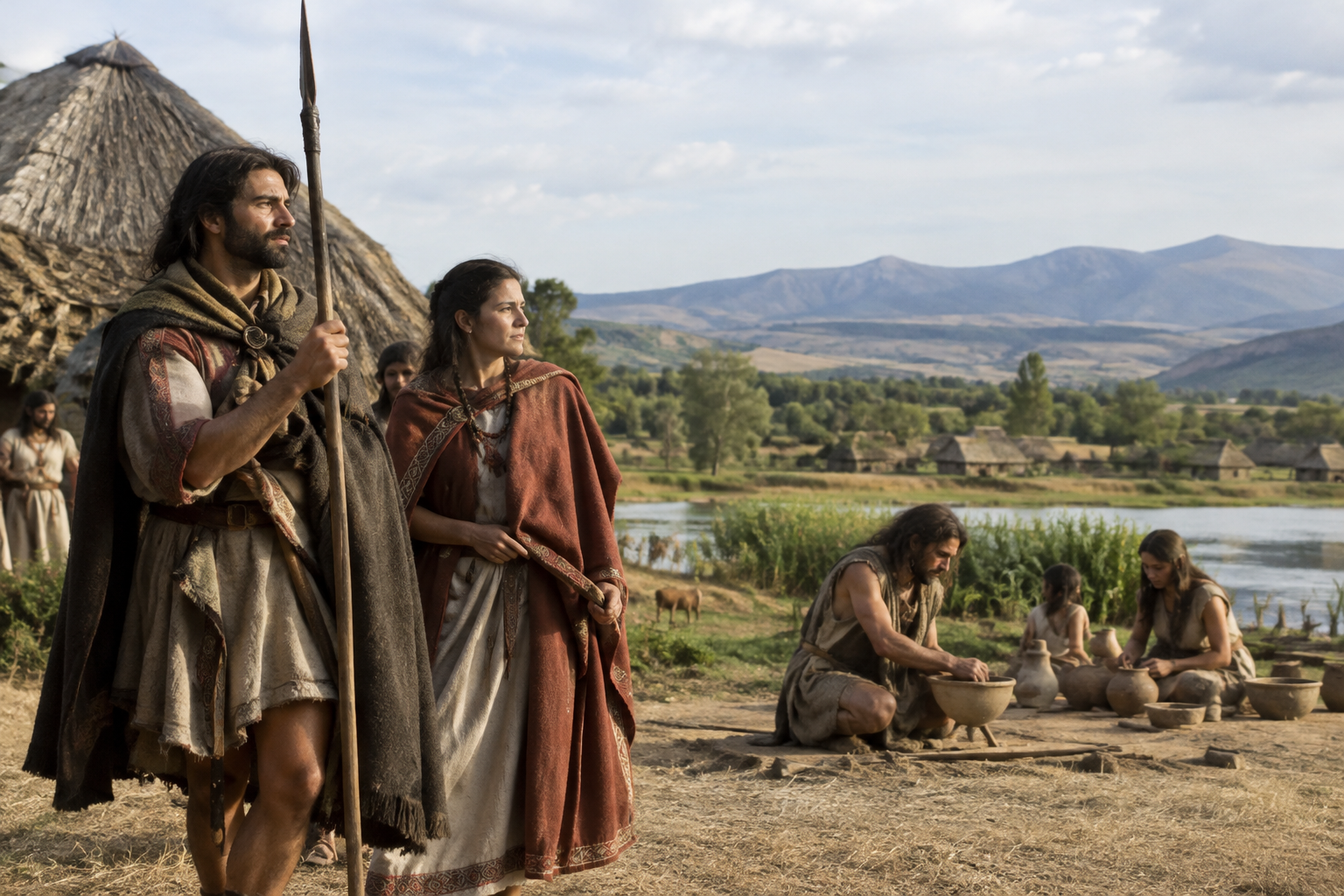
One of the clearest ancient signposts for haplogroup I2a1a1a1~ comes from Iron Age Vasconia, where sample I3759 is associated with the Vascones and dated to around 280 BC. That is already enough to make the find interesting. The Vascones sit in a part of northeastern Iberia that later classical writers knew well, but whose deeper biological history is still being pieced together from burials, settlement archaeology, and a small but growing number of ancient genomes.
For anyone exploring this paternal line, that matters because Y-DNA follows one direct male line only: father to son to son across many generations. It does not define a whole people or an individual's complete ancestry. But when a branch like I2a1a1a1~ appears in more than one ancient setting, it begins to show us something more useful than a modern distribution map. It shows endurance, movement, and local survival in real places.
The Vascones are historically important because they occupied a region near the western Pyrenees, between Iberia and the routes into Gaul. That borderland position has always tempted grand theories: isolation, continuity, resistance, refuges, ancient survivors. Genetics can sharpen some of those ideas, but it can also make them messier.
Sample I3759, assigned here in connection with I2a1a1a1~, offers a glimpse of a paternal line present in that Iron Age landscape before Roman rule transformed the peninsula. What makes the case especially interesting is not that one man "represents" the Vascones - he does not - but that his Y-line sits inside a broader European haplogroup family often associated with deep prehistoric roots on the continent. In Iberia, such lineages can speak to long-term local persistence as much as to migration.
A genetic study of Iron Age and historical populations in Iberia, published in Science, helped establish just how complicated the peninsula's population history really was. The larger lesson is worth holding onto here: even in regions famous for cultural distinctiveness, paternal lines may preserve very old regional structure while the rest of the genome reflects repeated episodes of mixture and change.
If I3759 gives us an Iron Age foothold in the western Pyrenees, sample I2741 takes the story much further back. This individual comes from Szigetszentmiklós-Felső-Ürge in Hungary and is dated to around 2350 BC, in the Bronze Age Carpathian Basin. The distance from Vasconia is striking. So is the date gap of more than two millennia.
That does not mean the man in Hungary was an ancestor of the man in Vasconia in any neat, traceable sense. Ancient Y-DNA rarely gives us that sort of tidy family-tree history over such spans. What it does show is that a paternal branch associated here with I2a1a1a1~ was present in two very different archaeological worlds: one in Bronze Age central Europe, another in Iron Age Iberia.
This is exactly the kind of pattern that makes haplogroup articles worth writing. Not because they deliver a simple migration arrow across a map, but because they expose how old European paternal lines could persist through changing cultures, languages, and political identities. Bronze Age Hungary and Iron Age Vasconia are not the same society. Yet the recurrence of the branch suggests that this was not some fleeting or narrowly local male line.
The site of Szigetszentmiklós-Felső-Ürge sits in a region that was already a crossroads in the third millennium BC. The Carpathian Basin linked the Balkans, central Europe, and the steppe-facing east. That alone makes any Y-chromosome finding here historically useful, because lineages in this zone can illuminate how populations endured or shifted during the Bronze Age transformations that reshaped much of Europe.
Research on Bronze Age European genomes, including work published in Nature, has shown that this was not a quiet period of static village life. It was a time of major demographic change, long-distance contacts, and the reworking of older Neolithic and Copper Age populations. Within that churn, branches of haplogroup I2 did not simply vanish when new ancestries spread. In many places they survived, sometimes beside more recently expanded paternal lines, sometimes in quite local pockets.
That is the broader significance of I2741. Even without over-claiming the exact subclade history, the sample anchors this lineage in a Bronze Age world where older European male lines were still very much part of the story. If your paternal ancestry falls under I2a1a1a1~, this is a reminder that such branches may have roots in the deep population history of Europe rather than in one single named historical people.
It is tempting to turn these two samples into a neat saga: a Bronze Age lineage marching westward, settling mountains, becoming tribal elites, then surviving into later historic populations. Archaeology is rarely so obliging. What we really have is stronger and more honest: two dated appearances of the lineage in widely separated contexts, showing that this paternal branch belonged to the long-lived human fabric of Europe.
That matters especially in Iberia. The peninsula saw repeated prehistoric and historic turnovers, from the arrival of steppe-related ancestry in later prehistory to Phoenician, Greek, Roman, and later movements. Yet some paternal lines clearly continued through these transitions. In that sense, an Iron Age Vasconian example of I2a1a1a1~ fits well with a wider picture in which regional communities could absorb cultural change without losing every trace of older male ancestry.
The western Pyrenees are often discussed as a zone of continuity, though continuity should never be confused with purity or isolation in some absolute sense. A paternal lineage can endure in a region for a very long time while the people carrying it become, genetically and culturally, part of many overlapping histories. That is one of the most important correctives ancient DNA has brought to old nationalist myths.
The tilde in I2a1a1a1~ is a useful warning sign as much as a label. It tells us we are dealing with an approximate or umbrella-level placement rather than a fully resolved, neatly terminal branch history for every ancient case. That is not a flaw. It is simply how ancient Y-DNA often works, especially when coverage varies between samples and publications.
So the responsible reading is this: the branch belongs within the wider I2 family, a deeply rooted European paternal grouping, and it appears here in at least two ancient contexts that are both historically meaningful. One is Bronze Age Hungary, where older and newer European population layers met in a dynamic landscape. The other is Iron Age Vasconia, where a distinctive regional society stood on the edge of the Roman world.
That combination makes I2a1a1a1~ a lineage of persistence rather than flash. It is not tied, on present evidence, to one empire, one conquering people, or one noble house. Its interest lies in something more archaeologically satisfying: the way a paternal line can remain visible across radically different chapters of European history.
If you belong to haplogroup I2a1a1a1~, the most defensible historical takeaway is not a glamorous dynasty or a single tribal badge. It is that your direct paternal line sits inside an old European lineage that appears in both Bronze Age central Europe and Iron Age Iberia. In other words, this is the sort of branch that seems to have lasted through upheaval rather than being created by it.
That is often the more interesting inheritance. Not a legend, but a durable thread running through real archaeological landscapes, from the Carpathian Basin to Vasconia.
Comments