Haplogroup I1a3b1

– 4 min read


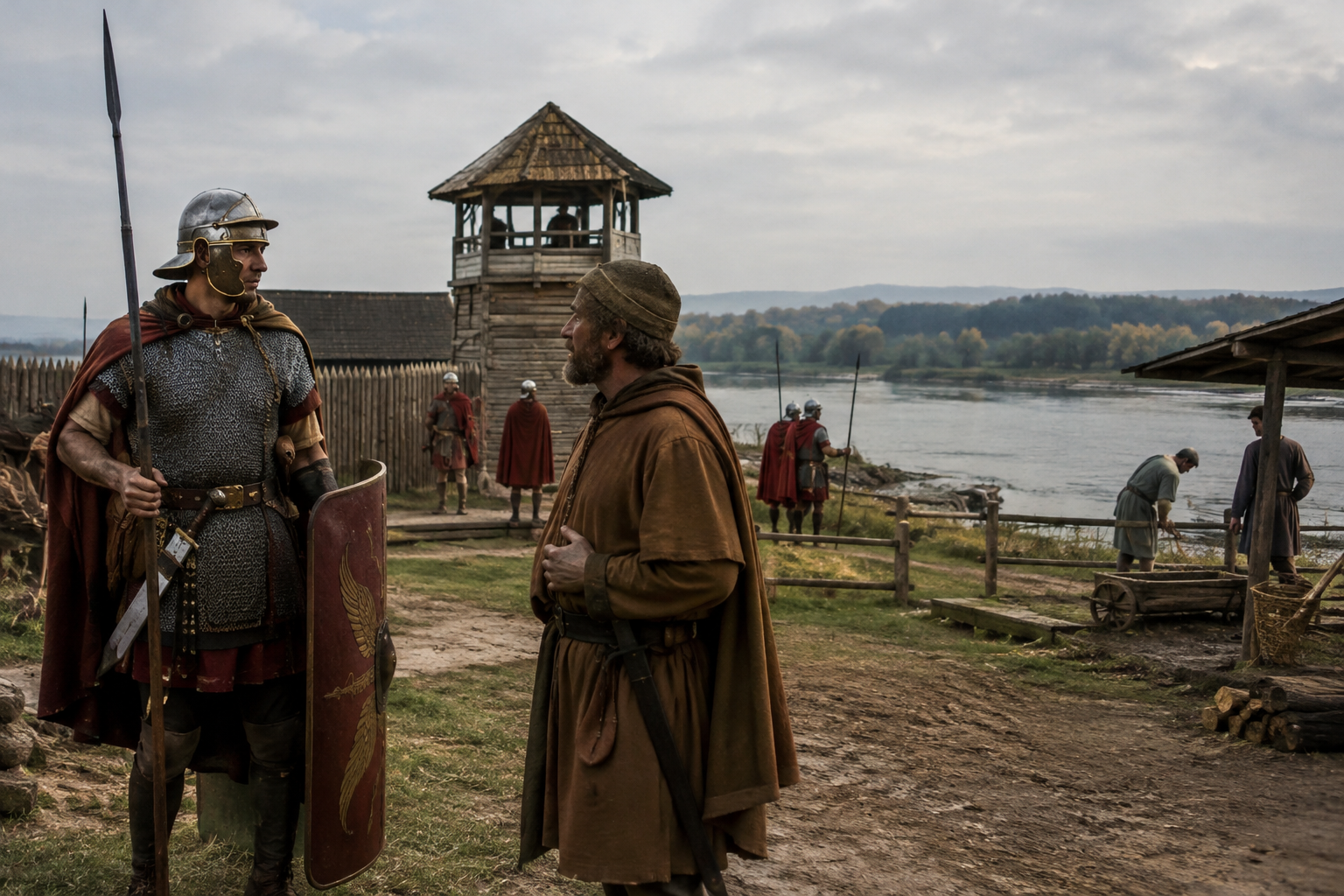
At Straubing-Azlburg on the Roman frontier in what is now Bavaria, one man from around AD 400 offers a sharp glimpse of how messy, human, and interconnected the late Empire had become. The ancient individual identified as STRAZ_I_29, from the late Roman frontier community at Straubing-Azlburg in Germany, has been associated with the Y-DNA haplogroup I1a3b1, a paternal branch within the wider I1 lineage that is often discussed in connection with northern Europe.
That single result matters because it does not come from a saga or a nationalist origin story. It comes from a cemetery on the edge of Roman power, in a period when soldiers, traders, families, and displaced people were moving through frontier zones that never fit neat labels. Y-DNA tracks one direct male line only, not a person's whole ancestry, but even one paternal lineage can illuminate the social world of a borderland remarkably well.
Straubing sits on the Danube, one of the great arteries of the Roman world and one of its great fault lines. By the late 4th and early 5th centuries, this was not simply a hard boundary between "Romans" and "barbarians." It was a lived landscape of forts, settlements, military service, intermarriage, local continuity, and new arrivals.
That is why STRAZ_I_29 is so interesting. A paternal line assigned to I1a3b1 in this setting fits a broader archaeological picture in which frontier communities could include men whose male-line ancestry linked them, more or less distantly, to regions farther north. But the important point is not to flatten him into a stereotype. A man buried at a Roman frontier site in AD 400 was part of a provincial world shaped by Rome, whatever the deeper history of his paternal line may have been.
An ancient DNA study of this wider frontier world, published in research on Roman-barbarian blending along the German frontier, helps frame the historical significance of such burials. The headline point is not a simple replacement of one population by another. It is mixture, adaptation, and local complexity.
The branch named here is I1a3b1, a specific subclade nested within the broader haplogroup I1. That distinction matters. The larger I1 lineage has a long and complicated history in northern Europe, but it would be careless to project every feature of I1 as a whole onto one narrower branch found in one late Roman burial.
Still, the appearance of an I1-derived paternal line at Straubing-Azlburg is historically plausible in exactly the way frontier evidence tends to be plausible: not because it proves a dramatic migration by one named people, but because it matches a world of repeated movement around the North Sea and the continental frontier. Military recruitment, federate service, cross-border marriage, and the slow reshaping of provincial communities all belong in the picture.
That is also where genetics has improved the conversation. Older histories often spoke as if frontiers were occupied by sharply bounded ethnic blocs. Ancient DNA keeps showing something less tidy and more convincing: border societies made up of individuals with different ancestries, different family histories, and sometimes very different paternal and maternal backgrounds.
For readers with this haplogroup, the temptation is obvious: to see a northern-associated paternal line in southern Germany around AD 400 and immediately translate it into a fixed identity such as "Gothic," "Germanic," or "Roman auxiliary." But archaeology is usually more stubborn than that. A burial place can tell us where a man was laid to rest; a Y-chromosome can tell us about one paternal line; neither, on its own, gives us a passport, a mother tongue, or a tribe named in a late antique text.
What the evidence does support is more interesting than a label. It shows that communities on the Roman edge included men carrying paternal lines that today are more familiar in the north, living within an imperial system that had long since ceased to be culturally uniform. That makes STRAZ_I_29 less a representative of one "people" than a witness to a mixed frontier society.
The Danube was not merely a defensive line on a map. It was a corridor. Goods moved along it, armies moved along it, and so did families. In late antiquity, when imperial administration was under strain and political allegiances could shift rapidly, these river-frontier communities became even more entangled with populations beyond the formal limits of Roman rule.
That setting helps explain why a haplogroup like I1a3b1 appears here without requiring melodrama. The frontier had been drawing in recruits and settlers from a wide catchment for generations. Some men may have arrived recently; others may have belonged to lineages already embedded in frontier society for centuries. The burial of STRAZ_I_29 belongs to that long process rather than to a single event.
Comparable work on other Roman frontier populations has underlined the same point: imperial border regions were biomolecular meeting grounds. The lower Rhine, the Danube, and adjacent military zones repeatedly show that life under Rome involved mobility on a scale older scholarship often underestimated.
It is easy to dismiss one ancient Y-DNA result as too small to be meaningful. In one sense, that caution is right: one sample does not define a population. Yet single burials often matter precisely because they anchor wider historical arguments in real people. STRAZ_I_29 is one such anchor.
He shows that the branch I1a3b1, or a reported association with it, is not only a modern testing category but part of the documented male-line landscape of late Roman Europe. For descendants exploring paternal ancestry today, that does not create a clean line back to one excavated man. What it does offer is a historically grounded setting: the world of frontier communities where northern-associated paternal lines could be woven into Roman provincial life.
This is one of the quiet strengths of archaeogenetics. It rarely confirms the grandest myths, but it often restores the real texture of the past. A haplogroup becomes less an abstract code and more a clue embedded in cemeteries, river corridors, and unstable imperial borders.
So the most responsible way to read I1a3b1 is not as a badge of one ancient nation, but as a paternal thread found in a documented late Roman frontier context at Straubing-Azlburg. The presence of STRAZ_I_29 around AD 400 suggests that this lineage belonged to the complicated human traffic of the Danube borderlands, where Roman institutions and non-Roman ancestries met in everyday life. For anyone researching this haplogroup now, that is already a substantial inheritance: not a fantasy pedigree, but a place in one of the most dynamic contact zones of late antique Europe.
Comments