Haplogroup I1a3a1e1

– 5 min read


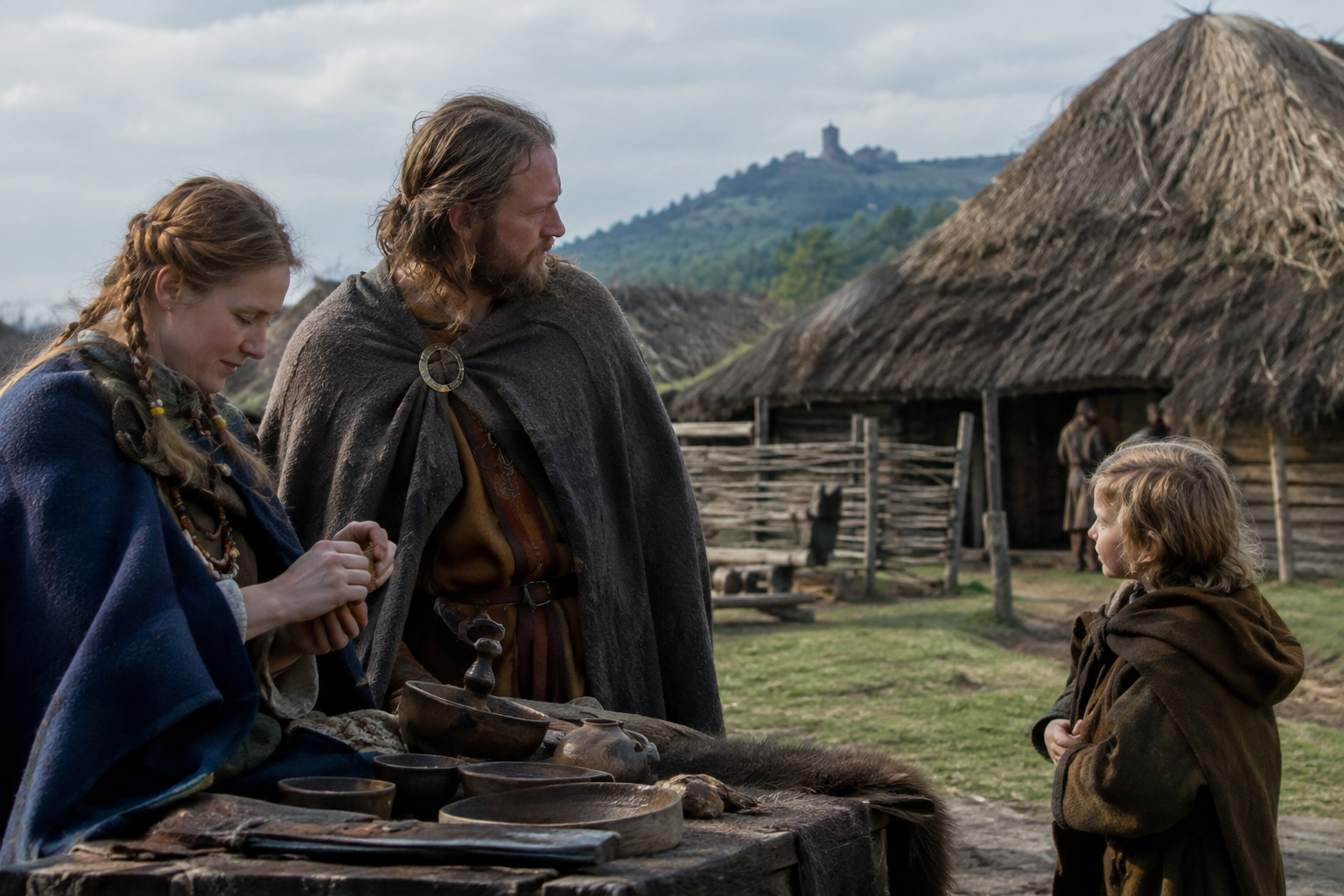
In early medieval Bavaria, one excavated individual helps put a very specific paternal line on the historical map. The sample Alh_72, dated to around AD 600 from Altheim, Germany, is associated here with the Y-DNA haplogroup I1a3a1e1. That is a narrow branch within the broader I1 lineage, a paternal line long associated in ancient DNA work with parts of northern and Germanic-speaking Europe, but which must not be confused with the whole story of any one population.
That distinction matters. A Y-chromosome haplogroup follows one direct male line only: father to son to son across generations. It does not tell us a person's full ancestry, language, legal identity, or social rank. But when a branch such as I1a3a1e1 turns up in a well-dated burial from Merovingian-period Bavaria, it gives us something very useful: a firmly placed point in time where one paternal lineage was part of the human landscape of a transforming post-Roman world.
Altheim in Bavaria sits within one of the most interesting zones of early medieval Europe: not a blank slate after Rome, but a region where older provincial populations, incoming groups, military retinues, farmers, and local elites all met. By around AD 600, this was Merovingian Europe, a world of Christianization, local power, and shifting identities. The sample Alh_72 belongs to that historical setting.
What makes such a find valuable is not that it lets us pin a grand ethnic label on one man, but that it anchors a paternal branch in a real archaeological horizon. In other words, I1a3a1e1 is not floating somewhere in a modern testing tree with no history attached. It is present in an excavated early medieval Bavarian individual, in a region central to the reshaping of western and central Europe after imperial Roman rule.
A wider ancient DNA study of this period and region has helped show how mixed and dynamic these post-Roman populations could be, with burial communities often reflecting local continuity alongside mobility and new social formations. For readers interested in the broader picture of language and migration in northern Europe, MyTrueAncestry's piece on Germanic languages and ancient genomics gives useful context.
Germanic languages and genomics
The haplogroup in this article, I1a3a1e1, is a fine-grained branch. Its parent lineage, I1, is better known in both modern and ancient population history than this particular subclade. That means we should be careful. It is reasonable to say that I1 branches are often discussed in connection with northern European paternal history; it is not reasonable to assume that every narrow descendant branch followed exactly the same route, expanded at the same date, or belonged to one neatly bounded people.
So the importance of Alh_72 is precise rather than grandiose. It shows that a man associated with this branch, or with a very close placement to it, was living in Merovingian Bavaria around AD 600. For someone researching a present-day paternal line, that is the sort of evidence that turns abstract phylogeny into history: a direct male-line marker appearing in a documented archaeological setting.
It also fits a wider pattern in early medieval Europe, where paternal lineages commonly appear in regions shaped by migration, alliance, and local persistence rather than single-population replacement. That is one reason ancient Y-DNA is so revealing. It can show continuity in one male line even when the surrounding ancestry picture is much more mixed.
The sixth and seventh centuries in Bavaria were not simply an age of newcomers sweeping into empty land. Archaeology and genomics increasingly suggest a more complicated society, one in which communities drew on different ancestral backgrounds while participating in new political worlds. Merovingian rule created broad frameworks of power, but local burial grounds still preserve intensely regional histories.
That is where a sample like Alh_72 becomes historically useful. Even without embellishing the burial with unverified detail, we can say that this individual belonged to a population living through the consolidation of early medieval Bavarian society. His paternal lineage, I1a3a1e1, therefore belongs in discussions of that society's making.
Research on ancient European populations has repeatedly shown that post-Roman cemeteries can contain people with varied ancestry profiles and varied family histories. Some lines may reflect deeper regional roots; others may represent movements across the old imperial frontier zones. A recent ancient DNA study connected with this research area underlines just how informative these early medieval burials can be for tracing population structure and mobility without collapsing everything into a single origin story.
Roman-barbarian frontier blending
At first glance, a single sample may seem a thin basis for an article. In fact, it is often the opposite. Ancient DNA becomes most powerful when it is tied to a date, a place, and a real burial population. Alh_72 is not just an isolated code. He represents one documented instance of I1a3a1e1 in the archaeological record of early medieval Germany.
For many haplogroup branches, especially narrow ones, that is exactly how the historical map is built: not by fantasy pedigrees, but by the slow accumulation of securely placed individuals. One burial in Bavaria can matter because it shows that this line was present in a region deeply involved in the making of medieval Europe. It situates the haplogroup in the world of Merovingian kingdoms, rural communities, shifting loyalties, and the long afterlife of Rome.
There is also a useful warning in this. A Merovingian-period burial in Bavaria does not make I1a3a1e1 exclusively Bavarian, exclusively Frankish, or exclusively anything else. Early medieval identities were political and cultural as much as biological, and paternal lineages cross those categories with cheerful indifference.
Although this article rests on the concrete evidence from Alh_72, the broader frame is northern Europe in the first millennium AD. Branches of I1 appear again and again in discussions of populations linked to Scandinavia, the North Sea, and Germanic-speaking regions. That does not mean every downstream branch has the same distribution, but it does make an early medieval Bavarian occurrence historically intelligible rather than surprising.
Bavaria itself was connected to these wider worlds. Trade, marriage, military service, and political alliances linked it to regions further north and west. The early medieval period is full of such entanglements, and genetics often confirms what archaeology has long suspected: local communities were not sealed boxes.
Readers who want to compare this with another early medieval case of varied ancestry in western Europe may find the Madrid burial study illuminating.
If your paternal line falls under I1a3a1e1, the strongest historical point here is refreshingly solid: this branch is represented by at least one documented ancient individual, Alh_72, living in Merovingian-period Bavaria around AD 600. That does not hand you a ready-made ethnic label or a royal pedigree. What it does offer is something better grounded: evidence that this direct male line belonged to the complex human world of early medieval central Europe, where older regional populations and wider northern connections met in the centuries after Rome.
Comments