Haplogroup I1a3a1a1a

– 5 min read


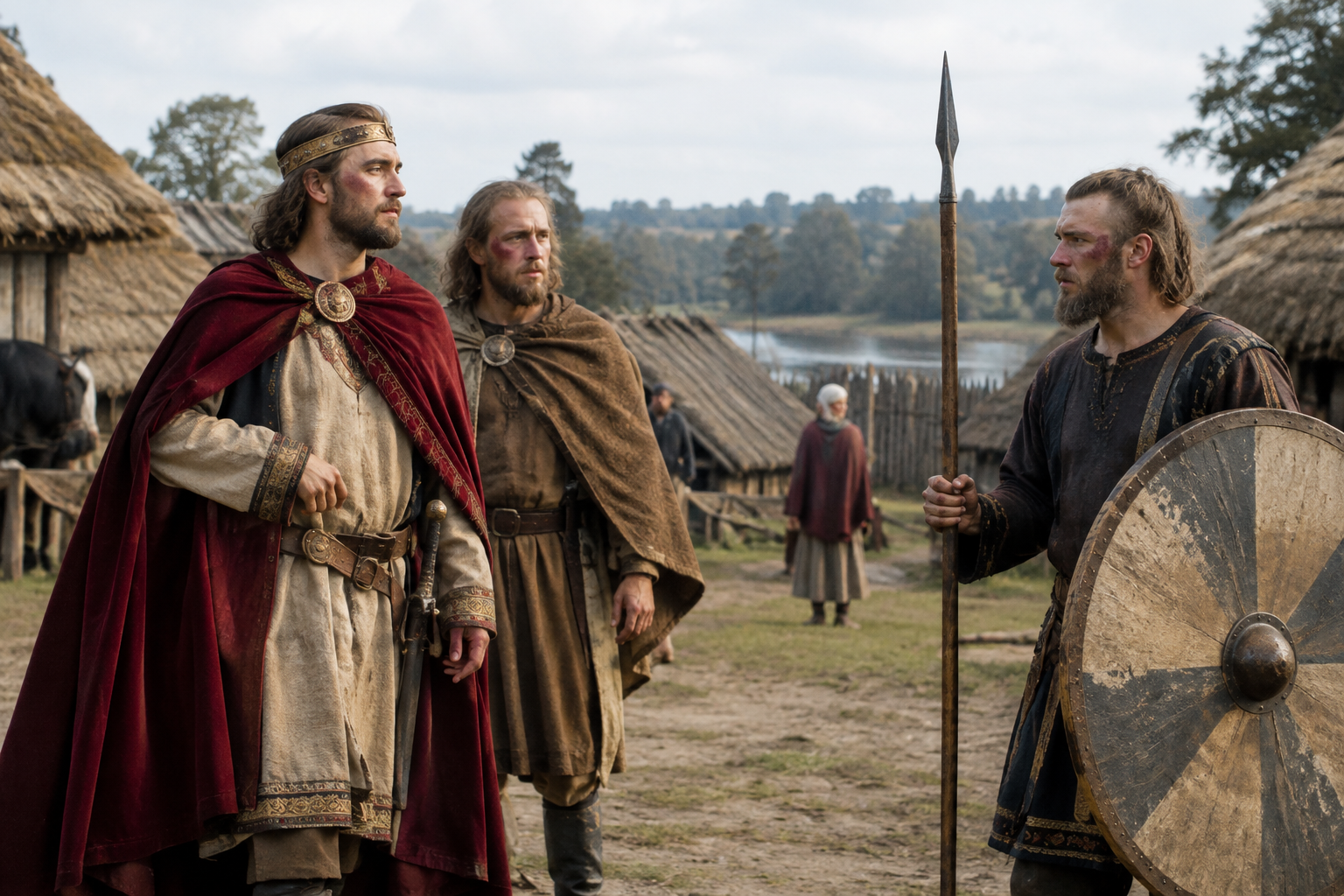
At Masłomęcz in eastern Poland, archaeologists uncovered a cemetery long associated with the Wielbark cultural world of the Roman Iron Age, a frontier zone where identities were never as tidy as later ethnic labels make them sound. One of the individuals linked here to Y-DNA haplogroup I1a3a1a1a, sample PL086, is dated to around AD 250 and placed in a Gothic-context community at Masłomęcz. That matters because it anchors this paternal line not in legend, but in a real burial landscape on the edge of the Roman world.
The wider Y-DNA family behind I1a3a1a1a belongs to haplogroup I1, a paternal lineage often discussed in northern European history. But this article's branch is much narrower than I1 as a whole, and the ancient evidence here is correspondingly precise and modest: a Gothic-associated burial in Roman-period Poland, and a later early medieval man from Bavaria, sample Alh_282, dated to about AD 600. Y-DNA tracks one direct father-to-son line only, yet even that thin line can reveal something striking about continuity and movement in post-Roman Europe.
Masłomęcz has become important precisely because it resists simple storytelling. The cemetery belongs to a region where communities interacted with the Roman Empire, absorbed outside influences, and participated in the shifting social world that classical writers flattened into names like "Goths." A burial from this milieu carrying I1a3a1a1a suggests that this paternal branch was present among people living in that northern frontier zone during the 3rd century AD.
That does not mean the haplogroup was uniquely "Gothic," nor that every man in the cemetery shared a close paternal origin. It means something more historically useful: communities identified archaeologically with the Wielbark horizon included paternal lines that fit broader northern European patterns, while the people themselves were part of a mixed and mobile society. A study-focused discussion of an atypical Masłomęcz burial can be found here: https://www.researchgate.net/publication/267038069_An_Atypical_Burial_at_the_Gothic_Cemetery_in_Maslomecz_Lublin_Province_Poland.
This is one of the most useful lessons from ancient DNA in the Gothic sphere. Archaeology gives us cemeteries, objects, and burial customs; genetics adds lineages and ancestry patterns; neither on its own can convert a grave into a neat tribal passport. For I1a3a1a1a, Masłomęcz is valuable because it places the lineage inside a documented late Roman-period community at a moment when northern and eastern Europe were deeply connected to imperial markets, military pressures, and migration routes.
The second key sample, Alh_282, comes from Altheim in Bavaria and is dated to about AD 600, in the Merovingian period. This is a very different political world from 3rd-century Masłomęcz. The Western Roman Empire had fallen, new kingdoms had formed, and Bavaria sat within the early medieval landscape shaped by local continuities, incoming groups, frontier exchange, and Christianization.
Finding the same narrow paternal branch in Merovingian Bavaria does not prove a straight-line migration from one excavated man to the other. But it does show that the branch belonged to the human fabric of central Europe across the centuries separating the late Roman frontier and the early medieval kingdoms. In historical terms, that is exactly the age when older regional populations, mobile war bands, and newly organized elites were being woven into fresh political identities.
Research on early medieval populations in this zone has increasingly shown that burial grounds can contain people of varied ancestry backgrounds, even when the cemetery looks culturally coherent. The point is not that genetics replaces archaeology, but that it sharpens it. A man with I1a3a1a1a in Merovingian Bavaria belongs to a world where paternal lines, local identity, and political affiliation did not always travel together.
German frontier blending, 400-700 CE
Because the branch name is so specific, it is tempting to over-read it. That would be a mistake. We can safely say that I1a3a1a1a is a narrow paternal subclade within the broader I1 family, and that the supplied ancient evidence places it in two historically important settings: a Gothic-associated Wielbark cemetery in Poland around AD 250, and a Merovingian-period Bavarian context around AD 600.
What we should not do is inflate that into a grand single-route origin story. The broader I1 haplogroup has a well-known northern European profile, but a sub-branch like this one may have had its own smaller-scale history of drift, movement, and survival. Ancient DNA is most convincing when it stays close to what the burials actually show: here, a line present in communities tied to the late Roman frontier and still visible in an early medieval population farther to the southwest.
That combination makes historical sense. The centuries between AD 250 and AD 600 were full of military recruitment, family movement, alliance-building, and resettlement. Some men moved long distances; others stayed local while political maps shifted around them. A paternal lineage can therefore appear in different archaeological settings without implying that the people themselves thought of belonging to one unbroken "tribe."
On their own, PL086 and Alh_282 are just two men. Together, they sketch a narrower but more interesting picture: this branch was present in the northern-central European world both before and after the collapse of Roman authority in the West. That gives I1a3a1a1a a documented place in one of the great transformation zones of European history.
The Bavarian sample also matters because Merovingian cemeteries are not simply "Germanic" in any naive sense. They belong to a landscape where late Roman inheritance, local communities, and newer ruling structures overlapped. A wider ancient DNA study of this period and region is linked here: https://www.nature.com/articles/s41586-026-10437-3. Even without forcing details beyond the evidence at hand, the broader implication is clear enough: paternal lineages such as I1a3a1a1a were part of the social worlds from which early medieval Europe emerged.
Mixed origins of Gothic communities
There is also a useful methodological point here. Ancient DNA has been steadily dismantling the old picture of migration-period peoples as biologically uniform blocks marching across maps. The Gothic-associated evidence from Poland fits that revision very well. So does the Bavarian evidence from the Merovingian age, where cultural labels and biological ancestry rarely line up in a simple one-to-one way.
If your paternal line falls under I1a3a1a1a, the most defensible ancient picture is not a fairy-tale founder or a guaranteed royal trail, but something more historically solid. This branch is attested in a Gothic-associated cemetery at Masłomęcz around AD 250 and again in Merovingian Bavaria around AD 600, placing it within the real human networks of late Roman and early medieval central Europe. That is a small dataset, certainly, but it is also exactly how archaeogenetics often begins: one burial, another burial, and a lineage quietly reappearing where history was being remade.




Comments