Haplogroup I1a3a
– 5 min read


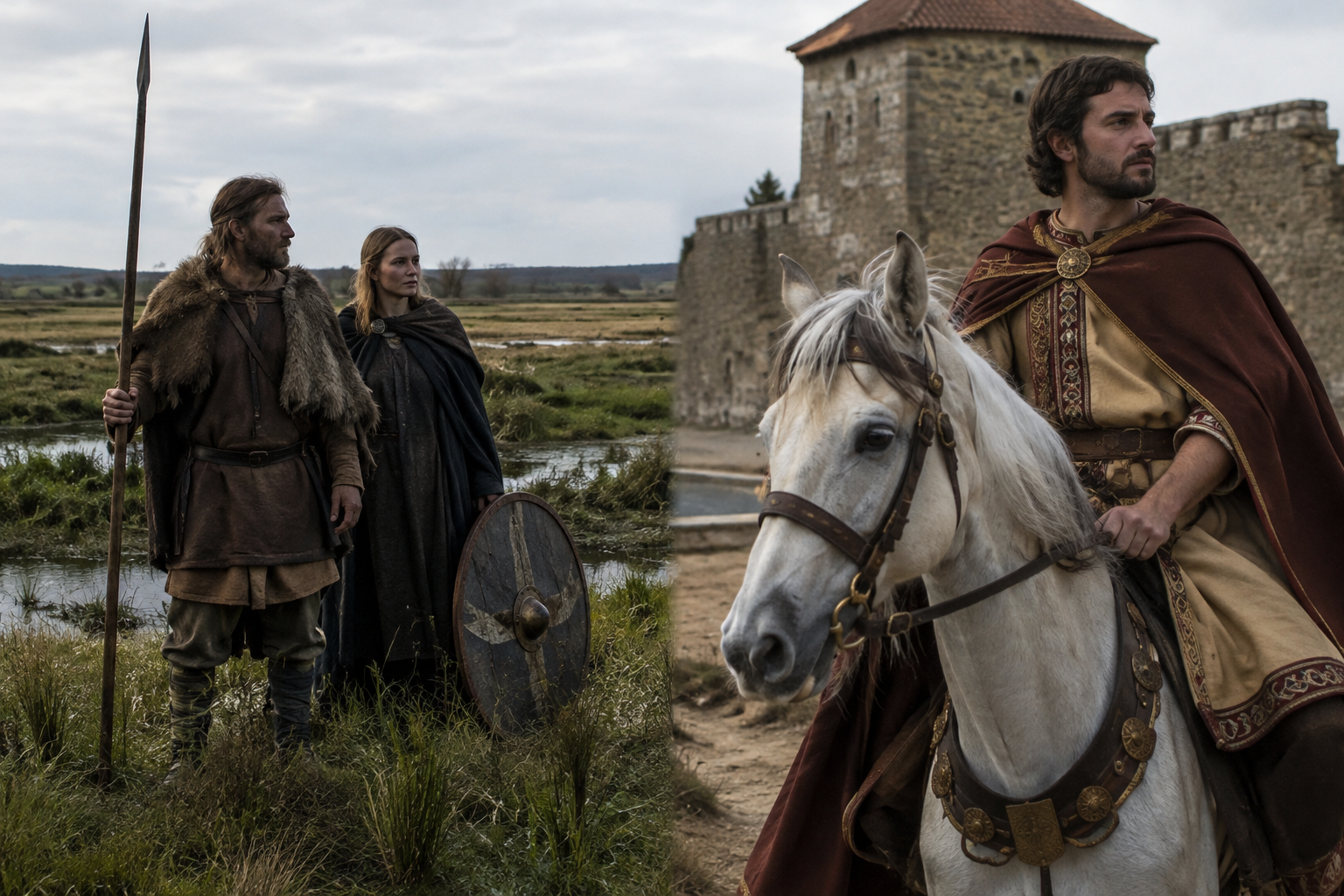
At Oustrup Mose on Lolland in Denmark, one ancient male dated to around 237 BC, identified as CGG106735, offers a small but telling glimpse of Y-DNA haplogroup I1a3a. The setting matters. This is not yet the Viking Age that tends to dominate popular imagination about Scandinavian paternal lines, but an earlier Iron Age world of local communities, wetlands, exchange routes, and emerging regional identities in southern Scandinavia.
That single find becomes more interesting when set beside a second one far to the south and many centuries later: CGG022053, dated to around AD 698, from Estevillas Virgen de la Torre in Spain and associated here with the Visigothic Migration Period. Taken together, these two samples do not tell us everything about I1a3a. Y-DNA traces one direct paternal line, not a whole ancestry. But they do show something historically valuable: a paternal branch connected first to Iron Age southern Scandinavia and later found in an early medieval Iberian context shaped by post-Roman mobility.
I1a3a is a sub-branch within the broader Y-DNA haplogroup I1, a lineage long associated in ancient and modern DNA studies with northern Europe, especially Scandinavia. That broader context is important, but the narrower label matters too. We should not lazily transfer every claim ever made about I1 onto I1a3a itself. A subclade has its own history, and often the evidence for that history is patchy, uneven, and dependent on a small number of ancient burials.
In this case, the useful pattern is not an enormous sample cloud but a sharp historical contrast: one occurrence in pre-Roman Denmark and another in early medieval Spain. The attraction of I1a3a, then, lies less in volume than in placement. Its ancient appearances sit in two moments when northern European paternal lines can be observed in very different archaeological worlds.
The earlier of the two known examples, CGG106735, comes from Oustrup Mose on Lolland, dated to about 237 BC. That places him in the later Iron Age of southern Scandinavia, in a landscape of islands and waterways that linked Denmark not only internally but to the Baltic and North Sea worlds beyond. Lolland was never an isolated edge. It was part of a maritime zone where people, goods, and ideas moved with greater ease than modern land-based maps sometimes suggest.
With only the brief record in hand, caution is essential. We should not invent burial details, social rank, or tribal identity. Yet the location alone is historically evocative. Southern Denmark is one of the key regions for the early history of I1-lineages in general, and a sample like CGG106735 helps anchor I1a3a in that older Scandinavian setting before the better-documented upheavals of late antiquity and the early Middle Ages.
That is worth pausing over. Too often, ancient DNA gets recruited into a story that begins only when written sources become plentiful. But this Danish sample reminds us that paternal lines later associated with Germanic-speaking populations were already present in the Iron Age north centuries before Gothic, Lombard, or Viking movements enter the historical spotlight.
A recent ancient-DNA preprint touching on these populations and their wider context can be found here. Even without leaning on details that are not explicit in the short record, the broader value of such research is clear: it helps place isolated haplogroup calls into a more archaeological frame.
The second sample, CGG022053, dated to around AD 698 at Estevillas Virgen de la Torre in Spain, belongs to a very different historical landscape. By the late seventh century, the Iberian Peninsula had already passed through Roman rule, imperial fragmentation, Visigothic kingship, and repeated episodes of population mixture. To find a branch like I1a3a here is not startling in a crude sense - northern and central European paternal lines are known in migration-period and post-Roman contexts - but it is still deeply informative.
The key point is not that one man in Spain "proves" a mass migration or a clean ethnic boundary. It does not. What it does show is that a paternal branch with earlier Scandinavian associations was present in an Iberian setting linked to the Visigothic world by the end of the seventh century. That neatly fits a broader historical picture in which post-Roman Iberia was neither genetically sealed nor culturally simple.
In recent years, archaeogenetic work on Iberia has increasingly shown just that complexity: Roman-era mobility, later central and northern European inputs, and strong local continuity all coexisting in different proportions from site to site. If you want the wider backdrop for this sort of evidence, MyTrueAncestry has explored it in Roman Hispania's Lasting Genetic Legacy.
Put these two men side by side and the historical value of I1a3a becomes easier to see. CGG106735 places the branch in Iron Age Denmark, within a southern Scandinavian setting that makes good sense for a sub-lineage under I1. CGG022053 shows the same branch, or a reported association with it, in early medieval Spain during a period shaped by the movements and political dominance of groups conventionally labeled Visigothic.
This is exactly the sort of pattern ancient DNA is good at revealing. Written history may talk about kingdoms, peoples, and conquests; genetics instead catches single paternal lines surfacing in particular bodies, at particular sites, on particular dates. The scale is smaller but in some ways sharper. We are not dealing with "the Goths" in the abstract, but with one excavated man in Iberia whose paternal ancestry connects him to a branch also seen in the Scandinavian north.
That broader Gothic and post-Roman story has become increasingly nuanced. Communities associated with Gothic material culture were often genetically mixed rather than biologically uniform, and their cemeteries can contain individuals with quite varied ancestry profiles. MyTrueAncestry's post on Ancient DNA reveals diverse origins at a 7th-century Madrid burial site is a useful companion here because it shows how early medieval Spain resists simple labels.
It is tempting to read a straight line from Denmark to Visigothic Spain and declare the matter solved. History is rarely that obliging. The term "Visigothic" can describe a political kingdom, a legal tradition, an archaeological horizon, or a set of historical narratives written after the fact. A Y-chromosome result, by itself, cannot decide which of those meanings applies most strongly to one burial.
Still, the classification is not meaningless. In a late seventh-century Iberian burial context, the reported presence of I1a3a is compatible with the long-known fact that post-Roman Iberia included paternal lineages with more northerly European connections than had been common in earlier local populations. The sample does not stand for every Visigoth, nor every Iberian, nor every man at the cemetery. It does, however, belong to that world.
This is also where archaeology rescues us from oversimplification. Migration-period populations were made not just by movement, but by settlement, intermarriage, service, alliance, and adoption into new political communities. A lineage can travel without an entire people moving in lockstep behind it. That is one reason individual ancient samples matter so much.
For someone researching a modern paternal line in I1a3a, these ancient finds point toward a plausible deep connection with northern Europe, especially the Scandinavian sphere, while also showing that this branch had already entered the more mobile and mixed societies of early medieval western Europe by about AD 700. That is a historically rich combination. It hints at roots in the Iron Age north and at later participation, direct or indirect, in the great reshaping of Europe after Rome.
The most distinctive thing about I1a3a, on present evidence, is not that it belongs to one neatly bounded people, but that it appears in exactly the sort of places where archaeology shows continuity and movement colliding: Iron Age Denmark and Visigothic Spain. That makes it a lineage with both local depth and long historical reach.


Comments