Haplogroup I1a2a1a1a3a1

– 4 min read


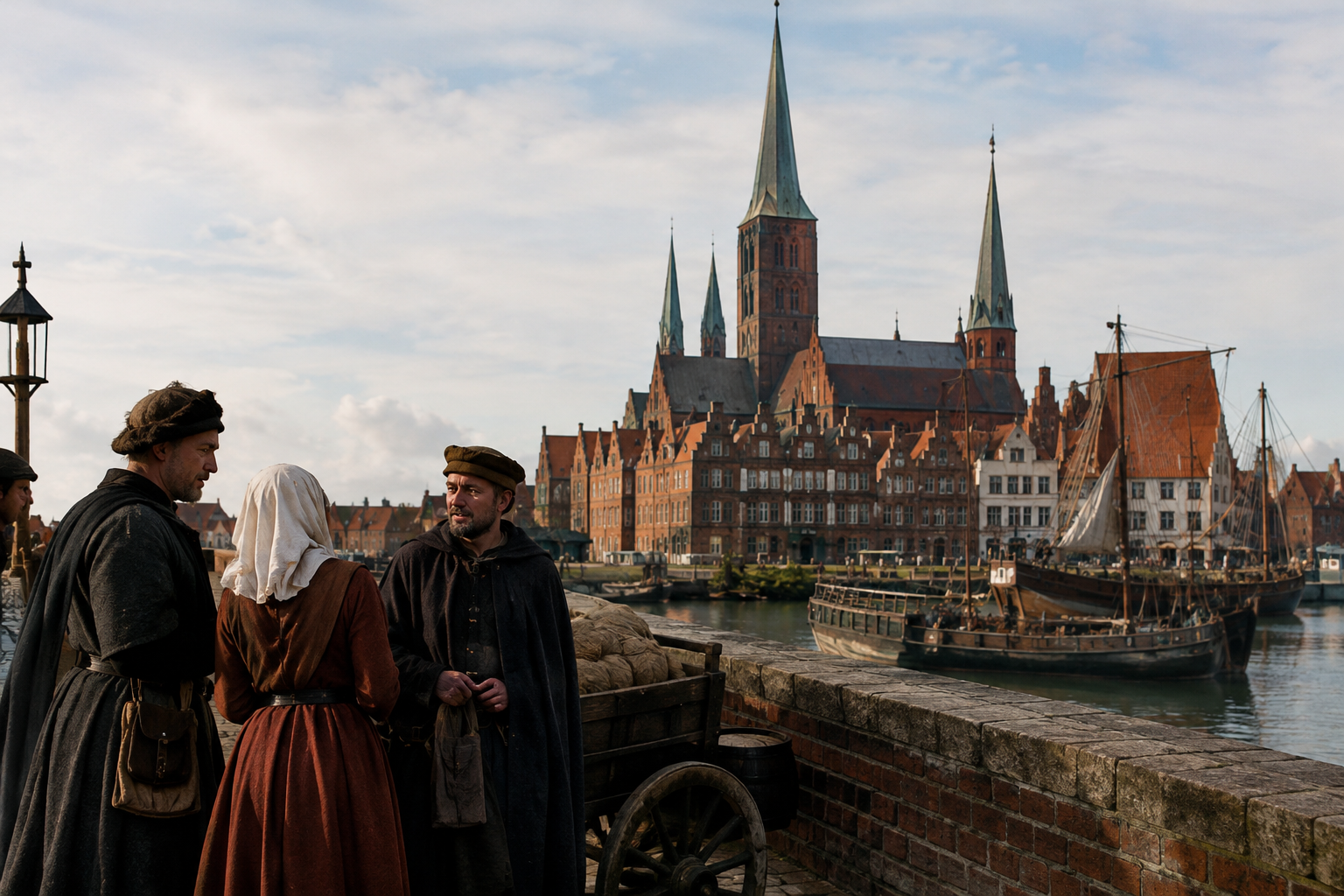
In early Hanseatic Luebeck, at St. Juergen in northern Germany, one medieval man has become unexpectedly useful to the history of Y-DNA. The individual labelled KH200408, dated to around 1335 AD, is associated here with the paternal haplogroup I1a2a1a1a3a1. That dry string of letters and numbers sounds forbidding, but the setting is vivid enough: a trading city on the Baltic, connected by ships, merchants, pilgrims, craft workers, and disease to a remarkably wide world.
That matters because a Y-DNA lineage is not a whole identity. It traces one direct paternal line only. Yet when a branch such as I1a2a1a1a3a1 appears in a medieval urban burial from Luebeck, it gives us a sharply focused glimpse of one male line moving through a city that stood at the crossroads of northern European history.
Luebeck in the 13th and 14th centuries was no sleepy provincial town. It was one of the great nodes of the Hanseatic world, linking the Baltic to the North Sea and connecting Scandinavia, northern Germany, the Low Countries, and beyond. A burial from St. Juergen therefore belongs to a place shaped by movement: of goods, people, languages, and pathogens.
The sample KH200408 is especially interesting for that reason. A lineage assigned here to I1a2a1a1a3a1 sits within the wider haplogroup I1, a paternal branch long associated in broad terms with northern Europe, especially the Scandinavian and Germanic-speaking world. But one must be careful: the wider history of I1 is not automatically the history of this exact terminal branch. What the Luebeck burial shows securely is that one man carrying this paternal line was present in a major Baltic town in the early 14th century.
That is already historically meaningful. Medieval port towns were not genetic isolates. They were places where local families, migrants from nearby rural districts, and incomers from far across the sea could all end up buried within the same urban orbit.
The strongest published context attached to this burial comes from research into medieval disease, especially leprosy susceptibility in Europe. A study associated with these remains, available at this research link, places the individual within a broader scientific effort to understand how medieval populations experienced infectious disease and how human genetic variation may have shaped that experience.
This is a useful reminder that ancient DNA does not only tell us where paternal lines sat on a family tree. It can also place those lineages inside real historical problems: illness, exclusion, care, mobility, and urban life. In a city such as Luebeck, where commerce brought prosperity but also constant biological contact, a cemetery sample can illuminate both ancestry and vulnerability.
It is tempting to turn every Y-haplogroup into a migration slogan, but the St. Juergen burial asks for a more grounded approach. Here the real story is not a heroic tribal trek. It is the dense, practical, often harsh world of a medieval Baltic town where a paternal line now labelled I1a2a1a1a3a1 formed part of a living community.
The lineage name in this article is highly specific. That specificity is useful, because it distinguishes the featured branch from the much broader parent haplogroup I1. Broad I1 has a deep and complex history in northern Europe, but a precise branch like I1a2a1a1a3a1 represents a much narrower segment of that story, probably one that had already passed through many generations of local branching before the 14th century.
So what can be said responsibly? First, the branch belongs to a paternal tradition well at home in the north European historical sphere. Second, its appearance in Luebeck fits the city's role in the Baltic and north German world. Third, one burial does not prove that every carrier of this branch was Hanseatic, urban, German-speaking, or local to Luebeck itself. Medieval towns gathered people from many backgrounds, and Y-DNA alone cannot sort language, profession, or legal status.
That may sound modest, but in fact it is one of the strengths of ancient DNA when used properly. It lets us place a real paternal lineage in a real medieval setting without pretending that one chromosome can explain an entire person.
To understand why a Luebeck sample matters, it helps to remember that northern Germany was never simply a sealed homeland of one static population. Over the long centuries before and after the formation of the Hanseatic League, the region saw shifting political frontiers, commercial expansion, Christianization, town growth, and regular movement across the Baltic and North Sea zones.
That wider background makes a lineage like I1a2a1a1a3a1 historically plausible in more than one way. It may represent paternal continuity from earlier populations of the north European plain. It may also reflect medieval mobility within the German-speaking and Scandinavian-connected world. In practice, both things can be true at once. A lineage can be regionally established and still travel widely through marriage, trade, apprenticeship, warfare, or urban opportunity.
Luebeck was precisely the sort of place where such histories accumulated. By the 14th century it was a city built on exchange, and exchange leaves traces in cemeteries as surely as it does in harbour accounts.
Readers sometimes assume that only royal tombs or huge cemetery series can tell us anything useful. In fact, a single well-situated sample can be revealing when the archaeological context is good. KH200408 anchors I1a2a1a1a3a1 in an identifiable place, St. Juergen, Luebeck, at an identifiable time, around 1335 AD, within a city whose historical role is exceptionally well understood.
That combination is what gives the evidence its force. The sample is not floating in abstraction. It belongs to a medieval urban landscape tied to the Hanseatic trade network, to north German society, and to the biological history of disease studied in human remains.
There is also a wider lesson here for paternal ancestry research. Many modern testers understandably look for grand labels - Viking, Saxon, Gothic, royal. But ancient DNA often gives something more valuable: not a legend, but a location. In this case, the location is a busy Baltic city in the 14th century, where one branch of the I1 family tree was part of everyday medieval life.
If you belong to I1a2a1a1a3a1, the most defensible historical insight from the present evidence is not a dramatic origin myth but a concrete northern European anchor. The sample KH200408 shows this paternal line, or a reported association with it, in early Hanseatic Luebeck around 1335 AD, inside a city shaped by trade, mobility, and the realities of medieval disease. That is a small window, but a clear one: your direct paternal line fits comfortably into the historical world of the Baltic and north German Middle Ages.




Comments