Haplogroup I1a1b1a1e2c5a

– 5 min read


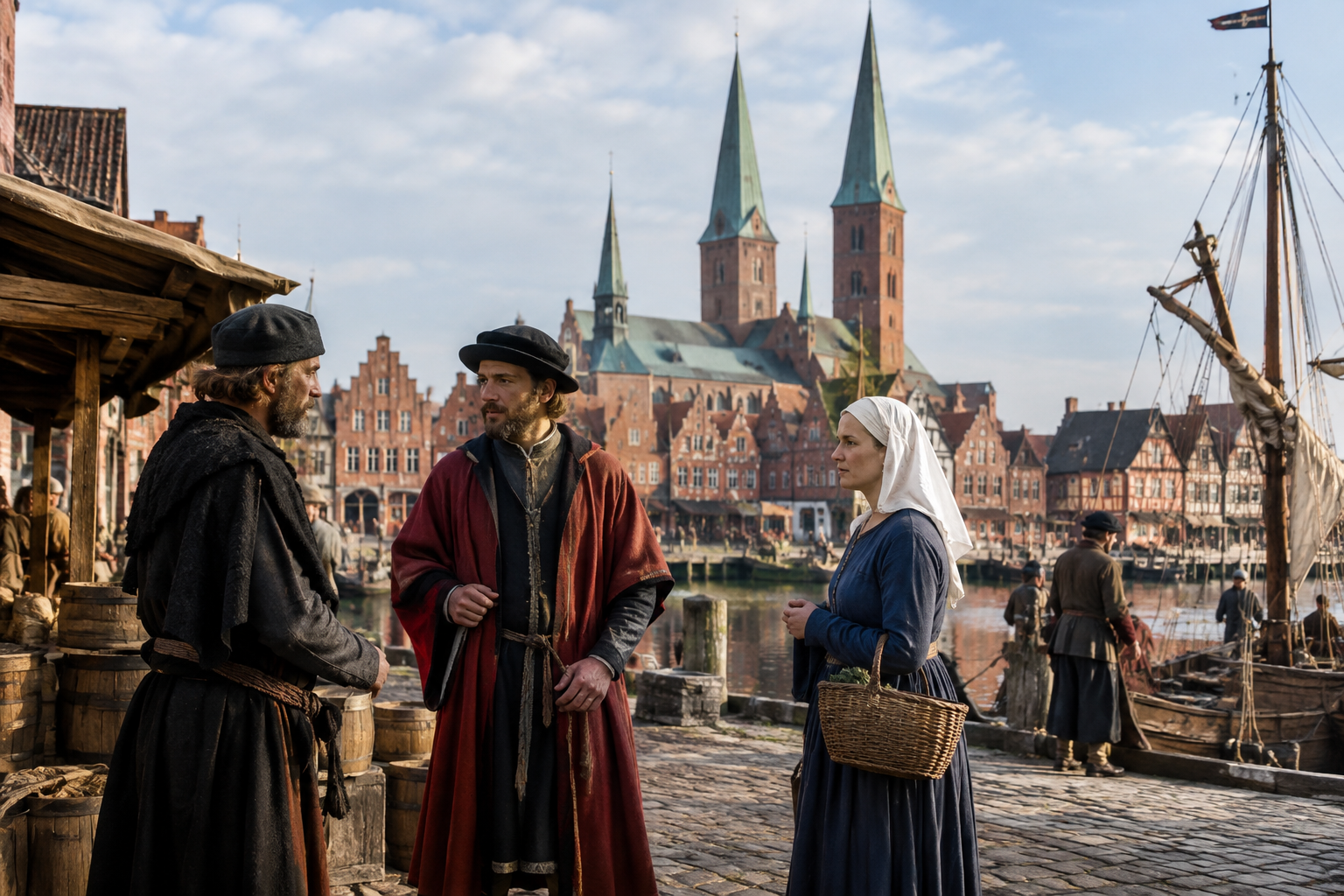
In around AD 1335, a man later catalogued as KH200393 was buried at St. Juergen in Luebeck, one of the great ports of the Hanseatic world. On its face that sounds almost ordinary: medieval town, churchyard burial, North German coast. But ancient DNA has made such graves newly talkative. In this case, the paternal line associated with him is reported as I1a1b1a1e2c5a, a very specific branch within the wider Y-DNA haplogroup I1.
That matters because Luebeck was no sealed local village. It was a commercial hinge between the North Sea and the Baltic, a place where people, goods, pathogens, and family lines all moved. A direct paternal lineage found there in the 14th century does not tell us everything about the man buried as KH200393; Y-DNA follows only one line among many ancestors. But it does place one slender, exact thread of ancestry inside a city that was central to medieval northern Europe.
Luebeck was not just another German town. From the 12th century onward it became one of the leading cities of the Hanseatic League, the loose but formidable commercial network that linked ports from the Low Countries to Scandinavia and the eastern Baltic. Its merchants handled grain, timber, wax, cloth, fish, and all the other dull-sounding but civilization-making commodities on which medieval urban life depended.
That is what gives KH200393 some historical weight. A paternal lineage like I1a1b1a1e2c5a appearing in this setting belongs not to an isolated frontier but to a city plugged into regional and long-distance exchange. The grave from St. Juergen sits in a landscape shaped by trade, migration, ecclesiastical institutions, and disease, all of which left marks in the burial grounds of late medieval Germany.
Research connected with these medieval remains has also been used to explore disease susceptibility in Europe, especially in relation to leprosy. A study linked to this material, published on medieval European ancient DNA and leprosy susceptibility, shows the sort of wider questions that such burials can illuminate: not just who people were in a genealogical sense, but how urban populations experienced illness, immunity, and social life.
Leprosy and migration in medieval Germany
The article haplogroup here is very narrow: I1a1b1a1e2c5a. That should immediately make us careful. The broader haplogroup I1 is strongly associated with northern Europe in both modern and ancient discussions, but a fine-grained subclade is not automatically entitled to inherit every grand claim made about I1 as a whole. A branch this specific may reflect more recent expansions, local founder effects, or medieval and post-medieval family histories that are far narrower than the story of the parent lineage.
Still, the wider setting is useful. I1 is one of the Y-chromosome lineages often encountered in discussions of Scandinavian and North German paternal history. Finding a descendant branch in medieval Luebeck is therefore historically plausible in a port city deeply connected to the Baltic and to regions where I1 lineages were well established. The key point is modest but important: KH200393 provides a dated, archaeological foothold for this paternal line in Hanseatic northern Germany.
For anyone tracing this haplogroup today, that is the real value of ancient DNA. It does not crown you a Viking, a merchant prince, or a member of some legendary tribe. What it can do is show that one branch of your paternal line was present in a documented medieval urban environment where northern European population history was being constantly remade.
It is tempting to glance at a medieval German sample and think only in modern national terms. But the Luebeck of KH200393's lifetime was part of a maritime commonwealth of sorts. Ships, legal customs, merchant families, laborers, clerics, and apprentices moved around the Baltic in ways that do not map neatly onto later identities.
That means this burial speaks to mobility as much as locality. Even when an individual was buried in one place, his ancestors might have come from another shore of the Baltic, from inland northern Germany, or from families already mixed through generations of commerce and marriage. The archaeological lesson is not that we can reconstruct KH200393's biography from a haplogroup, but that Luebeck is exactly the kind of place where paternal lines from across the northern world could converge and settle.
Germanic languages and ancient genomics
The deeper background to a lineage like I1a1b1a1e2c5a lies in the long reshaping of northern Europe after the Roman period. Northern Germany was never a blank stage onto which medieval towns suddenly appeared. It had already seen centuries of shifting settlement patterns, contact across the Rhine frontier, and the formation of communities later described in historical sources as Saxon, Danish, Slavic, or Frisian, depending on place and period.
Ancient DNA studies from nearby regions have increasingly shown that early medieval populations were neither perfectly static nor endlessly uprooted. Rather, they often combined local continuity with selective migration and intermarriage. That is a useful frame for medieval Luebeck as well. A precise Y-line there may belong to a family established locally for generations, or to one whose paternal origins lay elsewhere around the Baltic, but either way it formed part of a broader North Sea-Baltic world that was already centuries old by AD 1335.
One of the best things about archaeology is that it rescues the past from clean heroic stereotypes. Medieval port cities were prosperous, yes, but also crowded, unhealthy, and vulnerable to recurring disease. Churchyards and associated burial grounds preserve that harder truth. The individual KH200393 belongs to that real world of urban mortality rather than to the romantic pageant of ships and guild banners.
That is why the connection to biomedical questions is not a side note. Ancient DNA from medieval cemeteries can show how populations were structured, how far individuals had moved, and how certain genetic variants may have shaped disease risk. In a place like Luebeck, where population density and long-distance contact went hand in hand, those questions are especially historically meaningful.
The result is a fuller picture of lineage. A paternal haplogroup is not just an abstract code on a tree; in this case it belonged to a man living in a major late medieval city, embedded in trade networks and exposed to the hazards of urban life. That is a much more interesting form of ancestry than a simple ethnic label.
Medieval DNA from Germany's first townspeople
The most distinctive thing about I1a1b1a1e2c5a here is not a mythical origin story but a firm medieval setting: a man from St. Juergen in Luebeck, around AD 1335, in one of northern Europe's busiest commercial cities. That places this paternal line within the social world of the Hanseatic Baltic, where regional continuity and long-distance movement were both part of everyday history.
If this is your haplogroup, the responsible takeaway is a good one. Your direct paternal line can now be glimpsed in a documented medieval urban context in northern Germany, tied to the lived realities of trade, community, and disease rather than fantasy genealogy. That is exactly the sort of small, solid historical foothold from which better ancestry research begins.



Comments