Haplogroup I1a17

– 5 min read


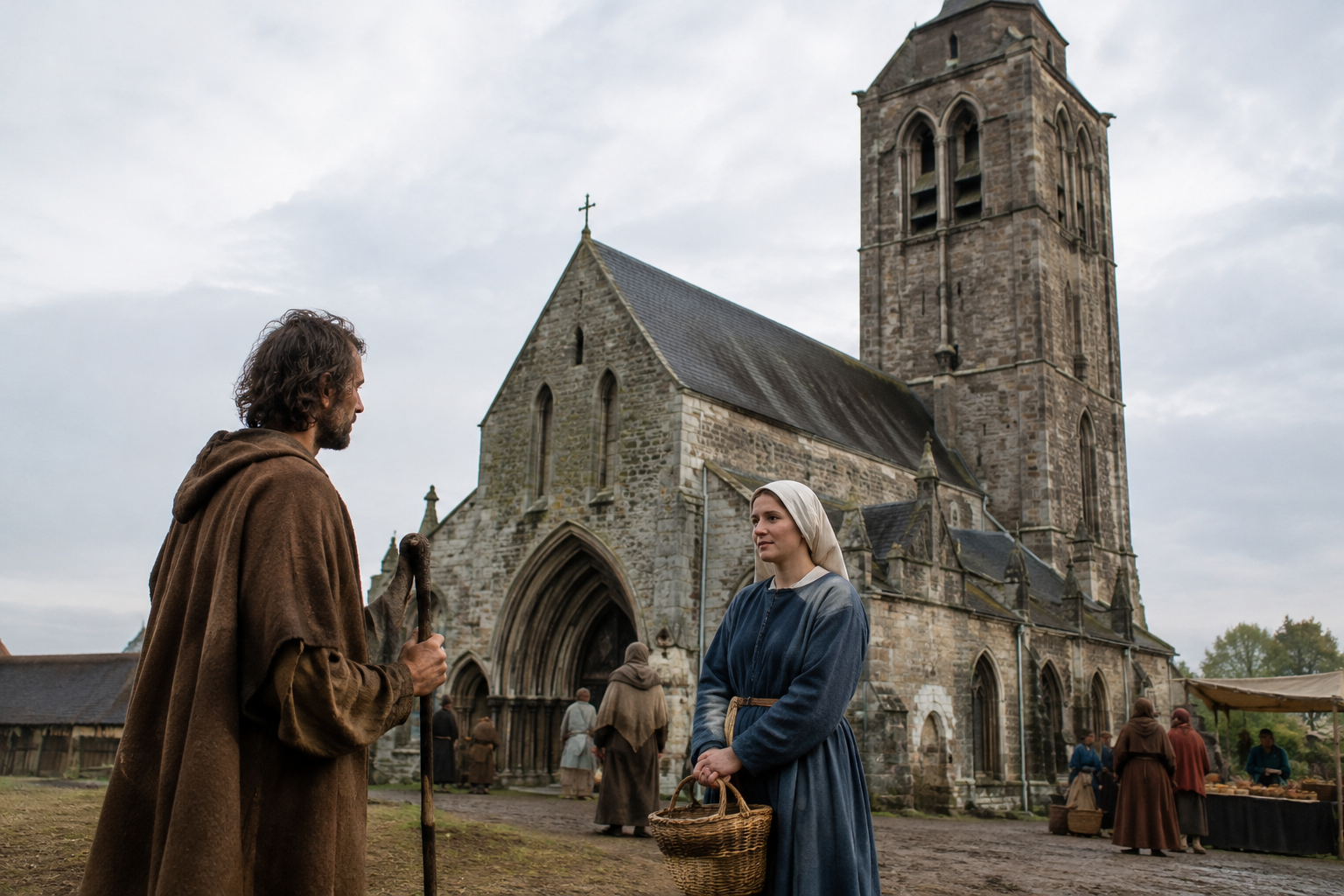
At Sint-Truiden in medieval Belgium, one excavated man stands out precisely because he did not seem to belong. The individual labelled ST1043, dated to around AD 900 and buried at Onze-Lieve-Vrouwekerk, was classified as an “outsider” in the site material. That word is a gift to the historian. It does not tell us a life story, but it does tell us that the burial community, when studied through archaeology and genetics, included people whose origins were not all the same.
For anyone exploring the Y-DNA haplogroup I1a17, ST1043 is therefore a wonderfully concrete starting point. Here is not an abstract map of northern Europe, nor a vague tale of “Germanic migrations,” but one early medieval man in a churchyard in the Low Countries whose direct paternal line has been associated with this branch. As ever, Y-DNA traces one paternal line only, not the whole of a person’s ancestry or identity. But in the right setting, that single line can still say something quite sharp about movement, community, and the making of medieval Europe.
Sint-Truiden was no remote hamlet. In the early medieval centuries it sat within a densely connected part of western Europe, shaped by monasteries, trade, lordship, and the long afterlife of the Carolingian world. A church burial ground such as Onze-Lieve-Vrouwekerk was part of that landscape of Christian settlement and social ordering. By around AD 900, this was a world in which local belonging mattered, but so did mobility.
That makes ST1043 especially interesting. When researchers single out an individual as an outsider, they are identifying difference within a larger burial population rather than simply attaching a dramatic label. In practical terms, that usually means the person did not fit neatly into the local biological pattern reconstructed from the cemetery as a whole. A recent ancient DNA study on medieval Sint-Truiden, published in Genome Biology, explored exactly this sort of urban and regional population structure in the town’s medieval dead.
The importance of ST1043 is not that he proves a grand migration all by himself. It is that he gives haplogroup I1a17 a securely medieval western European setting in a place where population mixing can actually be studied, rather than merely imagined.
The wider Y-chromosome haplogroup I1 is well known in European population history, especially in northern Europe and in discussions of Germanic-speaking regions. But this article is about I1a17, a narrower paternal branch. That distinction matters. One cannot simply take everything known about broad I1 distributions and paste it, wholesale, onto a smaller downstream lineage.
Still, even a narrow branch becomes historically meaningful when it turns up in an informative archaeological context. In the case of ST1043, the question is less “where did I1 come from in prehistory?” and more “what was a man bearing this paternal line doing in a ninth- or tenth-century community in central Belgium?” The answer is likely to lie in the texture of early medieval life: movement through military service, monastic networks, marriage alliances, craft mobility, trade, and the everyday churn of frontier regions that were never as static as older national histories liked to imagine.
That is the delight of Y-DNA when handled carefully. A haplogroup is not a tribe, not a language, and certainly not a ready-made ethnicity. But in an archaeological setting, it can mark one thread in a much larger social fabric.
It is tempting to treat medieval Belgium as a quiet middle ground between larger powers. In fact, the Low Countries were one of the great contact zones of northwestern Europe. Roman roads and river systems had already tied the region into wider networks, and the early medieval centuries did not erase those connections. They reworked them through new political structures, monasteries, market centres, and lordships.
By AD 900, Sint-Truiden belonged to a world that linked the Meuse basin, the Rhineland, the North Sea coast, and inland Francia. People moved through it constantly. Some were local over many generations; others arrived from nearby regions; still others may have come from much farther afield while still looking, archaeologically speaking, quite ordinary. That is why an “outsider” at Sint-Truiden is so valuable. He represents mobility made visible.
For I1a17, this context is arguably more useful than a heroic origin story. The branch appears here in a Christian cemetery embedded in the social machinery of an early medieval town. That places the lineage in the historical world of settlement, administration, and cross-regional movement that helped shape later populations in the Low Countries and beyond.
One of the more amusing habits in popular ancestry writing is to chase a haplogroup straight into kings, warlords, or legendary founders. But the real historical power of a case like ST1043 is almost the opposite. He was found not in a saga, nor in a royal tomb, but in an ordinary yet historically rich burial ground. This is the stuff from which real population history is built.
Churchyard cemeteries are especially revealing because they capture communities in formation. By the tenth century, Christianity had reorganised burial practice across much of western Europe, and cemeteries attached to churches became places where kinship, neighbourhood, status, and belonging intersected. Genetic variation within such a cemetery can show us how local communities absorbed newcomers, or at least buried them among their dead.
So ST1043 offers a modest but important kind of evidence. If his paternal line is associated with I1a17, then this branch was present in a socially integrated medieval setting in the Low Countries, even if the man himself was not considered entirely local in biological terms. That is a more historically grounded insight than any attempt to pin the lineage to a single “people” in the old-fashioned style.
Because broader I1 lineages often appear in discussions of northern and Germanic-speaking Europe, readers naturally wonder whether I1a17 should be placed somewhere in that broad historical sphere. That is a reasonable question, as long as one keeps the scale right. The presence of a narrow I1 branch in medieval Belgium sits comfortably within a wider northwestern European context shaped by centuries of interaction among Frankish, Saxon, Frisian, Scandinavian, and other populations.
But “comfortably within” is not the same as “identical to.” A man buried at Sint-Truiden around AD 900 was living in a thoroughly mixed post-Roman and early medieval world, not in a neatly bounded ethnographic box. If this branch has deeper roots in the north, the important historical point is that by the early Middle Ages such paternal lines could be carried into ecclesiastical towns and regional communities far from any simplistic homeland narrative.
Germanic Languages and Genomics
That broader picture also fits what many ancient DNA studies have been showing for years: language spread, political change, and family history overlap only imperfectly. The men who carried related paternal lineages were not all one people doing one thing. They were participants in long, messy histories of mobility and settlement.
If your paternal line falls within I1a17, ST1043 does not hand you a coat of arms or a named medieval dynasty. What he does offer is something more reliable: a documented early medieval presence for this branch in the Low Countries, in a burial population where genetic evidence can distinguish locals from incomers. That makes I1a17 a lineage with visible historical footing in the very regions where post-Roman Europe was being remade through movement, marriage, and community formation.
In other words, the best current picture is not one of isolated purity, but of participation. I1a17 appears here in the life of medieval Europe as it was actually lived: local, connected, and surprisingly mobile.

Comments