Haplogroup H2c1a

– 5 min read


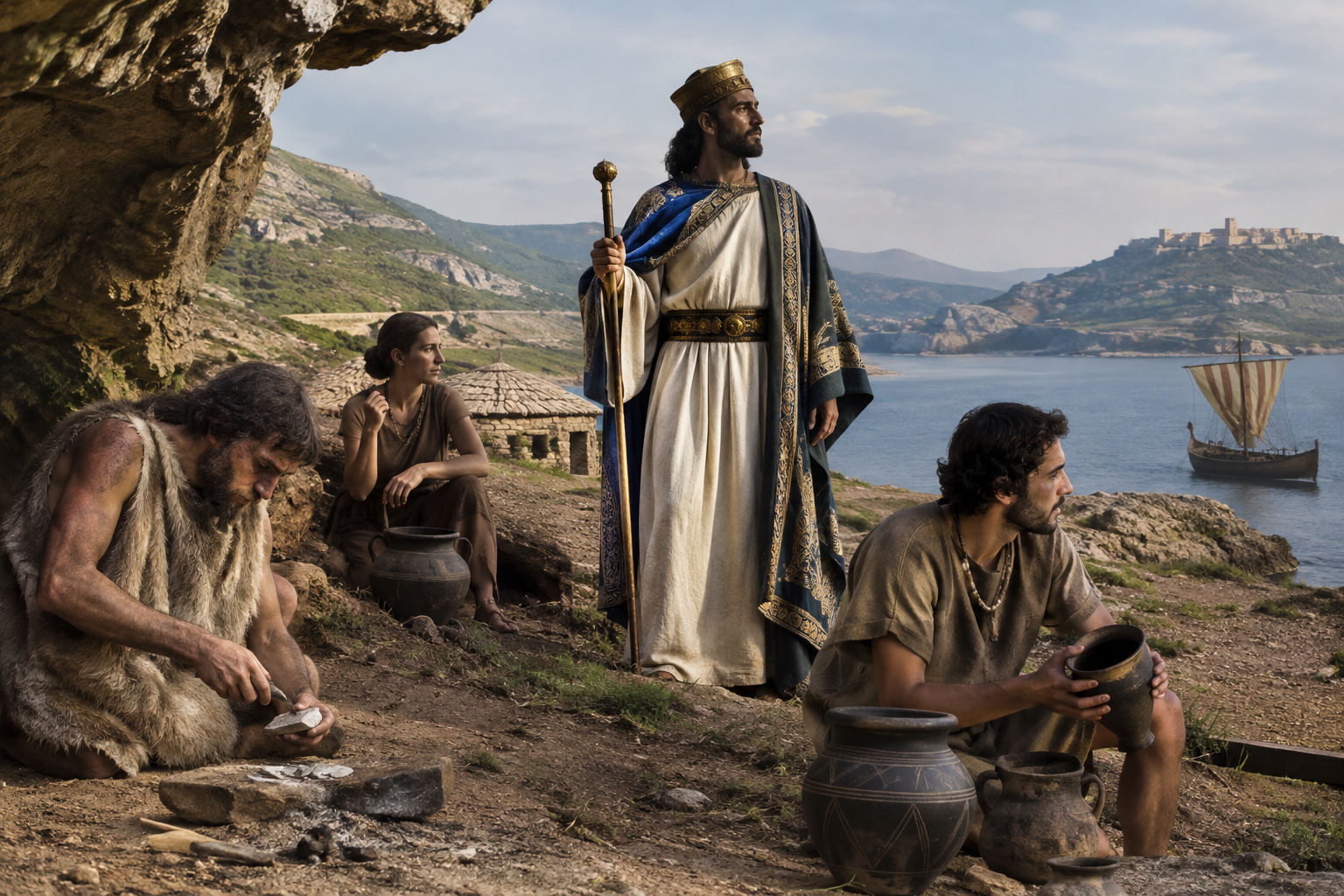
At Cova d'en Pardo in Spain, one late Neolithic male identified as CDP003a offers a particularly useful starting point for thinking about Y-DNA haplogroup H2c1a. He lived around 2950 BC, in a world where farming communities had already been established in Iberia for millennia, yet local populations were still changing, mixing, and adapting in regional ways. A paternal lineage like H2c1a does not tell us everything about him, of course, but it does place one thin, durable thread through that much larger human story.
What makes H2c1a interesting here is not modern prestige or a sweeping tale of conquest. It is the pattern of where it appears in the ancient record supplied for this branch: early in prehistoric Iberia, then again in the western Mediterranean, and later in the eastern Mediterranean under very different political circumstances. That is exactly the sort of thing ancient DNA is good at revealing: not a single heroic migration, but repeated appearances of a paternal line in connected worlds.
The Spanish evidence is especially valuable because it reaches back before the Bell Beaker horizon transformed much of western Europe's paternal landscape. Alongside CDP003a from Cova d'en Pardo, another Iberian individual in the record, ATP2, is listed as Pre-Bell Beaker Iberia and dated to about 3200 BC. That places H2c1a, or a reported association with this branch, in Iberia before the major demographic shifts often discussed for the later 3rd millennium BC.
That matters because haplogroup H2 is widely associated in ancient DNA discussions with some early farming populations of Europe, even though one must be careful not to project every broad H2 pattern directly onto the narrower branch H2c1a. Still, the Iberian appearances fit a plausible archaeological setting: settled farming communities, cave use, and regional continuity mixed with gradual change. Research on Neolithic burials and cave sites in this part of Spain has helped show how varied those communities were, and a site map including Cova d'en Pardo can be seen in this research figure.
Neolithic DNA in western Europe
It is tempting to make this into a neat tale of "the first farmers of Iberia," but archaeology rarely rewards neatness. By the late Neolithic, Iberia already contained communities with deep local roots, long-distance contacts, and different funerary traditions. What the two Iberian cases really show is that this paternal line was present in that landscape before the dramatic social and genetic reshuffling associated with later prehistoric expansions.
For people researching H2c1a today, the key point is that Y-DNA follows one direct male line only: father to son across generations. It is not a complete portrait of ancestry, language, or identity. But in prehistoric Europe, paternal lineages can sometimes illuminate the survival of older male lines through periods when other branches rose sharply in frequency.
That is one reason these Iberian samples are so intriguing. In many parts of Europe, early farmer-associated Y lineages became less common after the spread of later Bronze Age populations. Yet here we have evidence tying H2c1a to Iberia before that watershed. Rather than suggesting domination, it may suggest persistence: a lineage surviving inside local communities over long stretches of time.
A broader ancient DNA study of western Mediterranean populations, including island settings and long-term movement, is relevant to that background and can be consulted here: https://www.biorxiv.org/content/10.1101/2022.05.15.491973v1. It helps frame the kind of mobility and continuity that made the Mediterranean less a barrier than a corridor.
Mesolithic-Neolithic transition
By around 770 BC, the branch appears again in a very different setting: R11835 from San Imbenia in Sardinia, dated to the Late Bronze Age. Sardinia is one of those places that can look isolated on a map and anything but isolated in the archaeology. Coastal sites there were tied into exchange networks reaching across the Tyrrhenian Sea and beyond, involving Nuragic communities as well as contacts with Phoenician and other Mediterranean traders.
A H2c1a-associated male at San Imbenia is therefore historically interesting not because he proves a direct line from Neolithic Spain, but because he shows the branch persisting into a later maritime world. Sardinia often preserves lineages and ancestries that disappeared or became rarer elsewhere, while also receiving newcomers. That combination makes it one of the most revealing places in the Mediterranean ancient DNA record.
In practical terms, Sardinia reminds us that paternal lines do not have to stay put to remain old. A lineage can be both ancient in Europe and fully part of later commercial, coastal, and mixed societies. San Imbenia is not a fossil of the Neolithic; it is evidence that old lineages could still be present in active Bronze Age and early Iron Age communities.
The latest sample in this small set is SFI-39 from Saifi, Lebanon, dated to about 500 BC and placed in the Achaemenid Empire. Here the setting is no longer prehistoric village Europe or Bronze Age island exchange, but the urban and imperial eastern Mediterranean. Lebanon in this period sat within a world of ports, tribute, armies, merchants, and local traditions operating under Persian rule.
This is where the evidence becomes especially thought-provoking. If the H2c1a association is sound at this level of resolution, the branch was not confined to one western pocket. It also appears in the Levant, in a region that had long been central to Mediterranean connectivity. That does not mean the Lebanese individual was "from Spain," nor that all these men belonged to one recent family network. It means the paternal branch had a distribution broad enough to surface in both western and eastern Mediterranean contexts.
And that, in truth, is rather more historically interesting than a simple origin myth. Ancient Mediterranean populations were rarely tidy. They were layered, local, and connected all at once. A single Y-DNA branch turning up in Iberia, Sardinia, and Lebanon across more than two millennia fits that reality rather well.
Roman Hispania's genetic legacy
With only a handful of ancient examples, H2c1a should be handled carefully. The evidence here does not justify grand claims about a single homeland, an elite dynasty, or one uninterrupted migration route. What it does support is a picture of longevity and breadth: a paternal branch present in pre-Bell Beaker and late Neolithic Iberia, still visible in Bronze Age Sardinia, and also attested in the eastern Mediterranean during the Achaemenid age.
For someone carrying H2c1a today, the most responsible takeaway is that this branch has genuine ancient depth in Mediterranean-connected populations, with especially early evidence in Iberia. It may represent one of those older paternal lines that endured through enormous cultural changes rather than riding only one later expansion. That is a quieter story than legend usually prefers, but it is often how real history looks.
Comments