Haplogroup G2a2b2a3b1

– 4 min read


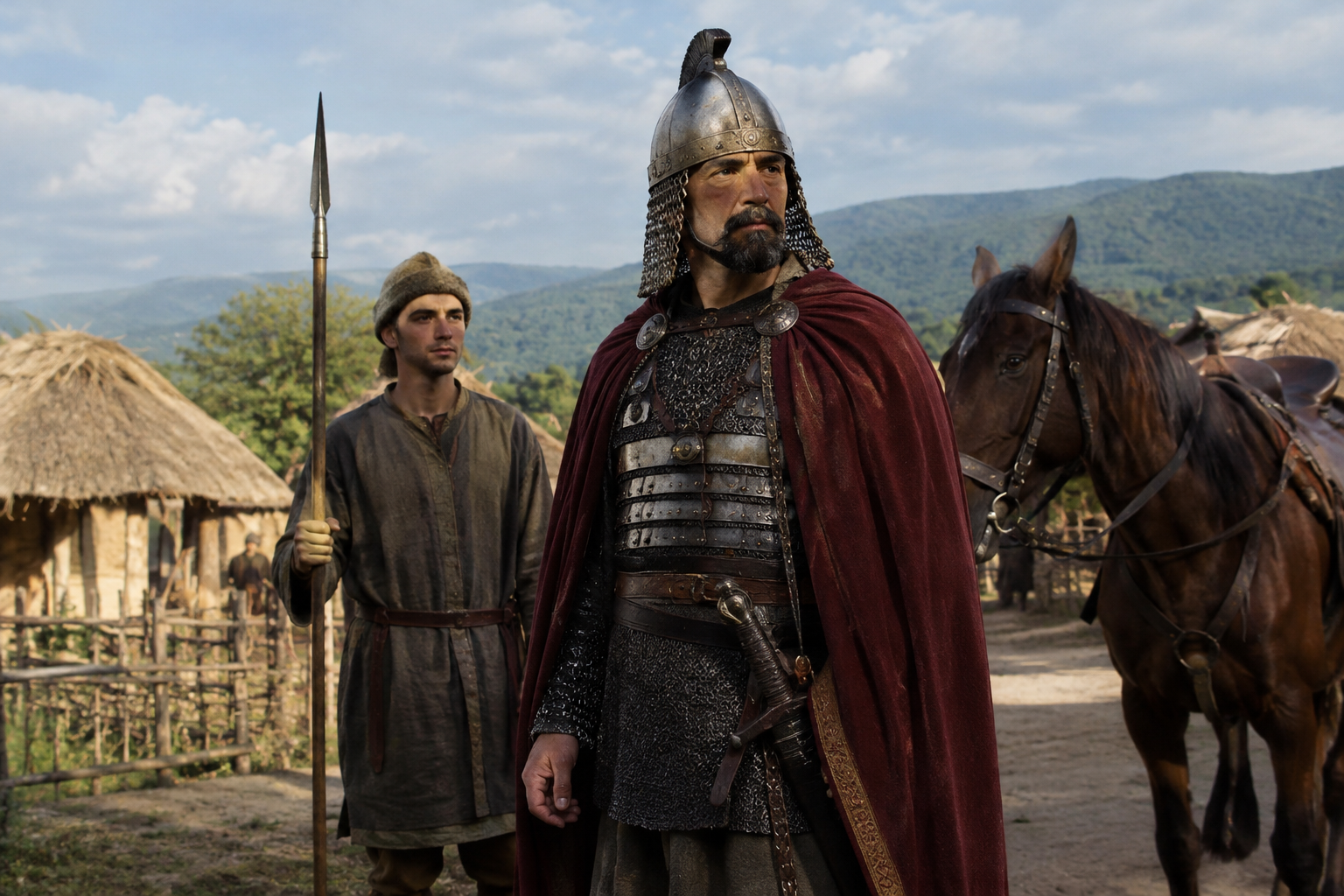
At Han Krum Village in Bulgaria, one ancient man has become an unexpectedly useful guide to a very old paternal line. The sample is identified as I41140, dated to around AD 400, and described as a Roman-era individual from the Aul of Kan Omurtag area. That is already enough to make him interesting: late Roman and post-Roman Bulgaria sat in a zone where imperial frontiers, local Balkan populations, and incoming groups all overlapped.
The Y-DNA branch associated here is G2a2b2a3b1. Y-DNA traces one direct paternal line only, not a person's whole ancestry, but even that narrow line can be revealing when it turns up in a place like late antique Bulgaria. Rather than pointing to a single simple identity, I41140 places this branch in a region where continuity and movement were happening at the same time.
Around AD 400, the Balkans were not some neat edge of empire with everyone standing in tidy ethnic boxes. This was a landscape of forts, villages, estates, military routes, and communities that had lived through centuries of Roman rule while also facing the pressures of Gothic, Hun, and other movements across the Danube world. A burial from this setting is valuable precisely because it belongs to that muddled, human reality.
What makes I41140 especially notable is not that he can be made to stand for an entire people, but that he gives us a documented appearance of haplogroup G2a2b2a3b1 in the eastern Balkans at a historically charged moment. The label "Roman Era" is important here. It situates him in a provincial world shaped by empire, but not reducible to Rome alone.
That matters because the Balkans often preserve deep local ancestry even when politics changes dramatically. In other words, a late Roman burial can contain lineages with much older regional roots, while the wider genome and the archaeology may reflect more recent contacts. That combination is exactly why ancient DNA from this region has become so useful.
The broader haplogroup G has a long history in western Eurasia and is especially famous in ancient DNA because branches of G appear repeatedly among early farmers in Neolithic Europe. But that does not mean every much later sub-branch should be treated as a straightforward "first farmer" signal walking unchanged across millennia. The narrower lineage in this article, G2a2b2a3b1, is a far more specific twig on that much bigger tree.
With only one supplied ancient sample, caution is essential. We can say that this paternal line is present in late antique Bulgaria through I41140. We should not pretend that one burial lets us reconstruct the full route, homeland, or social identity of the exact subclade. What it does suggest is persistence: a branch ultimately belonging to the wider G family was still part of the male population of the Balkans at the end of Roman antiquity.
That alone is historically interesting. The late Roman Balkans were often written about in terms of invasions and collapse, but paternal lineages such as this one remind us that population history is rarely a clean replacement story. Old local lines can remain in place while languages, rulers, military structures, and material culture shift around them.
The modern temptation is always to assign a burial too quickly: Roman, Goth, Thracian, Bulgar, local, foreign. Ancient DNA is useful partly because it makes that habit harder to sustain. A man buried in Bulgaria around AD 400 lived in a region where those categories could overlap awkwardly or change from one generation to the next.
For haplogroup G2a2b2a3b1, that means the most responsible reading is regional rather than tribal. The appearance of this lineage in I41140 shows that the branch belonged within the human landscape of the Balkans during late antiquity. It does not, by itself, prove a Gothic identity, a Roman military background, or descent from any named dynasty.
This is where archaeology and genetics are best used together. The archaeology tells us that the burial belongs to a late Roman setting in Bulgaria. The Y-DNA tells us that one man's direct paternal line fell within G2a2b2a3b1. The historical value comes from keeping those two facts together without forcing them into a melodramatic origin myth.
One reason this Bulgarian sample deserves attention is that the Balkans have repeatedly shown long-term demographic layering. Ancient DNA studies from southeastern Europe have often revealed that later historical populations can carry ancestry shaped by very old regional foundations, then modified by successive episodes of contact from the steppe, the Mediterranean, and central Europe.
That makes a late antique Y-lineage from Bulgaria more than a local curiosity. It belongs to a region where prehistoric farming expansions, Iron Age communities, Roman imperial integration, and early medieval transformations all left their mark. A branch like G2a2b2a3b1 may therefore be part of a much deeper Balkan story of survival through political change.
Research on ancient populations in this zone has increasingly emphasized that southeastern Europe cannot be reduced to a one-way corridor of invaders. It is also a reservoir of continuity. A genetic study connected with these ancient remains points to exactly the kind of evidence that has made the region so important: burials from historically turbulent settings can still preserve lineages that complicate easy narratives about replacement.
That broader perspective also fits well with recent work on the region's deeper past. If you want the long background to why Balkan genetic history is so layered, MyTrueAncestry's discussion of Balkan hunter-gatherers and their later impact is a useful companion to this much later Roman-period case.
There is a slightly comic tendency in popular history to think that only kings, conquerors, or richly furnished graves can tell us something important. In fact, a single identified male lineage from an ordinary late antique context can be just as revealing, especially in a frontier region. I41140 shows that G2a2b2a3b1 was part of the lived population history of Bulgaria around AD 400, during one of the most consequential transition periods in European history.
That does not give modern carriers a ready-made ethnic badge. It gives something better: a real ancient anchor. If your paternal line belongs to G2a2b2a3b1, this sample suggests that men from your direct male branch, or a closely related one, were present in the late Roman Balkans as empires frayed and new polities emerged. That is a properly historical insight, rooted in an actual burial rather than legend.
And there is a wider lesson too. Ancient DNA keeps nudging us away from tidy textbook labels and back toward the messiness of real past lives. In late antique Bulgaria, one man carrying G2a2b2a3b1 is enough to remind us that continuity can survive even in ages remembered for disruption.




Comments