Haplogroup G2a2b2a1b1a

– 5 min read


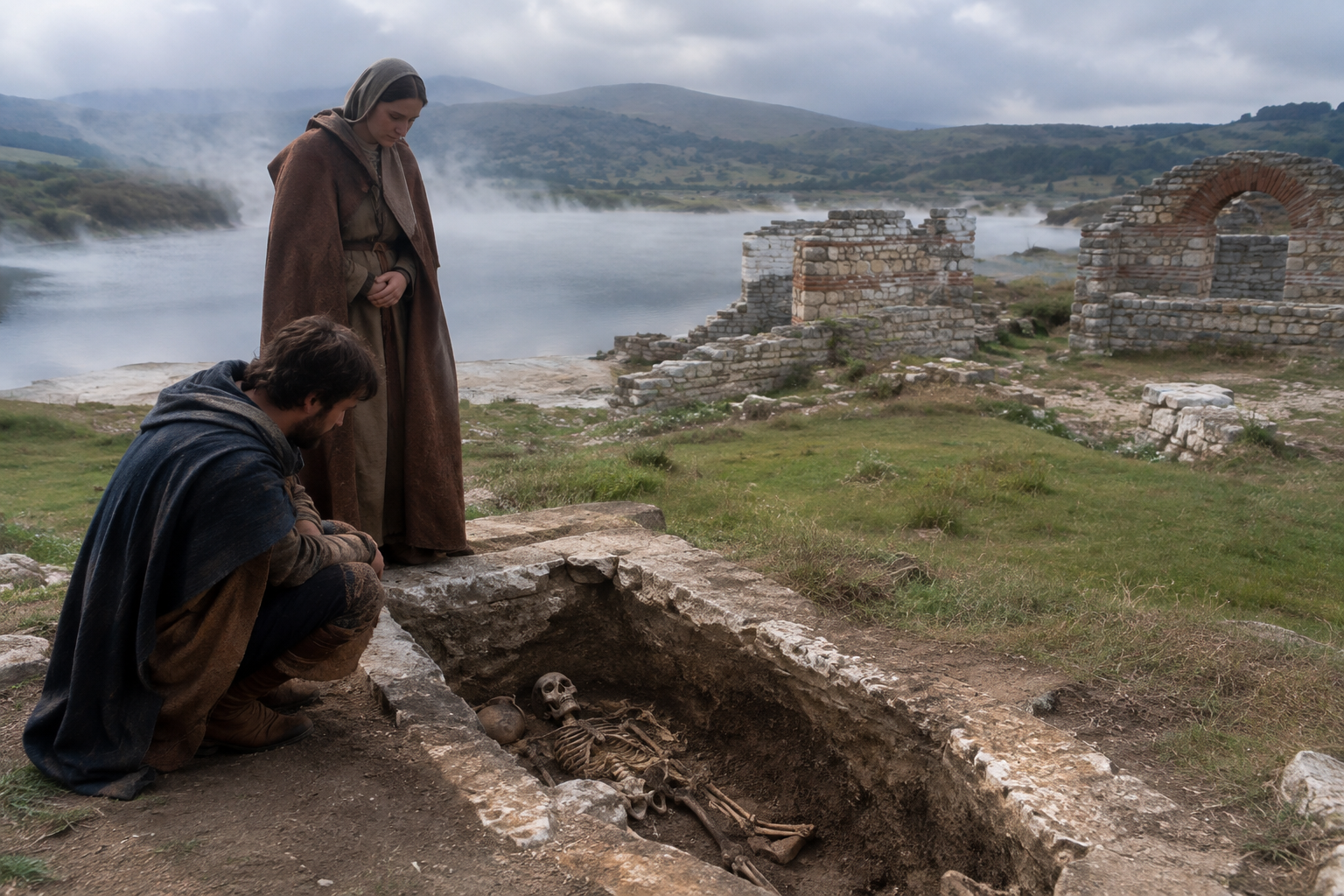
At Arrabona, near modern Gyirmot in northwestern Hungary, one man from the post-Roman centuries has become unexpectedly important for the history of a rare paternal line. He is sample GHD025, dated to around AD 550 and found in the Barbaricum zone beyond the old Roman frontier of Pannonia. In him, MyTrueAncestry associates the Y-DNA haplogroup G2a2b2a1b1a with a world that was neither neatly Roman nor simply "barbarian", but something much more entangled.
That is what makes this lineage interesting. G2a, in its wider sense, is famous in archaeogenetics for its deep association with early farming populations in Europe. But the branch discussed here, G2a2b2a1b1a, is a much narrower paternal twig, and one late antique man in western Hungary does not let us redraw all of European prehistory. What he does offer is a sharply focused glimpse of paternal continuity and movement in a frontier society where old imperial structures, local communities, and incoming groups all overlapped.
Arrabona had been a Roman center on the Danube frontier, part of the military and administrative fabric of Pannonia. By the sixth century, however, the map had changed faster than the landscape. Roman power in the West had ended, provincial habits persisted unevenly, and the region became a contact zone shaped by migration-period communities, shifting polities, and the stubborn afterlife of frontier settlement.
Sample GHD025 belongs to that unsettled horizon. The label "Post Roman Period Pannonia Arrabona Gyirmot Barbaricum Hungary" is already telling: this was a burial in a region historically defined by the Roman limes, but in a later context beyond direct Roman rule. The term Barbaricum is a Roman category, of course, and like many Roman labels it simplifies what on the ground was mixed, local, and changing.
An ancient DNA study of post-Roman communities in the Little Hungarian Plain helped bring such individuals into view, showing how much biological variety existed in these cemeteries and borderland settlements. For readers wanting the broader archaeological-genetic setting for western Hungary in this period, see this research on ancient DNA in the region.
Because Y-DNA follows one direct paternal line, it is both powerful and narrow. It can show that one man's father, father's father, and so on belonged to a particular male lineage. It does not tell us his whole ancestry, his language, or whether he thought of himself as Roman, Gothic, Gepid, Suebic, or anything else that historians and archaeologists might debate for sixth-century Pannonia.
Still, the presence of G2a2b2a1b1a in GHD025 matters precisely because it sits in a place and period where lineages met under pressure. The wider G2a family has deep roots in European prehistoric farming populations, but late antique appearances of narrower G2a branches remind us that paternal lines can persist for millennia while passing through utterly different cultural worlds. A lineage once associated, in broad terms, with the Neolithic does not remain trapped in the Neolithic. By AD 550 it could be carried by a man living in the political wreckage of Rome's frontier.
That point is worth lingering over, because frontier history is often told through tribes and armies. Genetics adds another register. Beneath the famous names from written sources, there were also ordinary local male lines continuing, mixing, and reappearing in communities that had long outlived the empires that tried to classify them.
Western Hungary in late antiquity and the early Middle Ages was not a sealed ethnic block. It was a corridor between the Alps, the middle Danube, and the wider Carpathian Basin. Armies moved through it, yes, but so did families, traders, herders, and displaced communities. Cemeteries from the post-Roman centuries in this region repeatedly show that cultural labels and biological ancestry do not line up in any tidy way.
That makes GHD025 more than a curiosity. He belongs to a landscape where burials can reflect local continuity, outside connections, or both at once. A paternal lineage like G2a2b2a1b1a in this setting may point to survival of older regional male ancestry, to migration from elsewhere in central or southeastern Europe, or to earlier mixing already absorbed into a local population. With the evidence currently at hand, the responsible answer is not to force one route, but to see this sample as part of the diversity that made post-Roman Pannonia historically distinctive.
This is also why the old frontier matters so much. The Danube border was never just a line on a map. It was a social engine. Soldiers recruited from afar, provincial civilians, federate groups, and neighboring communities all contributed to the human landscape. Long after imperial administration weakened, the biological consequences of centuries of contact remained.
One sample cannot stand for all of Hungary, still less for all carriers of G2a2b2a1b1a. But one sample can anchor a historical discussion when the context is good. GHD025 tells us that this paternal branch was present in the post-Roman Carpathian frontier by the mid-sixth century, in a zone where identities were negotiated locally rather than inherited from textbook categories.
That matters especially because migration-period history is so often flattened into the march of named peoples. Ancient DNA keeps disrupting that simplicity. Time and again, burials associated with supposedly coherent cultural groups turn out to include people of varied ancestry and varied paternal backgrounds. The result is not confusion for its own sake, but a better picture of how real communities formed.
Readers interested in that wider problem of mixed late antique populations may want to compare this Hungarian evidence with other work on genetically varied communities traditionally linked to Gothic or frontier settings.
It is tempting to match a Y-lineage to a language family or a named people, especially in a region where Germanic, Romance, steppe, and later Slavic histories all touch. But the evidence does not allow that jump. A man carrying G2a2b2a1b1a at Arrabona could have belonged to a community shaped by several generations of mixture and cultural change.
That caution is not a disappointment. In fact, it is the historical point. Late antique Pannonia was a place where language, dress, burial custom, political allegiance, and biological ancestry could all travel on different tracks. A paternal lineage survives through fathers and sons; culture can change in a generation. That mismatch is exactly why archaeogenetics is so useful when handled carefully.
It also connects this Hungarian case to a larger pattern in Europe, where genetic evidence is forcing historians to think again about how languages and identities spread. The answer is rarely a single people carrying a single lineage in a straight line across the map.
Germanic Languages and Genomics
For someone researching G2a2b2a1b1a today, the most useful lesson from GHD025 is not a grand claim of ethnic identity, but a more interesting one. This branch appears in a real sixth-century man from the post-Roman frontier of western Hungary, a region where older local ancestry and new historical formations met. That places the lineage inside one of Europe's great transitional zones: not at the start of farming, nor in a royal pedigree, but in the complicated human middle ground between empire and early medieval society.


Comments