Haplogroup G2a2b2a1a1b1a1c2a2

– 5 min read


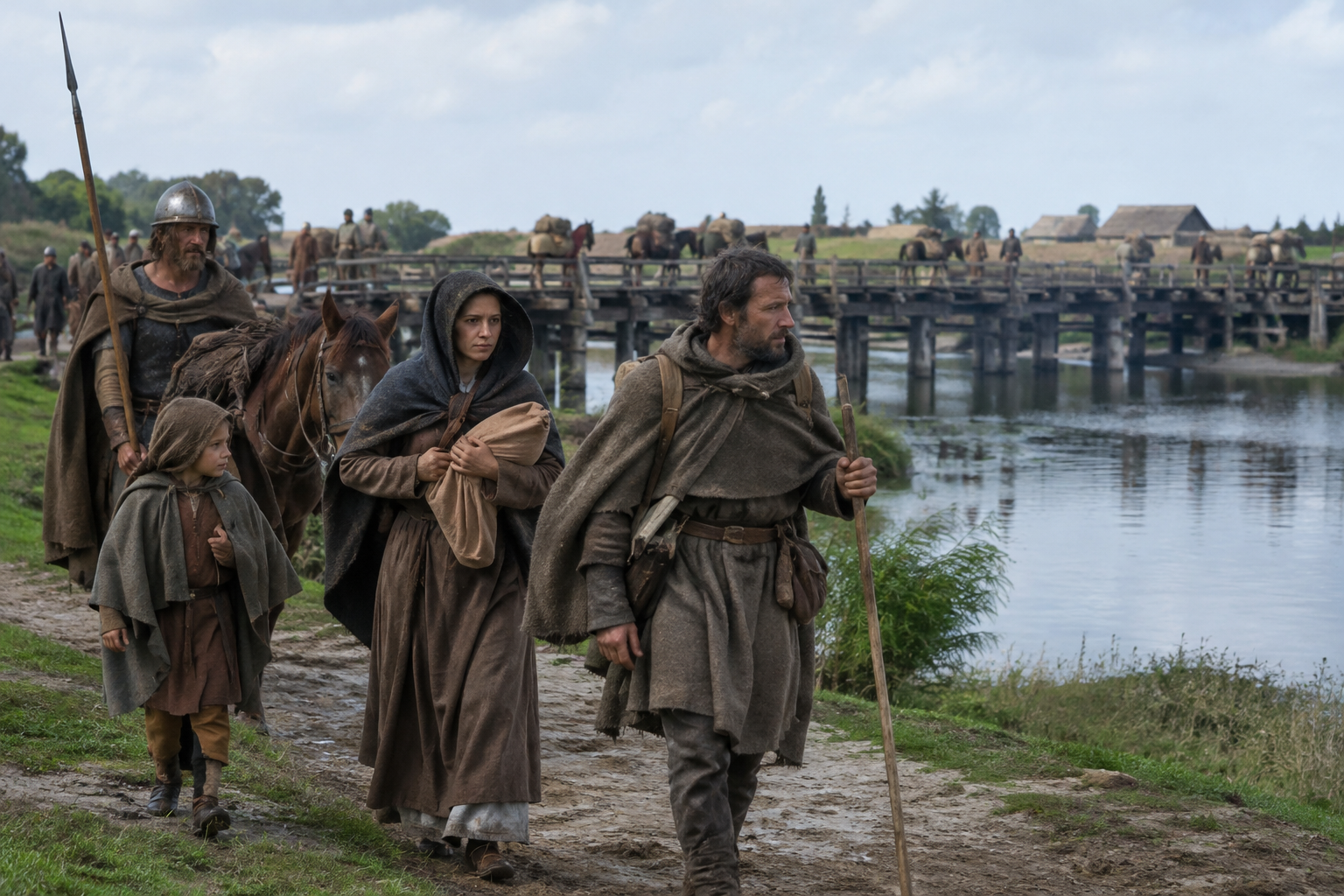
At Bruecken in Saxony-Anhalt, one man from around AD 500 has become an unusually sharp point of focus for a very long story. The individual identified as BRC010x, described as a Migration Period Roman migrant, carries the Y-DNA haplogroup G2a2b2a1a1b1a1c2a2. That is an intimidating string of letters and numbers, but the historical interest is quite simple: here is a paternal line better known in much older European prehistory turning up in the unsettled world that followed the western Roman Empire.
That makes BRC010x valuable not because one skeleton can explain an era, but because he sits at a crossroads. Around AD 500, central Germany was a place of movement, resettlement, military service, and mixed communities. A direct paternal lineage like this one traces only one line of descent, yet even that single line can reveal something important: old male lines did not vanish neatly when political worlds changed. They persisted, reappeared, and were folded into new societies with new labels.
The description attached to BRC010x is already enough to make historians pause. "Roman migrant" in Saxony-Anhalt during the Migration Period does not mean a toga-clad official stepping straight out of an imperial marble relief. In late antiquity and the early Middle Ages, Roman identity could be administrative, military, provincial, linguistic, cultural, or geographic. By AD 500, people connected to the Roman world might have been born inside the empire, on its frontiers, or in communities long entangled with it.
So the significance of BRC010x lies in context as much as classification. He appears in a region usually discussed through the movements of Germanic-speaking groups, but his label points to wider networks linking central Europe with the late Roman sphere. A paternal lineage assigned here to G2a2b2a1a1b1a1c2a2 fits that broader lesson rather well: ancestry in post-Roman Europe was not arranged into tidy ethnic boxes.
An ancient DNA project associated with these burials is linked through this research archive entry, which points to the larger genetic work behind such Migration Period identifications. Even without over-claiming the precise route by which this man or his paternal ancestors reached Bruecken, the archaeological value is clear. He belongs to that crowded historical zone where empire, frontier, and migration overlap.
To understand why this branch stands out in an early medieval grave, it helps to step back from the very narrow terminal subclade and look briefly at its broader family. Haplogroup G, and especially branches of G2a, is one of the classic Y-DNA signatures associated with many early farming populations of Neolithic Europe. That does not mean every later carrier was a "Neolithic farmer" in any simple sense. It means the deeper paternal ancestry of this line has roots in population movements that helped spread agriculture into Europe thousands of years before BRC010x lived.
By the first millennium AD, however, Europe had already seen repeated waves of mixture: with hunter-gatherer survivors, steppe-derived groups, Bronze Age societies, Iron Age communities, Roman provincial populations, and the many mobile peoples of late antiquity. A very specific branch such as G2a2b2a1a1b1a1c2a2 should therefore be treated cautiously. We can say it belongs within that broader G2a world; we should not lazily assign to this exact subclade every origin story ever told about G2a as a whole.
That distinction matters for family historians. If your paternal line falls on a rare and deeply nested branch like this one, it may preserve a lineage with great time depth in Europe, but the historically meaningful question is often not where the parent haplogroup first arose, but where and when your own branch appears in identifiable communities. In this case, the documented appearance we have is in a Migration Period individual from central Germany with a Roman-associated label.
One of the odd pleasures of archaeogenetics is that it forces us to keep several timescales in our heads at once. On the short historical timescale, BRC010x belongs to the age of collapsing western imperial structures, successor kingdoms, military federates, and mobile frontier populations. On the long genetic timescale, his Y-chromosome sits within a paternal framework whose deeper history reaches back toward Europe's first farmers.
That does not make him a relic from prehistory wandering unchanged into the early Middle Ages. Quite the opposite. It shows how misleading it is to imagine that each historical period arrives with an entirely new set of people. Communities change, political loyalties shift, languages spread, and burial traditions alter, while some family lines continue quietly through all of it. The survival of a G-derived paternal line in this setting is a reminder that the Migration Period was not only about incoming groups. It was also about the recombination of older local and regional ancestries.
Archaeogenetic work on language spread and mobility has increasingly underlined this point: large historical transformations rarely erase all earlier structure. They overlay it. That is why a lineage often associated in broad terms with earlier European farming populations can still surface in a man living in a world shaped by Rome and by post-Roman migrations.
Germanic Languages and Genomics
Saxony-Anhalt was not a historical backwater in this period. It lay within a central European zone deeply affected by movements across the former Roman frontier and beyond it. Elbe-Germanic regions, former imperial provinces, and the lands between them were tied together by warfare, trade, marriage, and service. Any one burial from this landscape must be read against that wider map.
That is what makes the Bruecken individual useful even in the absence of a theatrical grave narrative. We do not need invented weapons, jewels, or dramatic battlefield deaths to make him interesting. His importance lies in the combination of place, date, and genetic assignment. Around AD 500, when identities were being reformulated across Europe, this paternal line appears in a man interpreted as a Roman migrant in central Germany. That is already a strong piece of evidence for a socially mixed world.
It also fits a pattern seen in other ancient DNA studies of late antique and early medieval Europe: local continuity and long-distance mobility were happening at the same time. The old habit of sorting people into neatly bounded "Romans" and "barbarians" has not survived contact with the graves. The bones are awkwardly cosmopolitan, and that is one reason they are so historically useful.
Roman and Early Medieval Britain
For someone researching haplogroup G2a2b2a1a1b1a1c2a2, the most defensible lesson is not a grand claim about belonging to one famous tribe or dynasty. It is something subtler, and in its way more interesting. This branch appears in at least one documented male from the Migration Period who was buried in Saxony-Anhalt and classified as a Roman migrant, showing that very old European paternal lines could still be present within highly mobile late antique communities.
That is a good reminder of how ancestry actually works in the archaeological record. Deep paternal continuity and historical mobility are not opposites. They often sit in the same person. BRC010x stands as a small but vivid example of that fact: a man in an age of movement, carrying a lineage with a far older European background.

Comments