Haplogroup G2a2b2a1a1b1a1a2b

– 5 min read


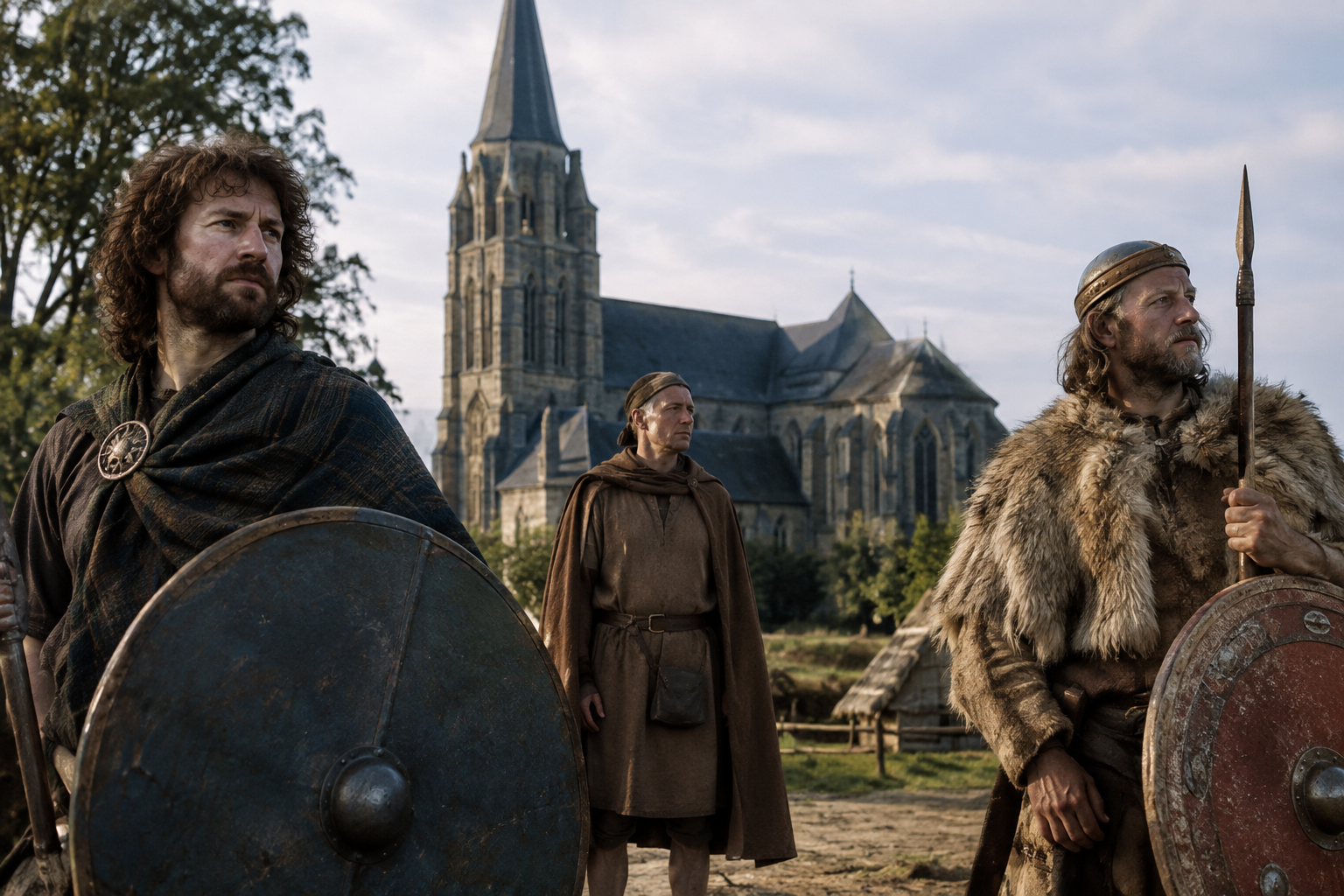
At Sint-Truiden in present-day Belgium, one medieval man stands out precisely because he did not quite fit in. Sample ST1016, dated to around AD 900 and recovered from Onze-Lieve-Vrouwekerk, has been described as an outsider in a growing urban community. That makes him an arresting place to begin for the Y-DNA haplogroup G2a2b2a1a1b1a1a2b: not with a sweeping origin myth, but with one real person in a churchyard whose paternal line hints at movement, mixture, and the complicated making of medieval Europe.
The interesting thing here is not that one Y-chromosome branch can explain a whole population. It cannot. Y-DNA follows one direct paternal line only. But when the same branch appears in very different settings, including Iron Age France, pre-Roman Britain, and early medieval Belgium, it gives us a small but vivid thread running through the western European past.
ST1016 comes from a period when towns in the Low Countries were beginning to thicken with commerce, ecclesiastical power, and human mobility. Sint-Truiden was not an isolated village at the edge of the world; it sat within a zone where monasteries, markets, political frontiers, and travel routes pulled people together. In that setting, an individual labelled an outsider is historically significant even before genetics enters the picture.
A genetic study of the medieval population at Sint-Truiden, linked to research on urbanization and population structure in the town, points toward just this kind of mixed local world. For a lineage like G2a2b2a1a1b1a1a2b, ST1016 is a useful reminder that paternal lines do not sit still inside neat ethnic boxes. By AD 900, western Europe was full of old lineages carried into new settings by marriage, service, pilgrimage, trade, and resettlement.
There is also a methodological point worth making. When a medieval individual appears genetically unusual in a town cemetery, that does not automatically mean a dramatic long-distance migration from some far-flung land. Sometimes "outsider" means regional mobility rather than continental adventure. Still, for anyone carrying this haplogroup today, ST1016 offers a concrete early medieval foothold in the historical landscape of the Low Countries.
The branch also appears earlier in Iron Age France, in sample I19356 from Chemin de Coupetz in Marne, dated to around 250 BC. That date places him in the later Iron Age, in a part of Gaul deeply associated with the world archaeologists often call Celtic, though one must be careful: a genetic lineage is not the same thing as language or tribal identity.
Even so, the location matters. The Marne region has long been central to discussions of Iron Age northern France, exchange networks, and the societies that Classical authors would later describe under broad labels such as Gauls. A paternal lineage found there and again across the Channel in Britain is suggestive not of a single family saga, but of the kinds of cross-regional ties that linked western Europe before the Roman conquest.
Sample I19356 helps anchor G2a2b2a1a1b1a1a2b in a pre-Roman continental setting. That is useful because modern discussions of Y-DNA too often jump straight from present-day testers to deep prehistory. Here, instead, we can place the lineage in a recognisably historical Iron Age landscape, among communities that were already mobile, connected, and far from isolated.
The British evidence comes from I11152, described as a Celtic Briton from Over, Cambridgeshire, dated to around 200 BC. This is a valuable counterpart to the French sample because it places the same paternal branch in Iron Age Britain before the Roman occupation. In other words, the lineage was already present in both continental and insular settings during the centuries when contact across the Channel was entirely normal.
Cambridgeshire in the Iron Age was part of a densely inhabited and carefully managed landscape, not an empty frontier. The fen-edge world and inland routeways of eastern Britain connected settlements, exchange zones, and social groups. If a branch such as G2a2b2a1a1b1a1a2b appears here as well as in Marne, that fits a wider archaeological picture in which Britain and northern Gaul were tied together by repeated movement of people as well as goods.
One of the most important recent syntheses for these centuries is a major ancient DNA study of Iron Age and Roman-era Britain, which showed just how informative local burials can be for reconstructing mobility and continuity. Without overclaiming for one sample, I11152 sits comfortably in that larger story: Britain before Rome was neither genetically sealed off nor simply overwritten by later arrivals.
The exact branch name is, admittedly, a mouthful. The key point is that G2a2b2a1a1b1a1a2b is a very narrow twig on the larger Y-DNA tree. The broader haplogroup G has a long and important history in western Eurasia and is well known from early farming populations in Europe, but it would be wrong to pour that entire deep history straight into this precise subclade as if nothing changed along the way.
What the ancient individuals here actually show is more modest and more interesting. This branch, or a reported association with it, appears in later prehistoric and early medieval western Europe, specifically in Iron Age France, Iron Age Britain, and medieval Belgium. That distribution points to persistence. It suggests that at least one paternal line within the wider G family remained part of western European populations through major cultural changes: late prehistoric exchange, the coming of Rome, the end of Roman rule, and the rise of medieval towns.
That continuity should not be mistaken for social continuity. The man in Marne, the man in Cambridgeshire, and ST1016 at Sint-Truiden did not belong to one known dynasty, one tribe, or one enduring elite house. What links them is narrower and more exact: a paternal signal turning up in different archaeological worlds.
Any one of these individuals on his own would be little more than a point on a map. Together, they form a sequence across roughly eleven centuries. Around 250 BC the branch is present in northeastern France; around 200 BC it appears in eastern Britain; by around AD 900 it turns up in a medieval church context in Belgium. That is not enough to reconstruct a migration route, but it is enough to show survival across time and across connected regions of northwestern Europe.
There is also a pleasing historical irony here. Modern family lore often wants a single homeland, one founding people, one decisive migration. Ancient DNA keeps spoiling that simplicity. The evidence behind G2a2b2a1a1b1a1a2b instead points to a lineage that was already embedded in mixed societies long before the high Middle Ages. Iron Age Britons were connected to the continent; medieval towns absorbed newcomers; paternal lines persisted while identities, languages, and political loyalties changed around them.
For someone researching the haplogroup G2a2b2a1a1b1a1a2b today, the clearest supported insight is not glamorous nobility or a single founding hero. It is that this paternal line has credible archaeological appearances in the western European record before and after Rome, and in places that were linked by movement across the Channel and through the Low Countries. That makes it a lineage of persistence within change: one direct male line carried through Iron Age communities and into the busy, mobile society of early medieval Europe.
Comments