Haplogroup G2a2b2a1a1b1a1a2a1a1b

– 4 min read


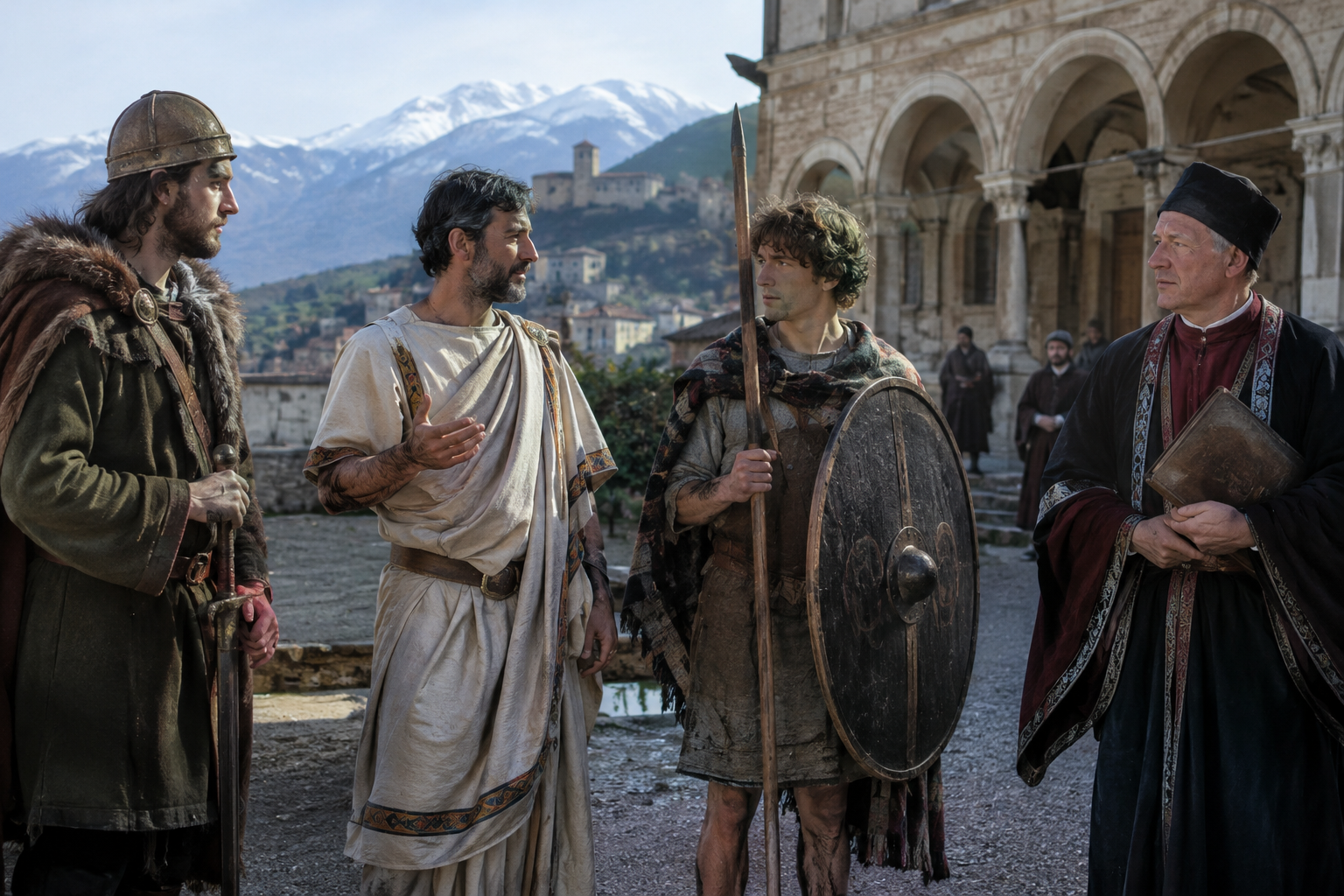
At Collegno, near Turin, one man from the Lombard period has become a useful anchor for an unexpectedly long paternal story. Sample COL_034b, dated to around AD 580, comes from a cemetery used in the generations after the collapse of Roman imperial rule in the West. He is associated here with the very specific Y-DNA lineage G2a2b2a1a1b1a1a2a1a1b, a deeply nested branch of haplogroup G that turns up, in this small set of evidence, not in one single ethnic setting but across a remarkably mixed archaeological landscape.
That is the interesting part. Y-DNA tracks one direct paternal line only, not a whole identity, yet even that narrow line can sometimes illuminate continuity where history tends to prefer rupture. In this case, the same reported branch appears in Iron Age northern Italy, Iron Age Britain, early medieval Italy, and a later medieval burial from Rome. That does not make all these men close kin, but it does place this paternal thread inside several very different worlds: Celtic, Roman, post-Roman, and medieval Christian.
Collegno matters because it sits in one of the key contact zones of the early medieval West. By the later sixth century, northern Italy was not simply "Roman" or "Lombard" in any tidy sense. It was a region of military settlement, local survival, intermarriage, changing identities, and the slow rebuilding of power after war. A genetic study of this cemetery and related material, published in PNAS, helps place such burials in the broader demographic shifts of early medieval Italy.
Within that setting, COL_034b is valuable less as a grand historical celebrity than as a grounded archaeological person. His reported lineage shows that this branch of G was present in northern Italy during the Lombard era, when older local populations and newcomers from beyond the Alps were living in the same political landscape. That is exactly the kind of context where a paternal lineage can survive while language, dress, burial custom, and political loyalty all change around it.
The northern Italian evidence goes back much further than the sixth century. Sample 3225n, dated to about 300 BC, is described as belonging to the Gallic Cenomani from Verona, at Seminario Vescovile. Here the historical setting is the Iron Age Po Valley, when Celtic-speaking groups were established across much of northern Italy while interacting constantly with older local populations, Etruscans, Venetic communities, and, increasingly, Rome.
This is where the haplogroup becomes historically useful in a properly modest way. If the same narrow paternal branch is reported both in an Iron Age Cenomani-associated individual and in a Lombard-era burial from northern Italy, that suggests the branch was not a one-off arrival tied only to the migration period. It had a place in the region centuries earlier. That does not mean uninterrupted descent from one excavated man to another, but it does make continuity in northern Italy a serious possibility.
It also reminds us that labels like "Gallic," "Roman," and "Lombard" describe historical and archaeological contexts, not sealed genetic containers. The Po Valley was one of Europe's classic mixing grounds. A paternal branch found there might belong to a man living under Celtic cultural forms in one century and to a man buried in a Lombard-period cemetery nearly nine hundred years later.
The most surprising appearance in this set is probably I28775, dated to around 270 BC, from Melton in East Yorkshire and described as Celtic Parisi. That places the branch in Iron Age Britain as well as continental and Italian contexts. The Parisi are one of those peoples who tempt easy stories because their name resembles that of the Parisii of Gaul, but archaeologists have long argued over how direct any connection really was. Ancient DNA has begun to sharpen those debates without settling every detail.
What matters here is not to overclaim a migration route for one man, but to notice the wider pattern: this branch was not confined to Italy. Its appearance in East Yorkshire fits a broader Iron Age picture in which communities around the North Sea and across temperate Europe were connected by mobility, exchange, and marriage networks. Research on Iron Age and Roman-period Britain, including work published in Science, has shown just how varied those ancient populations could be.
So the paternal line behind G2a2b2a1a1b1a1a2a1a1b was present in a British Iron Age community that lived far from the Mediterranean yet was not isolated from continental developments. That is worth pausing over. We often imagine lineages moving in one dramatic surge, but the older reality was usually a patchwork of small-scale movements repeated over centuries.
The latest sample in this group, R1224, is dated to around AD 1090 from the Roman Cancelleria Basilica. By then, of course, we are in a very different world: papal Rome, medieval churches, urban continuity layered over ancient ruins, and a population shaped by many centuries of movement through the city. If the reported association to this haplogroup is correct, it shows the same paternal branch still present in central Italy well into the medieval period.
Rome is the one place where continuity and mixture are always happening at once. A lineage present there in the eleventh century could reflect local Italian roots, older imperial-era movements, or the ceaseless reshaping of the city by clerics, traders, migrants, and families from elsewhere in the peninsula. The point is not to force R1224 into a single origin story. It is to see how a rare-looking modern haplogroup label can, in ancient contexts, belong to ordinary men living in very public historical settings.
With only four ancient occurrences, caution is essential. Still, these samples do suggest something distinctive about G2a2b2a1a1b1a1a2a1a1b: not a narrow association with one famous conquest, but a durable presence in western and southern Europe across very different cultural settings. The strongest pattern here runs through Italy, from an Iron Age burial at Verona to a Lombard-era cemetery at Collegno and on to medieval Rome, with a British Iron Age appearance showing that the branch was not purely local to the peninsula.
For someone researching this paternal line today, that is the sensible takeaway. This branch may belong to a very old European male line that moved through Celtic, Roman, and post-Roman worlds without being reducible to any one of them. Ancient DNA does not hand you a family tree reaching straight back to COL_034b or 3225n. What it can offer is something subtler and, in its way, more interesting: evidence that your direct paternal line was already part of the busy human traffic of Iron Age and medieval Europe.
Comments