Haplogroup G2a2b2a1a1b1a1a1a2

– 4 min read


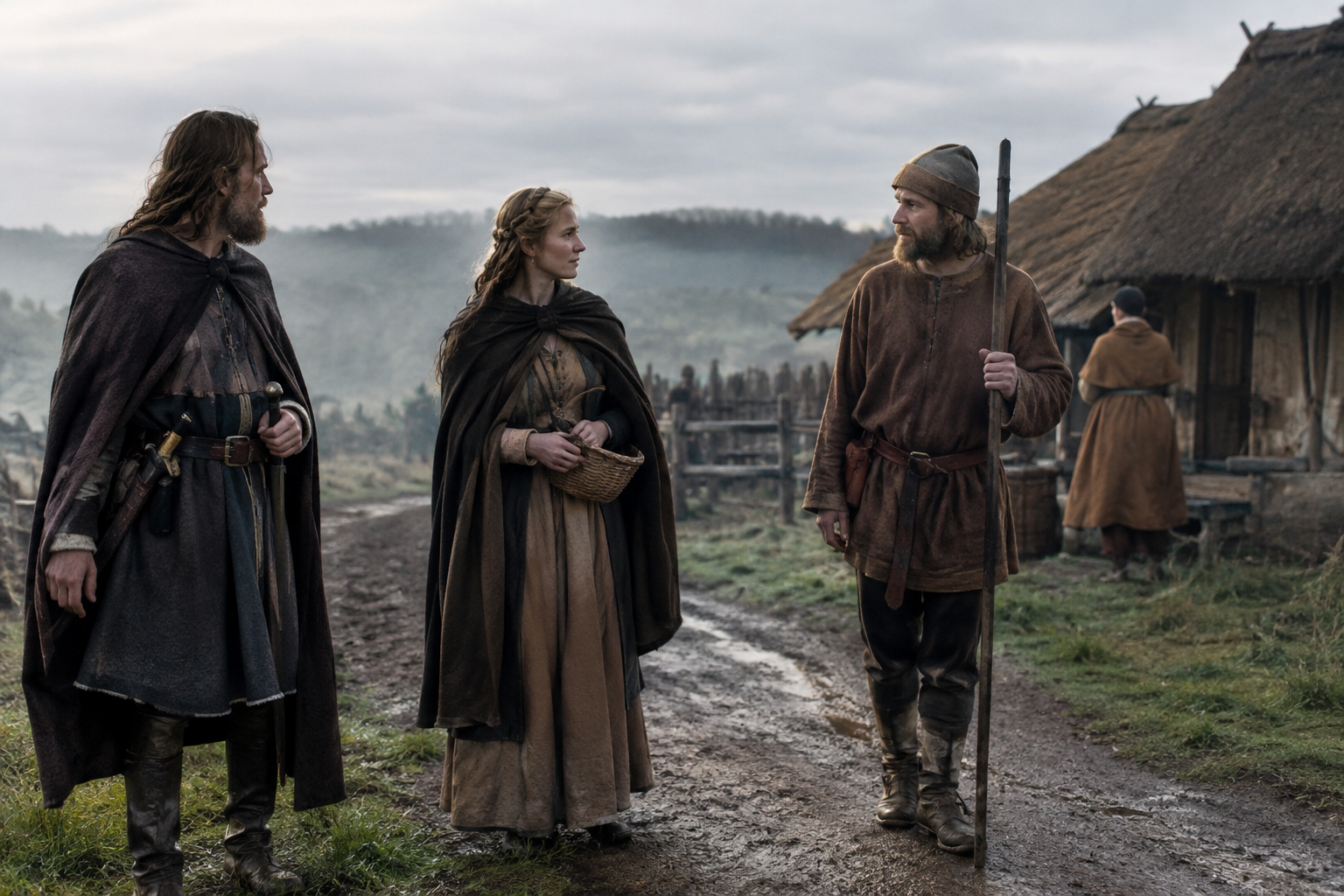
At Buettelborn in Germany, a man buried around AD 600 has become a small but telling witness to the early medieval world. Identified as Btb194 and described as a Merovingian-period Frankish individual, he carries the Y-DNA haplogroup G2a2b2a1a1b1a1a1a2 - a very specific paternal branch that appears here not in a prehistoric farming village, but in the society that grew up after the Western Roman Empire had fractured.
That is what makes this sample interesting. Haplogroup G is often discussed in very broad terms because some of its larger branches are famous in European prehistory, especially among early farmers. But Btb194 reminds us that a precise subclade such as G2a2b2a1a1b1a1a1a2 belongs to a much narrower paternal story. One early medieval Frankish burial does not tell us where the whole branch began, nor does it define Frankish identity. It does, however, place this paternal line squarely inside the mixed and mobile population of Merovingian Europe.
Buettelborn lies in Hesse, a region that in the 6th and 7th centuries sat within the orbit of the Frankish kingdoms. This was a landscape shaped by former Roman frontiers, shifting political loyalties, Christianization, and local continuity. By AD 600, the word "Frankish" did not describe a neatly uniform biological population. It referred to a political and cultural world that had absorbed many kinds of people over generations.
That matters when reading a Y-chromosome result. Y-DNA follows one direct paternal line only: father to son across time. It can preserve a long lineage signal, but it does not stand in for a person's whole ancestry, language, or social identity. In the case of Btb194, the value lies precisely in seeing a rare and specific paternal branch embedded in a Frankish context, where older European lineages and newer political identities had already become entangled.
A useful wider backdrop comes from research on ancient genomes from this historical setting, which has helped show just how varied post-Roman communities could be. Early medieval cemeteries in western and central Europe repeatedly reveal that labels such as Frank, Goth, Roman, or Alemannic were never simple genetic boxes.
Germanic languages and ancient genomics
There is a temptation, when seeing a G haplogroup in Europe, to jump straight back to the Neolithic and stop there. That would be too crude. The broad haplogroup G did indeed have an important place in the spread of early farming into Europe, but a highly downstream branch like G2a2b2a1a1b1a1a1a2 cannot simply be treated as a direct shorthand for "first farmers" without further evidence.
What Btb194 shows instead is survival and transmission. Paternal lines can persist through enormous cultural change: through the Bronze Age, Iron Age, Roman rule, and the migration-period transformations that produced the Merovingian kingdoms. By the time this man was buried, whatever deep prehistory lay behind his paternal line had been folded into a very different social world - one of Frankish law, local burial grounds, rural communities, and expanding Christian influence.
That is one of the pleasures of ancient DNA when used carefully. It does not flatten history into a single migration story. It shows that old lineages can turn up in new political worlds, and that the people who carried them were not relics from the past but participants in the making of early medieval Europe.
The Merovingian period is often narrated through kings, saints, and chronicles, but cemeteries tell a subtler story. Burial communities across regions under Frankish control could include people with quite different ancestry profiles and family histories. Some lineages may reflect deep local roots in the former Roman provinces or neighboring regions; others may connect to movements during late antiquity; many individuals were likely products of admixture over several generations.
Btb194 fits neatly into that broader picture of diversity without needing to be made more exotic than the evidence allows. We are not obliged to turn him into a migrant hero, a tribal emblem, or the founder of a dynasty. The real point is simpler and better: early medieval Frankish populations were built from multiple paternal strands, and G2a2b2a1a1b1a1a1a2 was one of them.
Roman-Barbarian blending on the frontier
This also helps correct an old habit in popular history, where "Germanic" is imagined as though it described a single bloodline marching intact across the map. Ancient genomics has been steadily dismantling that picture. Communities that used related material culture, lived under similar rulers, or spoke related languages were often biologically varied. The Frankish realm was a kingdom, not a clone army.
The setting of Buettelborn is especially suggestive because western Germany in this period stood at the junction of several long histories. Roman administration had once shaped much of the Rhine world. After imperial authority receded, local populations did not vanish. New rulers emerged, older settlements continued, and the social map was redrawn in ways that archaeology and genetics are only now allowing us to trace more clearly.
Seen in that context, Btb194's haplogroup is less a badge of a single event than a marker of long continuity through change. A paternal line could move, persist locally, or spread by ordinary family history rather than by any one dramatic conquest. That is often how real history works: not as a clean replacement, but as accumulation, intermarriage, and adaptation over centuries.
For readers interested in how post-Roman populations around western Europe could be both locally rooted and surprisingly mixed, there is a useful comparison in MyTrueAncestry's discussion of 7th-century Madrid burials with diverse origins. The comparison is not that Buettelborn and Madrid were the same, but that early medieval communities repeatedly resist tidy ethnic categories.
If your own paternal line falls under G2a2b2a1a1b1a1a1a2, the Buettelborn sample offers something valuable, even if modest: a securely ancient point showing this branch in Merovingian-period Germany around AD 600. That does not prove that every modern carrier descends from Frankish elites, from one German site, or from one medieval family. But it does show that this paternal branch was part of the human landscape of early medieval central Europe.
In other words, the significance of G2a2b2a1a1b1a1a1a2 is not that it unlocks a single grand label. Its interest lies in endurance. This is a paternal line that had already traveled through many earlier chapters of European history before appearing in the grave of Btb194, a Frankish-era man in Buettelborn. Ancient DNA lets us glimpse that persistence - one burial, one lineage, and one careful reminder that the early Middle Ages were made by populations far more varied than old stereotypes allowed.
Comments