Haplogroup G2a2b2a1a1b1a1a1a1b4b1

– 5 min read


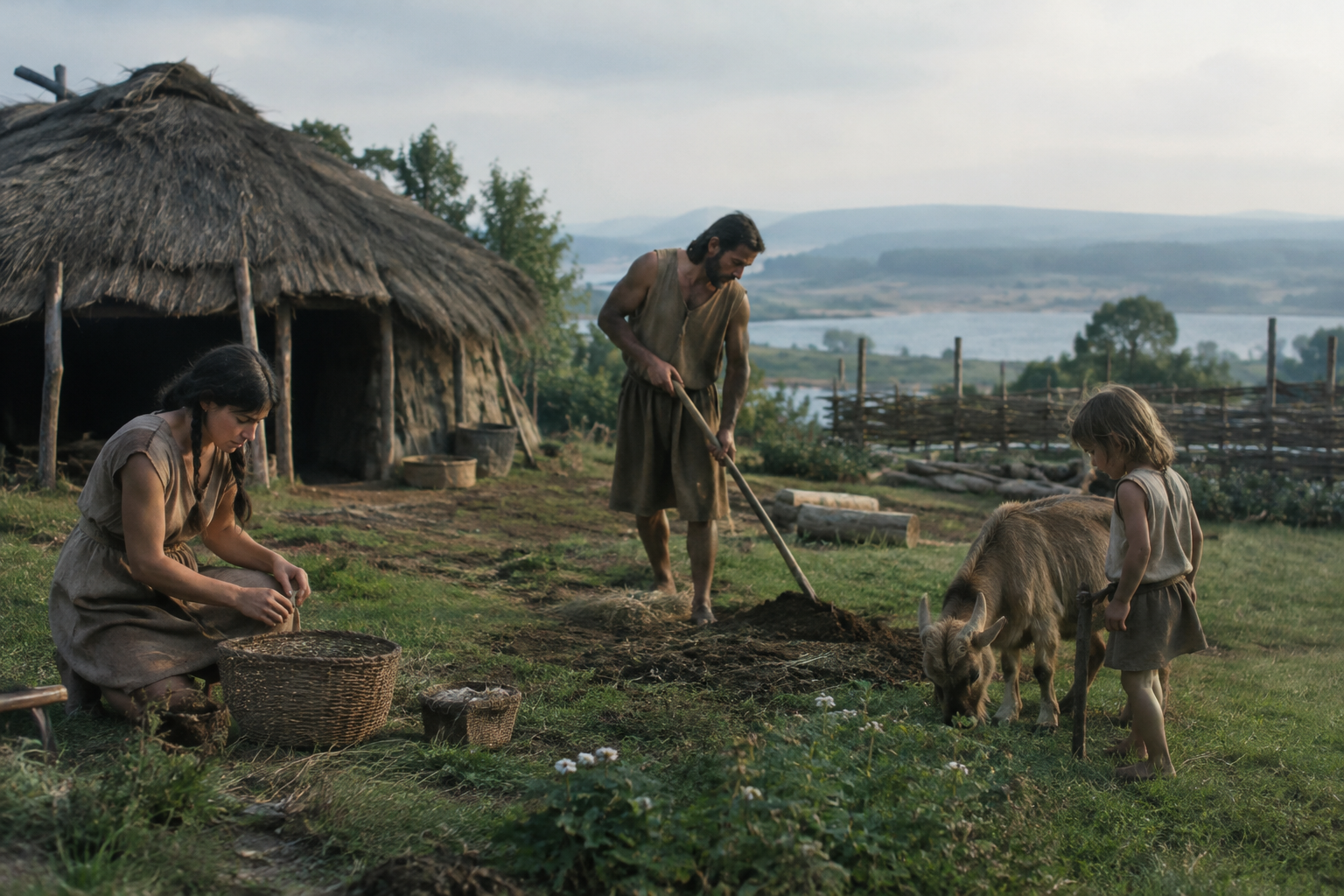
At Franzhausen in Lower Austria, one excavated man from around 1900 BC carries a particularly fine-grained paternal label in modern reporting: Y-DNA haplogroup G2a2b2a1a1b1a1a1a1b4b1. He is recorded as sample FZH002, an individual from Bronze Age Austria. That is already intriguing, because Franzhausen is not a remote curiosity on the edge of prehistory. It sits in one of the best-studied Early Bronze Age landscapes of central Europe, where cemeteries, settlement zones, and river corridors let us watch communities taking shape in unusual detail.
The first thing to say, and it matters, is that a Y-DNA result tracks one direct paternal line only. It does not sum up the whole ancestry, language, or identity of FZH002. But even a single paternal line can be historically revealing when it appears in the right archaeological setting. In this case, the interest lies in seeing a branch of haplogroup G, better known for deep roots in early farming populations of Europe, still present in an Early Bronze Age man living in the Danube region long after the first Neolithic expansion.
Franzhausen belongs to a dense archaeological zone in Lower Austria, a region that became a crossroads in later prehistory. By 1900 BC, this was a world of established farming communities, burial grounds used over time, and contact routes linking the eastern Alps, the Danube basin, and the plains beyond. FZH002 therefore belongs to a society that was local, settled, and connected all at once.
That combination is important for interpreting a lineage like G2a2b2a1a1b1a1a1a1b4b1. Haplogroup G is strongly associated, in broad ancient-DNA terms, with the spread of early agricultural populations into Europe during the Neolithic. Yet Bronze Age central Europe is often discussed through the lens of later population shifts, especially those connected with steppe-derived ancestry and changing male lineages. A Bronze Age Austrian carrying such a deep G branch is a reminder that those shifts were never simple replacements. Older paternal lines could persist within communities that were otherwise fully part of Bronze Age central European society.
The exact string G2a2b2a1a1b1a1a1a1b4b1 is a very narrow subclade, far more specific than the broad label "G2a." That matters because broad G2a has a long and varied history across prehistoric Europe, from early farmers in the Balkans and central Europe to later scattered survivals in many regions. It would be careless to project the whole history of G2a onto this exact Bronze Age branch without direct evidence for each step.
What we can say more safely is that FZH002 shows the persistence of a paternal line within that wider G2a family in Early Bronze Age Austria. In public discussions of ancient DNA, there is sometimes a temptation to imagine that each period has one signature lineage and everyone else somehow vanishes. Real populations are much messier than that. They contain continuity, local survival, and occasional lineages that outlast major cultural change.
That is one reason Bronze Age cemeteries are so valuable. They let us see individuals, not just averages. A large-scale ancestry profile may tell us about population trends; a Y-line such as this one tells us that one particular paternal descent line was still present in a burial community nearly three millennia after the first farmers entered much of Europe.
The wider historical significance of FZH002 lies in timing. By 1900 BC, central Europe had already undergone enormous transformation. The Neolithic farming world was long established, copper and bronze technologies had altered economies and status systems, and population histories had become layered through repeated movement and mixture. An older farmer-linked paternal heritage surviving into this setting is therefore not an anachronism, but evidence of how thoroughly mixed and entangled these societies had become.
This is precisely the sort of point that ancient genomics has sharpened over the last decade. Cultural change does not always mean one neat biological turnover. New burial customs, new exchange systems, and new material styles can spread through populations that still preserve surprisingly old local ancestry threads. In Lower Austria, that appears to have been the case often enough to make the region especially interesting for kinship and mobility research.
Lower Austria kinship networks
Franzhausen fits into that broader picture of continuity alongside connection. Communities in this landscape were not isolated villages frozen in place. They were part of wider exchange networks, but they also carried forward lines of descent that could reach far back into earlier prehistoric populations. FZH002's haplogroup is one small but vivid piece of that longer story.
Ancient DNA becomes most useful when the genetics are kept tethered to place and archaeology. In Austria, Bronze Age graves are particularly revealing because they come from landscapes where burial organization, chronology, and regional comparison are relatively strong. That means an individual like FZH002 can be placed in a meaningful social and historical frame rather than being treated as a floating genetic datapoint.
Research on Early Bronze Age Austrian burials has also become important for another reason: some sites have begun to illuminate the biological pressures that shaped these communities, including disease history. A study connected with Austrian Early Bronze Age graves, including material from the wider regional context, can be found here. Even where a specific paper does not resolve every question about one named individual, it underscores how much more these cemeteries can reveal when archaeology, biomolecular evidence, and chronology are studied together.
This is worth stressing because readers sometimes meet a rare or elaborate haplogroup label and assume the label alone is the history. It is not. The history is the burial ground, the region, the date, the surrounding population, and then, within that setting, the paternal line. FZH002 matters not because of an impressive chain of letters and numbers, but because he lived in a documented Bronze Age community at a moment when central Europe was balancing inherited local traditions with wider transformations.
There is a broader prehistoric question behind this Austrian case. Why do some lineages that seem especially characteristic of early farmers persist in later periods while others become rare or disappear from sampled graves? Part of the answer is simple probability: burial evidence is patchy, and survival in the record is uneven. But part of it is historical. Families endure. Some male lines continue locally through ordinary generations even when the wider population changes around them.
That is why a branch like G2a2b2a1a1b1a1a1a1b4b1 deserves attention. It hints at the longevity of paternal descent in central Europe without demanding a fantasy of unbroken ethnic identity. Bronze Age Austria was not "Neolithic" in culture, but neither had it erased every trace of its earlier human past. FZH002 stands precisely in that middle ground, where deep ancestry and Bronze Age life meet.
For someone researching this haplogroup today, the most responsible conclusion is also the most interesting one. The branch G2a2b2a1a1b1a1a1a1b4b1 is represented here by a real man, FZH002, buried in Bronze Age Austria around 1900 BC. In him, a very narrow paternal lineage appears not at the dawn of farming, but in a mature Bronze Age community shaped by centuries of local development and wider contact. That does not make every modern carrier "Bronze Age Austrian," still less a member of one ancient people. It does show, though, that this paternal line belongs to the long and complicated survival story of central Europe.

Comments