Haplogroup G2a2b2a1a1b1a1

– 5 min read


At Pont de Cornaux-Les-Sauges in Switzerland, archaeologists recovered a Late Iron Age individual dated to around 200 BC, identified here as sample 3436. On its own, that would be one more grave in one more cemetery. But when a paternal line such as G2a2b2a1a1b1a1 turns up there and also appears in other Iron Age and early medieval contexts stretching from Celtic central Europe to Iberia, it becomes a neat little historical problem: not the story of one tribe or one kingdom, but of a male line moving through very different worlds.
That is the useful thing about Y-DNA. It follows one direct paternal line only, not a person's whole ancestry, language, or identity. Even so, the appearances of G2a2b2a1a1b1a1 in these ancient individuals suggest a lineage present among Iron Age Celtic communities north of the Alps and still visible centuries later in post-Roman Spain.
The Swiss sample 3436 comes from Gallo-Celtic Pont de Cornaux-Les-Sauges, dated around 200 BC. That places him in the later La Tene world, when communities in what is now Switzerland were part of a dense network of settlements, exchange, and local political power. This was not some remote fringe. It was a central zone in Iron Age Europe, tied into the wider Celtic-speaking sphere.
What makes this sample especially useful is that it gives the haplogroup a firm foothold in a well-known archaeological landscape. Research on Late Iron Age mobility and burial practice in Switzerland has shown just how connected these communities could be, and how local cemeteries can preserve evidence of both continuity and movement. For context on that wider setting, see this related piece on Late Iron Age Switzerland.
We should be careful, though, not to load too much onto one burial. Sample 3436 does not prove that G2a2b2a1a1b1a1 was common across all Celtic populations, nor that every bearer of the branch shared the same cultural identity. What it does show is that this paternal line was present within the human fabric of Late Iron Age Switzerland.
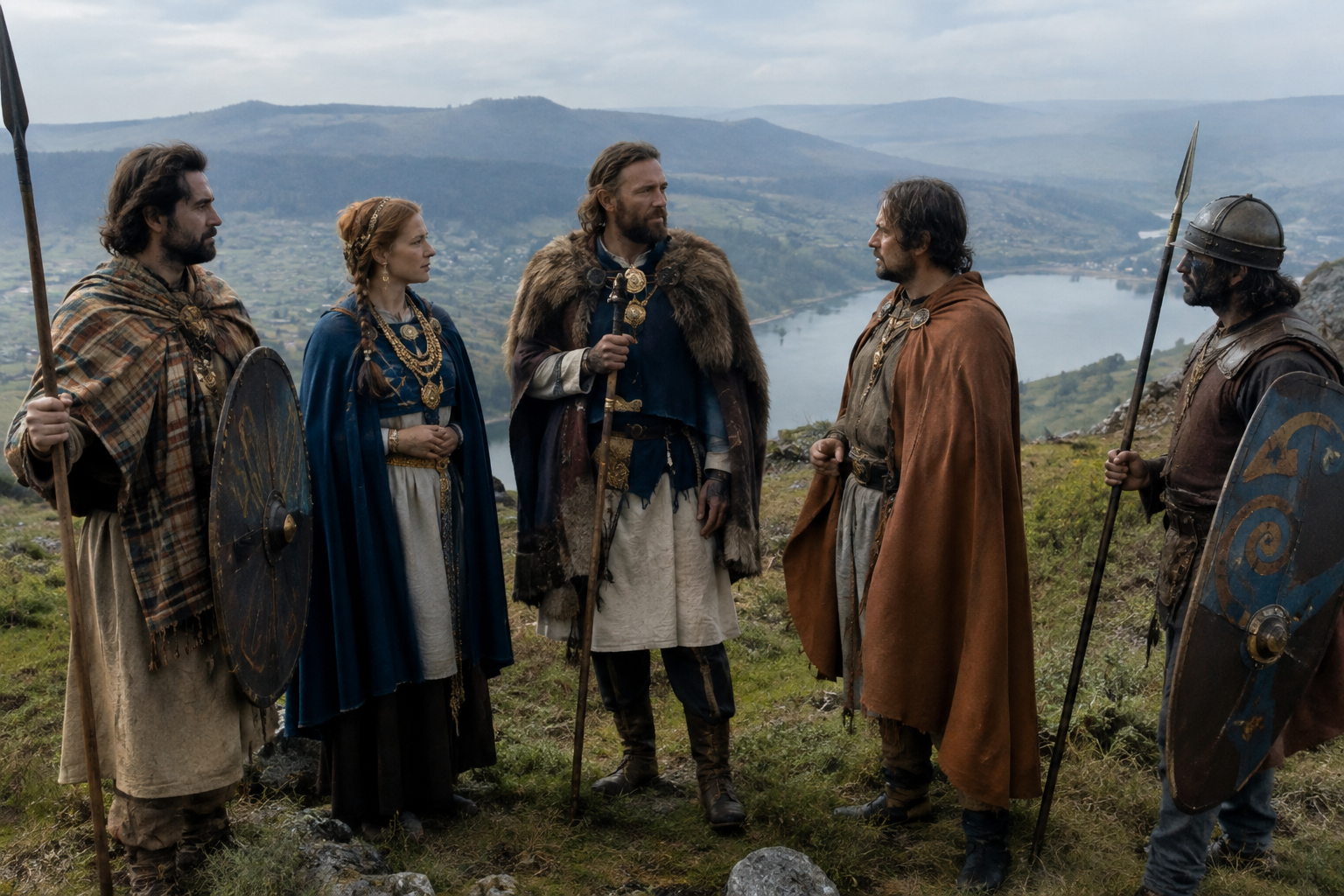
A more socially pointed example is sample HOC004, dated to around 515 BC from Eberdingen-Hochdorf Biegel in Germany and described here as an elite Celtic individual. Hochdorf is one of the famous names of early Celtic archaeology, associated with the Hallstatt-La Tene transition and with high-status burials that have shaped how historians picture early Iron Age elites north of the Alps.
That does not mean the haplogroup itself was an "elite lineage" in any grand dynastic sense. Ancient cemeteries rarely let us make that leap safely. But the presence of G2a2b2a1a1b1a1 in an elite-associated context matters because it places this paternal branch within the circles of rank and display that were emerging in temperate Europe during the first millennium BC.
There is also a broader historical point here. Early and Middle Iron Age central Europe was not genetically uniform, and status did not map neatly onto one biological background. A lineage found in a prominent burial setting may reflect inheritance, marriage networks, or local continuity rather than some exclusive ruling-house origin. Still, HOC004 anchors this haplogroup in a world of fortified centers, prestige exchange, and expanding regional hierarchies.
A related MyTrueAncestry article on Celtic population history is worth reading alongside this evidence, especially for the bigger central European background.
Another Iron Age appearance comes from COL330, dated to around 340 BC at Colmar in France and described as linked to the Gallic Triboci. The interesting bit here is geographical rather than glamorous. Colmar sits in the Upper Rhine zone, a region that later became one of the great contact belts between Celtic groups, Germanic-speaking neighbors, and eventually Roman power.
That matters because it shifts the picture from a single Swiss or south German pocket to a broader corridor. If G2a2b2a1a1b1a1 appears in both Switzerland and the Rhine region in Iron Age contexts, then this paternal line was not confined to one small valley or one isolated family history. It belonged to the kind of interconnected continental Europe where communities traded, moved, fought, and absorbed newcomers long before the Roman frontier hardened these maps.
One should be cautious with tribal labels, of course. Ancient ethnonyms such as Triboci come from historical and archaeological interpretation, not from DNA alone. But as a regional marker, COL330 strengthens the impression that this branch was present in the Celtic-speaking and Celtic-associated societies of the Upper Rhine world.
An ancient DNA study examining Celtic-linked populations in central Europe and beyond has pushed this discussion forward, and one of the most relevant broader research leads associated with these finds is this study on ancient DNA and Celtic population history.
The latest sample in this group is CGG022026 from Los Berrocales in Spain, dated around AD 800 and described as post-Visigoth. By then, the political map had changed almost beyond recognition from the age of Hochdorf or Pont de Cornaux. Rome had come and gone in the west, Visigothic rule had risen and collapsed, and early medieval Iberia was a landscape of new states, old local populations, and layered identities.
This is where Y-DNA becomes especially revealing in a quiet, unfussy way. A paternal branch that appears in Iron Age central European contexts and then again in early medieval Spain does not automatically narrate a single migration route. But it does suggest durability. Male lines can survive enormous cultural upheavals, passing through Romanization, post-Roman transition, and regional reorganization while the surrounding historical labels keep changing.
Los Berrocales is also a reminder that Iberia after Rome was no simple ethnic patchwork of "Romans," "Visigoths," and "locals." Ancient DNA has repeatedly shown more variety than those old textbook boxes allow. For a parallel discussion of that complexity in central Iberia, this related article is particularly apt.
And for the longer background to how Roman and post-Roman population history shaped the peninsula, see also this MyTrueAncestry article on Roman Hispania.
The exact branch named here, G2a2b2a1a1b1a1, is a very narrow place on the Y-chromosome tree. That matters because the larger haplogroup G has a much deeper and wider history than this specific twig of it. One should not casually transfer the whole prehistory of haplogroup G onto this exact branch.
What the present sample set supports, more modestly and more usefully, is a historically situated pattern: this lineage is attested in Iron Age contexts associated with Celtic Europe, especially in the Alpine and Upper Rhine zones, and it remains visible in at least one early medieval Iberian individual centuries later. That is a story of persistence across changing archaeological cultures, not a claim about one timeless people.
For readers interested in the broader western European backdrop, another regional research lead associated with these kinds of questions is this genetic study of ancient populations in western Europe. It helps place individual burials into a much larger conversation about continuity, mixture, and local history.
Taken together, 3436 from Pont de Cornaux-Les-Sauges, HOC004 from Hochdorf, COL330 from Colmar, and CGG022026 from Los Berrocales do not describe a dynasty or a single migration event. They do something more interesting. They show G2a2b2a1a1b1a1 as a paternal line with a documented foothold in Iron Age Celtic Europe and a later presence in early medieval Iberia, surviving the collapse and remaking of entire political worlds.
If this is your haplogroup, the responsible takeaway is not a fantasy of direct descent from one famous chieftain, but a more solid and rather better historical connection: your direct paternal line belongs to a branch that ancient DNA has already placed among real people living in the Celtic societies of central Europe and in the reshaped societies of post-Roman Spain.
Comments