Haplogroup G2a2a1a2a1b

– 5 min read


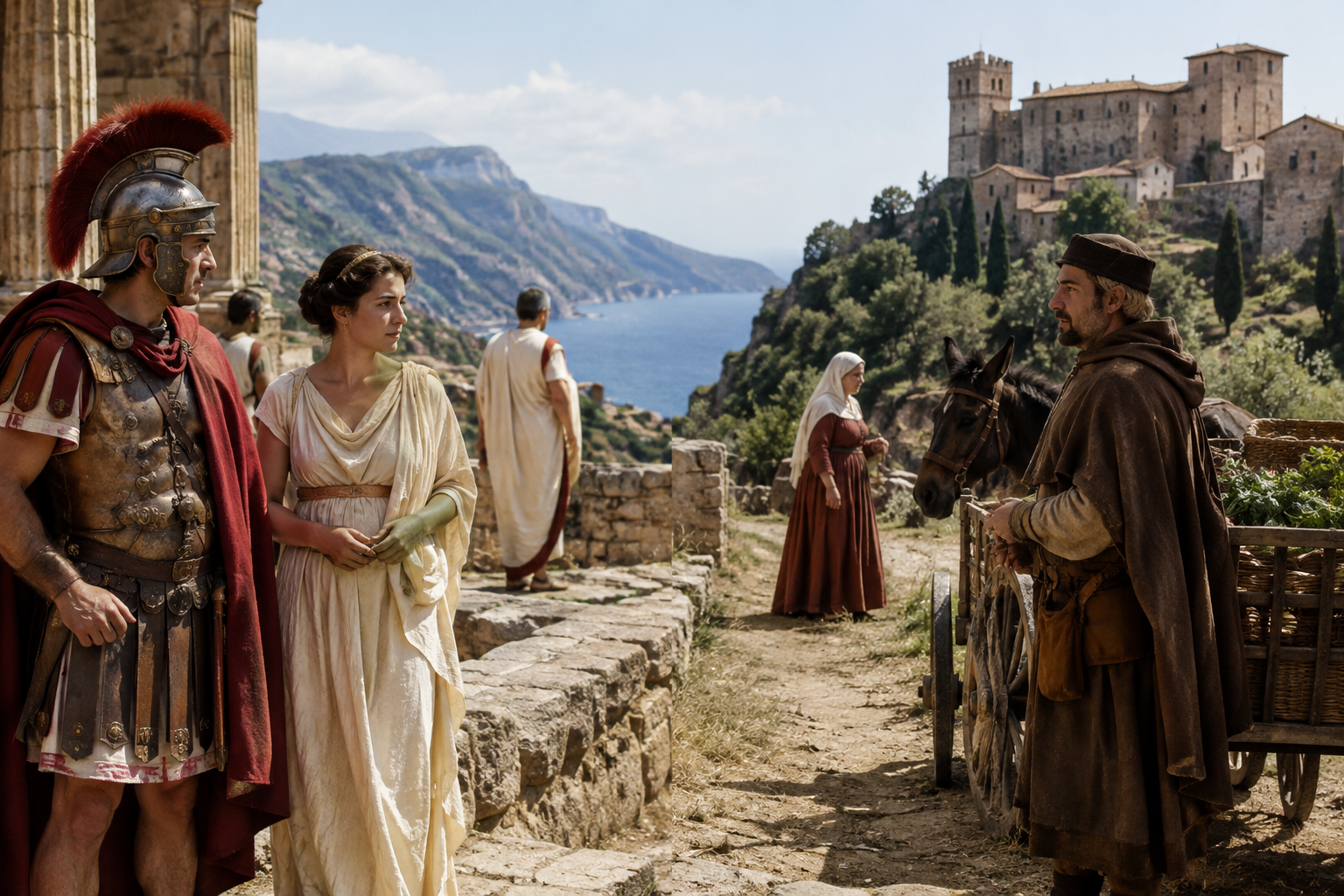
At Villa Magna, southeast of Rome, archaeologists and geneticists have been able to peer into the lives of people who inhabited a great estate long after the Roman Empire had ceased to be Roman in the old imperial sense. One of the men from this site, sample R52, dated to around AD 1355, is associated here with the Y-DNA haplogroup G2a2a1a2a1b. That may sound forbiddingly technical, but the human point is simpler: it marks one direct paternal line turning up in medieval Italy, in a place where power, agriculture, religion, and local continuity all met.
The other anchor point is older and insular rather than inland: AMC014, from Imperial Roman-era Sardinia, around AD 200. Taken together, these two samples do not give us a grand dynasty or a neat migration tale. What they do offer is something more interesting and, frankly, more historical: a glimpse of one paternal branch present in two different Italian settings, one in Roman Sardinia and one in late medieval central Italy, across more than a thousand years.
Y-DNA traces a direct father-to-son line. So when we talk about G2a2a1a2a1b, we are talking about one narrow paternal branch, not the total ancestry, language, status, or identity of the men who carried it. That distinction matters enormously in archaeology, because a Roman provincial, a medieval peasant, a cleric, or an estate worker could all in theory belong to the same paternal line while living in utterly different worlds.
The broader haplogroup G has a very old presence in West Eurasia and is often discussed in connection with early farming populations. But one must be careful here. It would be wrong to treat the full, deep history of haplogroup G as if it automatically explained this much narrower branch, G2a2a1a2a1b, in these specific Italian individuals. The safer conclusion is narrower too: this paternal line was present in Italy in both the Roman and late medieval periods, and it belonged to real people embedded in very different archaeological contexts.
For a wider look at how ancient DNA helps distinguish between lineage, ancestry, and historical interpretation, this overview is useful:
Sample AMC014, dated to about AD 200, comes from Imperial Roman Sardinia. Sardinia is one of those places historians are forever tempted to describe as isolated, and then the evidence rudely reminds us that islands are rarely isolated at all. Under Rome, Sardinia was tied into imperial systems of taxation, grain supply, military movement, and maritime exchange, even while retaining strong local continuities.
That makes AMC014 especially useful. A paternal line associated with G2a2a1a2a1b appearing in Roman Sardinia does not by itself tell us whether this man's paternal ancestors had been on the island for centuries or had arrived more recently through the movements of the imperial world. But it does plant this lineage firmly within the lived population of Roman-period Sardinia.
Recent ancient DNA work on the islands of Italy has helped show just how complicated such populations could be, with continuity in some respects and new inputs in others. One relevant discussion appears in MyTrueAncestry's article on Paleogenomics of Ancient Italian Islands, which gives helpful background for understanding why a Roman-era Sardinian Y-lineage should never be reduced to a single origin story.
There is also a broader scientific backdrop here. Research on ancient Mediterranean and Roman-era populations, including work published in this major ancient DNA study, has made one point very clear: Roman populations were often far more diverse and mobile than older, simpler narratives allowed. Even where one particular sample remains locally rooted in context, the world around that individual was anything but static.
The second sample, R52, comes from Late Medieval Villa Magna in Italy, around AD 1355. Villa Magna is a fine example of historical layering. It began as an imperial estate in the Roman period and remained important, in changing forms, through the centuries that followed. By the late Middle Ages, such places were no longer Roman villas in the classical sense, but they still occupied the old landscapes of cultivation, lordship, and ecclesiastical power.
That is what makes R52 so evocative. Here is a man tied to a direct paternal branch associated with G2a2a1a2a1b, living more than a millennium after AMC014, in a very different Italy. The empire had fractured, kingdoms had come and gone, and the social order had been remade many times. Yet one paternal line, or at least a closely related branch within it, still appears in the peninsula's genetic record.
We should be cautious: AMC014 and R52 are not evidence of an unbroken known family line from Roman Sardinia to medieval Latium. They are far too few for that. But they do show that this branch belonged not only to prehistoric or early farming discussions of haplogroup G, but also to historically documented Mediterranean societies of the Roman and post-Roman worlds.
For readers interested in the wider genetic setting of central Italian communities after Rome, this related article adds valuable context:
There is a tendency, when people see a very specific Y-haplogroup, to want a single dramatic answer: "Where did it come from?" But history is usually less obedient than that. With G2a2a1a2a1b, the supplied evidence is strongest not for one sharp origin event, but for persistence across changing social worlds in Italy.
In one case, the context is an island in the Roman imperial system. In the other, it is a medieval estate landscape shaped by local continuity and centuries of political change. That contrast matters because it reminds us that paternal lineages survive not as abstract markers floating over a map, but through ordinary generations of fathers, sons, households, marriages, work, and burial.
Ancient DNA studies of Italian populations increasingly support exactly this sort of textured view. Some lineages continue locally; others appear through mobility; many populations are mixtures of both. A useful MyTrueAncestry companion piece for that larger frame is:
There is also a methodological point worth making. The older preprint research on ancient Rome and surrounding populations, available at this study of ancient genomes from Rome and central Italy, helped popularize the now familiar picture of Italy as a region of long-term demographic change rather than simple replacement. Even without forcing either sample into an overconfident narrative, that framework helps explain why a branch like G2a2a1a2a1b may appear in very different Italian settings over time.
Seen together, AMC014 and R52 make G2a2a1a2a1b look less like an exotic outlier and more like one of the many smaller paternal threads woven into the history of Italy. Sardinia and central Italy were not interchangeable places. The island had its own local population history, while Villa Magna stood in the orbit of mainland political and ecclesiastical structures. Yet both settings show that this branch could be part of settled, historically real communities.
That should interest anyone whose direct paternal ancestry falls into this haplogroup. The lesson is not that your line belonged to one empire, one ethnic group, or one noble house. Rather, the evidence points to a branch at home in the Mediterranean world of documented history, appearing in both Roman-era and medieval contexts within Italy.
What makes G2a2a1a2a1b distinctive in this evidence is not sheer quantity of samples, but chronology. With AMC014 in Roman Sardinia around AD 200 and R52 at Villa Magna around AD 1355, the branch enters the record in two sharply different historical settings and still remains recognizably part of Italy's human story. For someone researching this paternal line today, that is the useful takeaway: not a fantasy pedigree, but a credible connection to the layered populations of Roman and medieval Italy.



Comments