Haplogroup G2a1a1a1
– 5 min read


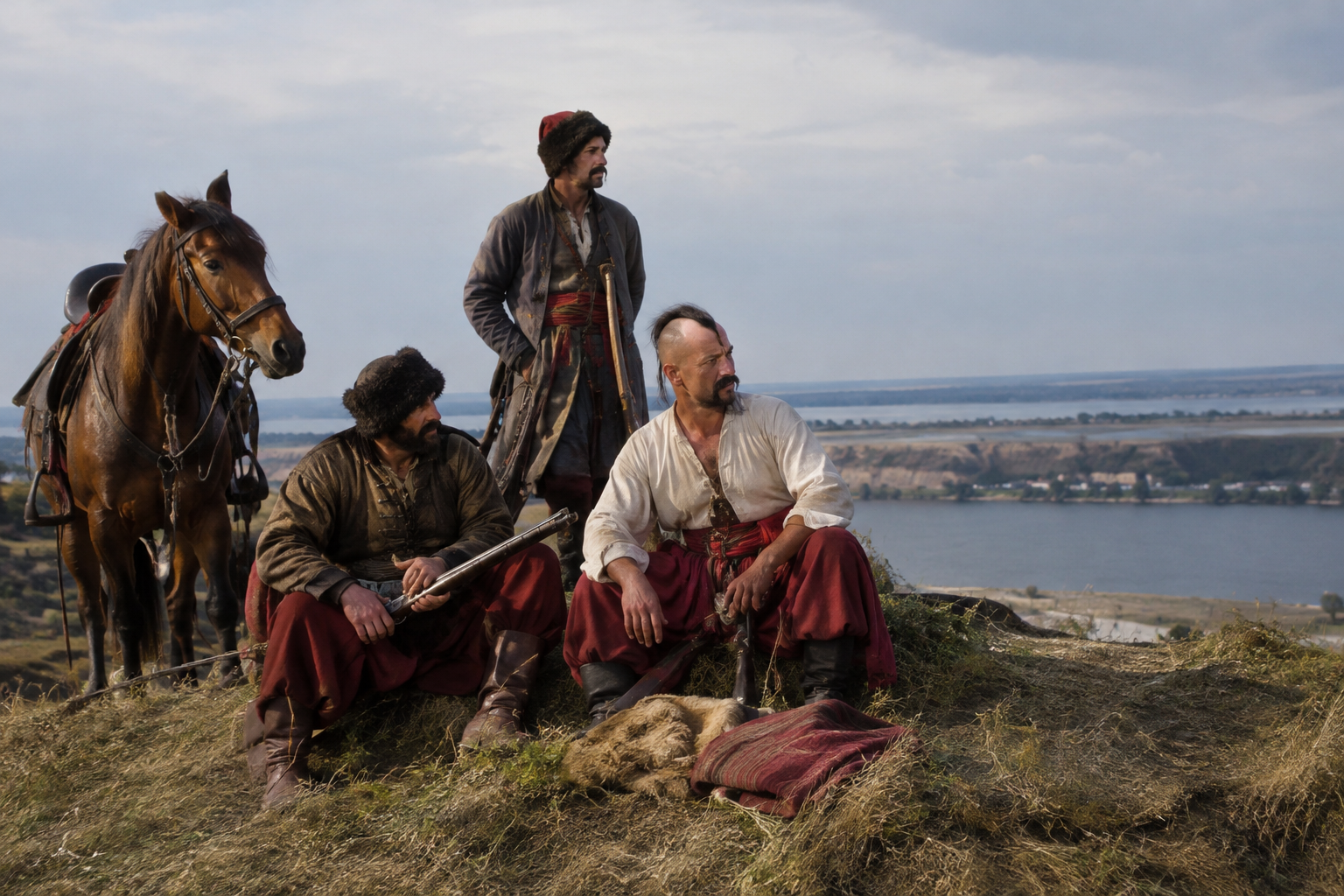
At Mamay-Gora in Zaporizhzhia, one medieval man has given haplogroup G2a1a1a1 a rare and very grounded historical setting. The individual known as UKR024, dated to around AD 1450, comes from the northern Black Sea region: a landscape of river crossings, steppe movement, frontier warfare, and stubborn local continuity. That matters, because G2a is a famous old West Eurasian paternal lineage, but this much narrower branch, G2a1a1a1, is far less often anchored to a clearly identified ancient person.
So the interesting question is not simply where G2a began in some remote prehistory. It is why a man carrying G2a1a1a1 turns up in late medieval southern Ukraine, at a place that sat between worlds. Y-DNA traces one direct paternal line rather than a person's whole ancestry, but that single line can still be historically revealing when it appears in a well-placed burial from a contested region.
Mamay-Gora lies in the lower Dnipro zone, a region that has long been a meeting ground between steppe and settled worlds. By the 15th century, this was no quiet backwater. Political influence in the wider area shifted among the successors of the Mongol world, Lithuanian and Ruthenian powers, Crimean networks, and local frontier communities. A site here can rarely be read in purely local terms.
UKR024 is therefore valuable even in the barest form of the evidence we have: place, date, and Y-lineage. A man buried in this region around AD 1450 belonged to a world shaped by mobility, military pressure, trade routes, and mixed populations. A genetic study focused on movement in Ukraine from the Bronze Age to the early modern period places exactly this sort of find into a longer archaeological frame, showing why the northern Black Sea zone is so important for reading population history through ancient DNA: research on mobility in Ukraine from the Bronze Age to the early modern period.
What makes the sample especially intriguing is that G2a lineages are often associated in popular genetic writing with much earlier farmers and early West Eurasian expansions. Yet here the branch appears not in an early Neolithic village but in a late medieval burial in southern Ukraine. That is a useful corrective. Haplogroups do not stay neatly attached to one era, one language, or one culture. They persist, split, travel, and become part of new societies.
The wider haplogroup G is an old branch of Y-chromosome diversity in West Eurasia, and branches of G2a are well known in ancient DNA from early farming contexts in Europe and areas further east and south. But the article haplogroup here is not the whole of G2a. It is the more specific branch G2a1a1a1, and that distinction matters.
With only one ancient sample supplied here, it would be wrong to build a grand migration story for this exact subclade. We cannot say that UKR024 founded a local dynasty, represented a whole ethnic group, or stood for the entire medieval population of Zaporizhzhia. What we can say is simpler and more useful: by around AD 1450, this paternal branch was present in the lower Dnipro region, inside a historically mixed frontier zone.
That alone makes G2a1a1a1 historically interesting. Some paternal lines are easiest to glimpse in stable core regions; others appear in places where populations collided and recombined. Southern Ukraine is one of those places where archaeology repeatedly shows movement without erasing local continuity.
The northern Black Sea region has a habit of frustrating tidy historical labels. Over many centuries it saw Scythian, Sarmatian, Greek colonial, Gothic, Hunnic, Turkic, Slavic, and Mongol-period presences, among others. None of those labels is equivalent to a haplogroup, but all help explain why a lineage like G2a1a1a1 might survive in such a setting.
In other words, UKR024 is best read against a background of layered populations rather than a single migration event. The lower Dnipro was a corridor. People moved through it, settled in it, fought over it, and married across its boundaries. A paternal line that may once have deeper roots elsewhere in West Eurasia could perfectly well reappear centuries later in a medieval man from Ukraine without any contradiction at all.
This is precisely why Black Sea archaeology is so rewarding. It forces us to stop imagining ancestry as a set of sealed boxes. Ancient DNA from this region more often shows entanglement: steppe ancestry mixing with local ancestry, frontier cemeteries containing varied backgrounds, and communities shaped by long-distance connections as much as by local tradition.
By the 15th century, the lands around Zaporizhzhia were part of a broad contact zone extending toward Crimea, the Pontic steppe, and the forest-steppe to the north. This was the era just before the Cossack world became so prominent in written history, but the region already had the ingredients of frontier society: mobility, armed communities, shifting loyalties, and repeated resettlement.
That makes a sample like UKR024 useful far beyond the narrow matter of haplogroup labeling. He reminds us that medieval Ukraine was not composed of one frozen ancestral bloc. The paternal landscape, like the political one, could include lineages with deep and varied pasts. A branch such as G2a1a1a1 may have arrived in the region generations or even millennia before this burial, or it may reflect more recent movement within the larger Pontic world. The present evidence does not let us choose between those scenarios with confidence.
Still, the location itself sharpens the interpretation. A burial from Mamay-Gora is not coming from an isolated mountain hamlet or an undisturbed island population. It belongs to a transit region. That makes the presence of G2a1a1a1 less surprising in one sense, but more historically meaningful in another: it shows this branch participating in the human churn of the north Pontic frontier.
There is a temptation, when a rare subclade appears, to turn it into a banner for an entire people. Archaeology is usually less obliging than that. One reason UKR024 is valuable is precisely that he is modest evidence: a single ancient man, from a known region, in a known broad period, carrying a specific paternal branch. That is not enough for myth-making, but it is enough for history.
For members of the MyTrueAncestry community who belong to G2a1a1a1, this sample offers a concrete medieval waypoint in the north Pontic world. It suggests that this paternal line was part of the population mosaic of southern Ukraine by the late Middle Ages, in a region where identities were local, imperial, steppe, and mercantile all at once.
The strongest insight from G2a1a1a1, at least from the evidence here, is not a sweeping origin story but a sharply placed historical presence. UKR024 from Mamay-Gora shows this paternal branch in late medieval Zaporizhzhia, inside one of Eurasia's great contact zones. For anyone researching this haplogroup today, that is a valuable clue: your direct paternal line belongs to a lineage that could endure through deep time and still surface in the complicated, mobile society of the Black Sea frontier.


Comments