Haplogroup E1b1b1b2a1a1a2

– 5 min read


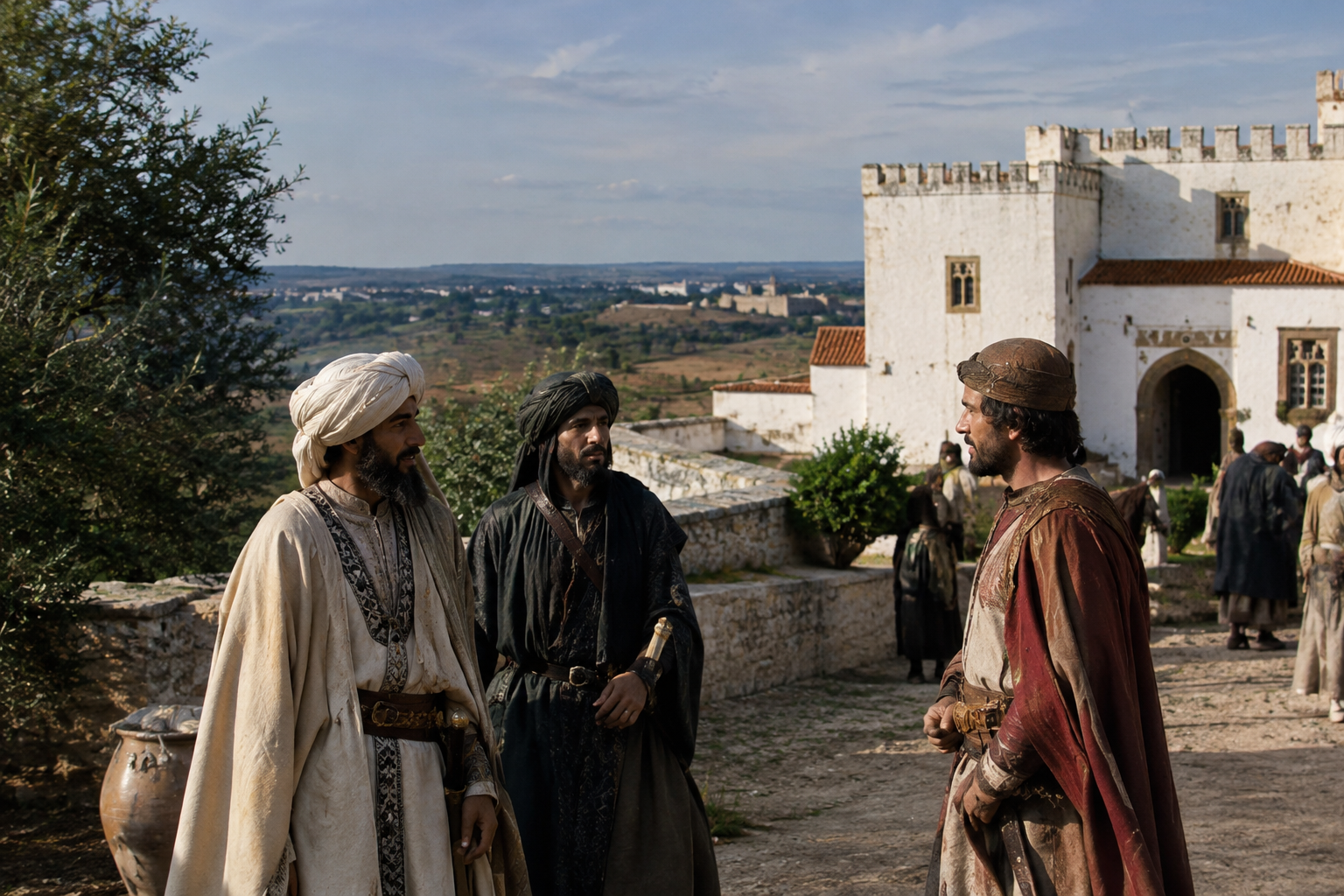
At Loulé in the Algarve, at the site of Quinta da Boavista, one medieval man has become unexpectedly important for the history of a Y-chromosome lineage. The individual identified as LP115_6, dated to around AD 1250 and associated with the Umayyad Caliphate horizon in medieval Portugal, is linked here to the paternal haplogroup E1b1b1b2a1a1a2. That is a very long genetic label, admittedly, but the setting is wonderfully concrete: not an abstract map of migrations, but a real person from an Islamic-period community in southern Iberia.
The value of a find like this is that it puts a narrow paternal branch into a recognizable historical landscape. Y-DNA follows one direct male line only; it does not define a person's whole ancestry, language, faith, or identity. Even so, when a lineage appears in an excavated medieval context like Loulé, it helps anchor family history in the lived world of the western Islamic Mediterranean.
By the 13th century, the Algarve stood at the meeting point of several histories at once. It was part of a region shaped by centuries of Roman rule, post-Roman change, Islamic conquest, settlement, trade, and then the advancing Christian reconquest. A man buried at Loulé in this period belonged to a society that was neither isolated nor simple. Southern Portugal was connected by sea and land to al-Andalus, North Africa, and the wider Mediterranean.
That is what makes LP115_6 so useful. The haplogroup assignment does not by itself tell us whether his paternal ancestors had deep roots in Iberia, arrived through North African-linked movement, or came from some other strand within the Islamic world. But the archaeological and historical setting makes one thing clear: this was a population formed in a zone of repeated contact, where lineages from different regions could meet and persist.
The branch name E1b1b1b2a1a1a2 sits deep within the wider haplogroup E1b1b family, a major paternal lineage with a long and complicated history across parts of Africa, the Mediterranean, and southwest Eurasia. The crucial point is not to flatten that complexity. A broad parent haplogroup may have a very wide distribution, while a much narrower sub-branch can tell a more local or more recent story. One should not casually assign the whole history of E1b1b to this exact terminal label.
In practice, lineages of this broader family often turn up in discussions of Mediterranean mobility because the sea connected rather than separated people. Ports, garrison towns, farming districts, and frontier settlements all drew in newcomers. Medieval Iberia, especially the south, is precisely the sort of place where a paternal line might survive through generations of conquest and coexistence without matching any tidy ethnic narrative.
That is why this Loulé individual matters more than a bare haplogroup frequency table. He gives the branch a documented medieval context in Portugal. The story is not that one sample "proves" a single origin, but that it shows this paternal line present within the social world of Islamic Algarve.
The Algarve is often imagined as peripheral, tucked away at Europe's southwest edge. Historically, it was anything but peripheral. Under Islamic rule it was part of a maritime system stretching across the western Mediterranean and into the Atlantic approaches. Goods, ideas, and people moved through it. So did armies, administrators, farmers, religious communities, and enslaved persons. Any of them could contribute to the paternal landscape later seen in medieval burials.
For that reason, the significance of E1b1b1b2a1a1a2 at Loulé lies in context more than spectacle. The lineage appears not in a legendary prince or a famous chronicler, but in an ordinary excavated individual from a period of political transition. That ordinariness is exactly what makes ancient DNA so powerful. It lets us study the population beneath the grand narratives.
A recent ancient DNA study on medieval Portugal and the Muslim-Christian transition in the Algarve has helped frame this world more securely, linking burials and genomes to the region's changing political order without reducing them to a single ancestry label: research published on these medieval Portuguese remains.
One of the most important corrections made by archaeology and genetics alike is that "Muslim Iberia" was not a single biological population. The political history of al-Andalus included Arab-led conquest, strong Amazigh or Berber participation, local Iberian converts, enslaved and freed communities, and links to Jewish and Christian populations living within or alongside Islamic states. Over centuries, that produces not a neat ethnic block but a layered human landscape.
So when a lineage such as E1b1b1b2a1a1a2 appears in medieval Portugal, it should be read against that diversity. It may fit broadly with patterns often associated with North African and Mediterranean connections, but the archaeological honesty here is to stop short of more than the evidence allows. LP115_6 was a man in 13th-century Loulé, not a shorthand for an entire people.
This wider point is strengthened by other recent work on medieval Iberia, including studies showing varied ancestry profiles in early medieval and Islamic-period settings rather than a single uniform template. That broader regional picture is worth keeping in mind when interpreting any one paternal line.
There is also a longer Iberian background to remember. Southern Portugal did not begin history with the Islamic conquest. Roman Hispania had already tied Iberia into imperial networks of soldiers, merchants, administrators, and migrants from around the Mediterranean. Late antique and early medieval centuries then added Visigothic rule, local continuity, and fresh connections across the Strait of Gibraltar.
That means a medieval paternal lineage found in the Algarve may stand at the far end of several overlapping processes rather than one dramatic migration event. Some male lines could have been present in Iberia long before the 8th century; others may have arrived later under Islamic rule; still others may reflect continuing movement back and forth across the western Mediterranean. Ancient DNA is beginning to sort out those possibilities, but sample by sample, site by site.
The sensible historical reading of E1b1b1b2a1a1a2, then, is not a slogan about origins. It is a reminder that Portugal's medieval south was formed through accumulation: Roman layers, post-Roman survival, Islamic-era settlement, and frontier change.
If your Y-DNA falls within E1b1b1b2a1a1a2, the most responsible takeaway is not that you descend from one named medieval man at Loulé, but that your direct paternal line belongs to a branch with at least one documented presence in the Islamic-period Algarve. That is already historically meaningful. It places your line within the same broad human world that linked Iberia, North Africa, and the Mediterranean in the Middle Ages.
LP115_6 shows how ancient DNA can turn a technical label into a historical setting. In this case, the setting is 13th-century southern Portugal: a frontier region, a crossroads, and a place where paternal lineages such as E1b1b1b2a1a1a2 were part of the real population on the ground.

Comments