Haplogroup E1b1b1b2a1a1a1a1b2b1a1b

– 5 min read


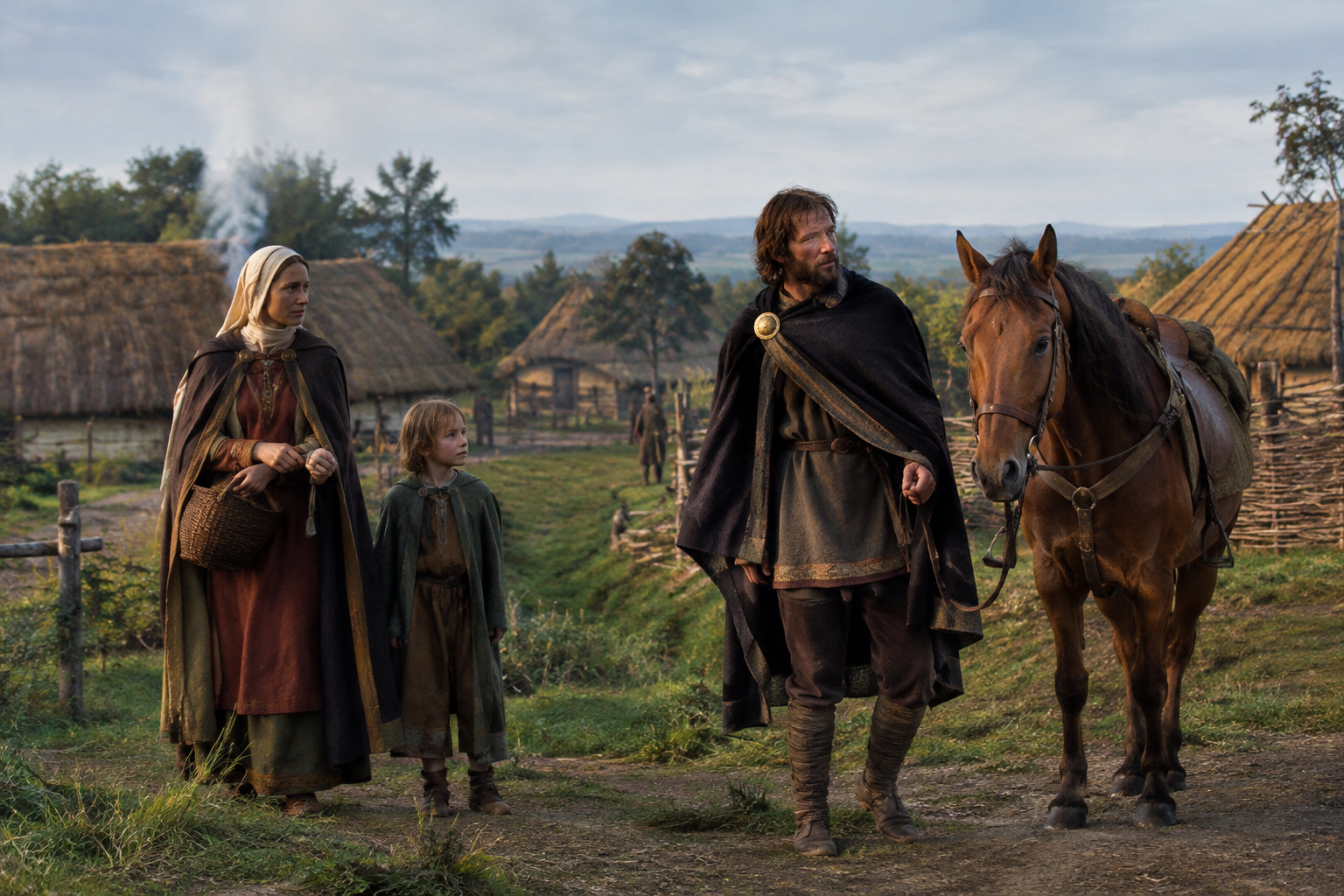
In around AD 600, a man buried in Buettelborn in what is now Germany entered the archaeological record under the identifier Btb164. He belonged to the Merovingian-period Frankish world, a society formed in the centuries after Roman imperial rule in the west, when old provincial landscapes, new political loyalties, and mobile communities overlapped in complicated ways. For anyone carrying the very specific Y-DNA branch E1b1b1b2a1a1a1a1b2b1a1b, this is the concrete ancient clue we have here: a paternal line associated with one early medieval individual in a Frankish setting.
That is already more interesting than it may sound at first. E lineages are often discussed in very broad terms, but this article's branch is far narrower than the parent haplogroup, and ancient DNA works best when we resist turning one burial into a sweeping migration saga. What Btb164 gives us is something better: a fixed point in time and place, showing that a man linked to this paternal branch was living within a Merovingian community in early medieval central Europe.
Buettelborn sits in a part of western-central Germany that, by the sixth and seventh centuries, belonged to the heartland of the Frankish kingdoms. This was not an empty stage onto which "the Franks" simply marched. It was a landscape shaped by the long afterlife of Rome, by regional populations already present, and by generations of movement across the Rhine frontier. A Merovingian burial from this zone belongs to that mixed and historically layered world.
The sample identifier matters because ancient DNA is strongest when it stays close to the excavated person. Btb164 is not "the Franks" in the abstract, still less all men with this haplogroup. He is one individual from one cemetery context, dated around AD 600, whose paternal line has been associated with the branch discussed here. That makes him valuable precisely because he anchors a modern lineage to a real early medieval community rather than to legend, heraldry, or retrospective ethnic labels.
A recent ancient DNA study on populations in this period helps frame why such finds matter, showing how genetically varied communities could be within the post-Roman and early medieval world of Europe: research published on these ancient populations. Even without forcing Btb164 into a dramatic origin story, the wider lesson is clear enough. Frankish-period cemeteries can preserve paternal lines whose deeper histories may reach far beyond the political label attached to the burial.
Germanic languages and genomics
Y-DNA follows one line only: father to son across the generations. That makes it unusually powerful for studying paternal continuity, but also very narrow. A man buried as a Frank in Merovingian Germany may have had maternal and autosomal ancestry drawn from several different regions, just as his community may have included people with different backgrounds living under the same political umbrella.
This is especially important with E1b1b1b2a1a1a1a1b2b1a1b. The branch name is extremely specific, far more so than simply saying "haplogroup E1b1b1." The broad parent lineage has a large and complicated history across parts of Africa, the Mediterranean, and Europe, but one should not lazily assign that whole history to this exact subclade without direct evidence. In this article, the defensible statement is modest and useful: an early medieval male from Buettelborn, sample Btb164, has been associated with this paternal branch, placing it in a Frankish-era setting in Germany by around AD 600.
That may sound restrained, but in archaeology restraint is not a weakness. It is how real history is built. One securely placed burial can be more informative than ten romantic assumptions.
The Merovingian kingdoms were heirs to a broken Roman west, but also creators of something new. Frankish rule stretched across much of Gaul and into regions east of the Rhine, binding together old Roman towns, rural cemeteries, military traditions, church networks, and local elites. To find an E-line paternal branch in such a context is a reminder that early medieval Europe was not genetically neat or culturally sealed.
That point has grown clearer as ancient DNA has accumulated from post-Roman cemeteries across Europe. Archaeological labels such as Frankish, Gothic, Lombard, or Alemannic often describe a historical and cultural setting, not a single biological population. The men buried in these cemeteries did not all belong to one paternal lineage, and the same broad haplogroup could appear in very different communities.
In other words, Btb164 should not be read as an outsider simply because the branch sits within haplogroup E, nor should he be taken as proof of a single migration event. Early medieval societies repeatedly absorbed soldiers, settlers, dependants, spouses, and descendants of earlier provincial populations. Frankish identity, like most identities in the period, was historical before it was genetic.
Roman-Barbarian frontier mixing
Buettelborn belongs to a region where the Roman frontier had once structured military life, trade, and movement. Even after imperial institutions weakened, people did not stop moving across these landscapes. Some families had deep local roots; others arrived through service, alliance, marriage, or resettlement. By AD 600, a cemetery in this zone might contain descendants of several centuries of such entanglements.
This is why a paternal branch like E1b1b1b2a1a1a1a1b2b1a1b appearing in Merovingian Germany is historically plausible without being simplistic. It fits a world in which lineages could travel long before the burial itself, and in which political belonging did not erase older ancestry. The Frankish kingdoms were not ethnographic museums. They were active, composite societies.
The same broader pattern has appeared elsewhere in early medieval Europe, where burials tied to recognisable historical periods can reveal unexpectedly diverse ancestry profiles. A useful comparison, though in a different region, comes from work on seventh-century Iberia, where ancient DNA has also highlighted mixed origins within communities that older narratives once treated as more uniform.
For a modern tester, the temptation is always to turn a long haplogroup string into a ready-made ethnic badge. Ancient DNA is much more interesting than that, and much less tidy. If your paternal line belongs to E1b1b1b2a1a1a1a1b2b1a1b, the Buettelborn evidence does not mean your direct male line was "Frankish" in any simple sense. It means that one known bearer of this branch was part of a Merovingian-period community in Germany around AD 600.
That is a subtle but important distinction. Y-DNA can place your direct paternal ancestry into a documented historical landscape. It cannot, by itself, reconstruct your whole family tree, your language, or your cultural identity in the early Middle Ages. But when paired with archaeology, it can show where one thin but durable thread of ancestry appears in the record.
And here that thread runs through an early medieval burial ground in the Frankish sphere, at exactly the sort of time when Europe was being remade out of Roman provinces, regional populations, and new ruling powers. If you carry this branch today, your deepest paternal story may include movements and mixtures still only partly visible to us, but Btb164 shows that one chapter of it was written in Merovingian Germany.
The most distinctive thing about this haplogroup, on the evidence here, is not a grand claim of origin but a precise historical foothold. Sample Btb164 shows this paternal line in a Merovingian-period Frankish context in Germany around AD 600, inside a world shaped by post-Roman change and regional diversity. For anyone researching E1b1b1b2a1a1a1a1b2b1a1b, that makes your lineage not merely ancient in the abstract, but archaeologically visible in one of early medieval Europe's most important frontier societies.
Comments