Haplogroup E1b1b1b1a1c

– 4 min read


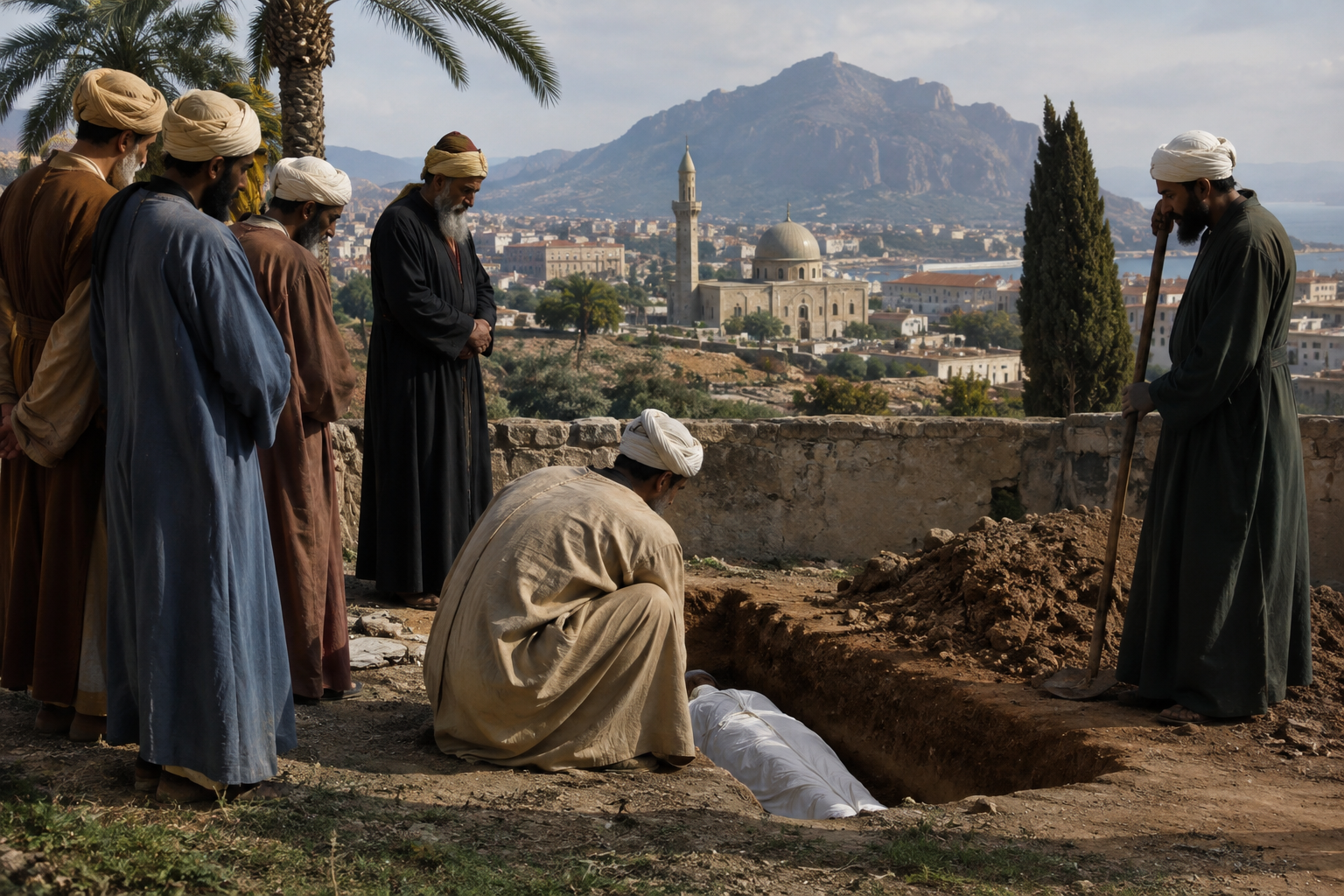
In Palermo, at the site of La Gancia, one medieval burial stands out for what it says about Sicily's place in the wider Mediterranean. The individual identified as GABN5b, dated to around AD 828 and described as an Islamic burial, has been associated here with the Y-DNA haplogroup E1b1b1b1a1c. That may sound like a very narrow technical label, but in historical terms it opens onto a larger question: who was living in Sicily at the beginning of Islamic rule, and how mixed was that society already becoming?
This is exactly the sort of case where genetics is most useful when kept on a short leash. Y-DNA tracks one direct paternal line only, not a person's whole ancestry, language, religion, or identity. Even so, a branch like E1b1b1b1a1c appearing in an early medieval burial from Palermo is a neat reminder that Sicily was never a sealed island. It was a port, a frontier, and often a prize, drawing people from North Africa, the central Mediterranean, southern Europe, and the eastern Mediterranean into the same urban world.
The date attached to GABN5b matters. Around AD 828 places this burial close to the period when Muslim forces from North Africa began the conquest of Sicily. Palermo would soon grow into one of the major cities of the Islamic western Mediterranean. A burial from this setting is therefore more than a single biological datapoint; it belongs to a city in the middle of political upheaval, maritime movement, and social reorganization.
What makes the La Gancia burial especially interesting is not that it gives us a simple label for "who the Sicilians were". It does almost the opposite. Early Islamic Sicily was a meeting ground. Some people buried in its cemeteries may have had local roots stretching back through Byzantine or late Roman populations; others may have come more recently from across the sea; many probably belonged to families already shaped by centuries of mobility around the Mediterranean basin.
A recent ancient DNA project connected with medieval Sicilian material has helped underline that wider picture of diversity rather than neat separation, and the underlying research archive can be found here: https://www.ebi.ac.uk/ena/browser/view/PRJNA1400023. On its own, that does not tell us every life story behind every grave. What it does support is the basic archaeological point that medieval Sicily is an excellent place to see how genetics, burial practice, and history intersect.
The haplogroup name in this article, E1b1b1b1a1c, belongs within the broader E1b1b paternal family, a major lineage with a long history in parts of Africa, the Mediterranean, and southwest Eurasia. But one has to be careful here. The history of the larger E1b1b umbrella cannot simply be pasted onto a much narrower downstream branch as if nothing changed along the way.
So the sensible reading is modest but still meaningful. If GABN5b is associated with E1b1b1b1a1c, that places one paternal line in early medieval Palermo within a branch that fits perfectly well in a Mediterranean context shaped by movement between North Africa and southern Europe. It does not prove that this individual had newly arrived from any one region, nor that everyone buried nearby shared the same paternal background.
This distinction matters because medieval Sicily is often flattened into a succession of rulers: Byzantine, Muslim, Norman. Real populations are never so tidy. Haplogroups help us see continuity, mixture, and coexistence beneath political labels that can otherwise dominate the story.
The description of GABN5b as an Islamic burial is itself historically important. Burial practice can mark religious affiliation, community norms, or the adoption of new customs. In a place like Palermo, that tells us we are looking not just at biological ancestry but at life within a changing social order, where belief, law, language, and urban life were being reshaped.
One should resist the temptation to assume a simple one-to-one link between burial rite and geographic origin. An Islamic burial in Sicily does not automatically mean a first-generation immigrant from North Africa, just as a Christian burial would not automatically mean an unmixed local Byzantine. Still, the combination of burial context, date, and paternal lineage makes this individual a useful witness to the making of Islamic Sicily.
The value of such burials is cumulative. A single grave is interesting; a cemetery begins to show patterns; multiple cemeteries across different faith communities start to reveal how a medieval city was really composed. That is why Palermo matters so much in archaeogenetics. It allows us to move beyond dynasties and chronicles and ask who was actually present on the ground.
Geography is the quiet force behind this whole story. Sicily sits in the central Mediterranean, close enough to North Africa to be tied into its political and commercial worlds, yet also deeply connected to southern Italy and the wider European mainland. Long before the ninth century, Phoenician, Greek, Roman, Vandal, Byzantine, and other networks had already left their mark on the island.
That is why a paternal lineage like E1b1b1b1a1c is so plausible in this setting without needing melodrama. The island had been receiving, absorbing, and reshaping people for many centuries. Under Islamic rule those links intensified in new ways, especially with Ifriqiya and the western Islamic world, but they did not begin from nothing.
Archaeology and genetics increasingly agree on this broader point: Sicily's population history is not a tale of replacement by one neatly bounded people after another. It is better understood as a long sequence of overlaps. Ports, markets, military garrisons, estates, and city neighborhoods all created opportunities for marriages, conversions, migrations, and the passing on of paternal lines across cultural boundaries.
For someone who carries E1b1b1b1a1c today, GABN5b is not a guaranteed ancestor and not a family tree shortcut. Ancient DNA does not work like that. But it does provide something more historically grounded: evidence that this paternal branch was present in a real medieval community at a real turning point in Sicilian history.
That can be especially valuable for lineages connected to the Mediterranean, where written genealogies often run out quickly while population history remains extremely layered. A sample like GABN5b anchors the haplogroup in a society shaped by conquest, trade, religion, and daily coexistence. It gives the branch a human setting rather than a mere label on a phylogenetic tree.
And perhaps that is the most interesting thing here. E1b1b1b1a1c appears in the record not in some abstract origin story, but in Palermo, at the start of Islamic Sicily: a city where categories were constantly being negotiated, and where a paternal line could belong at once to local history and to a much wider Mediterranean world.

Comments