Haplogroup E1b1b1a1b1a6a1f
– 5 min read


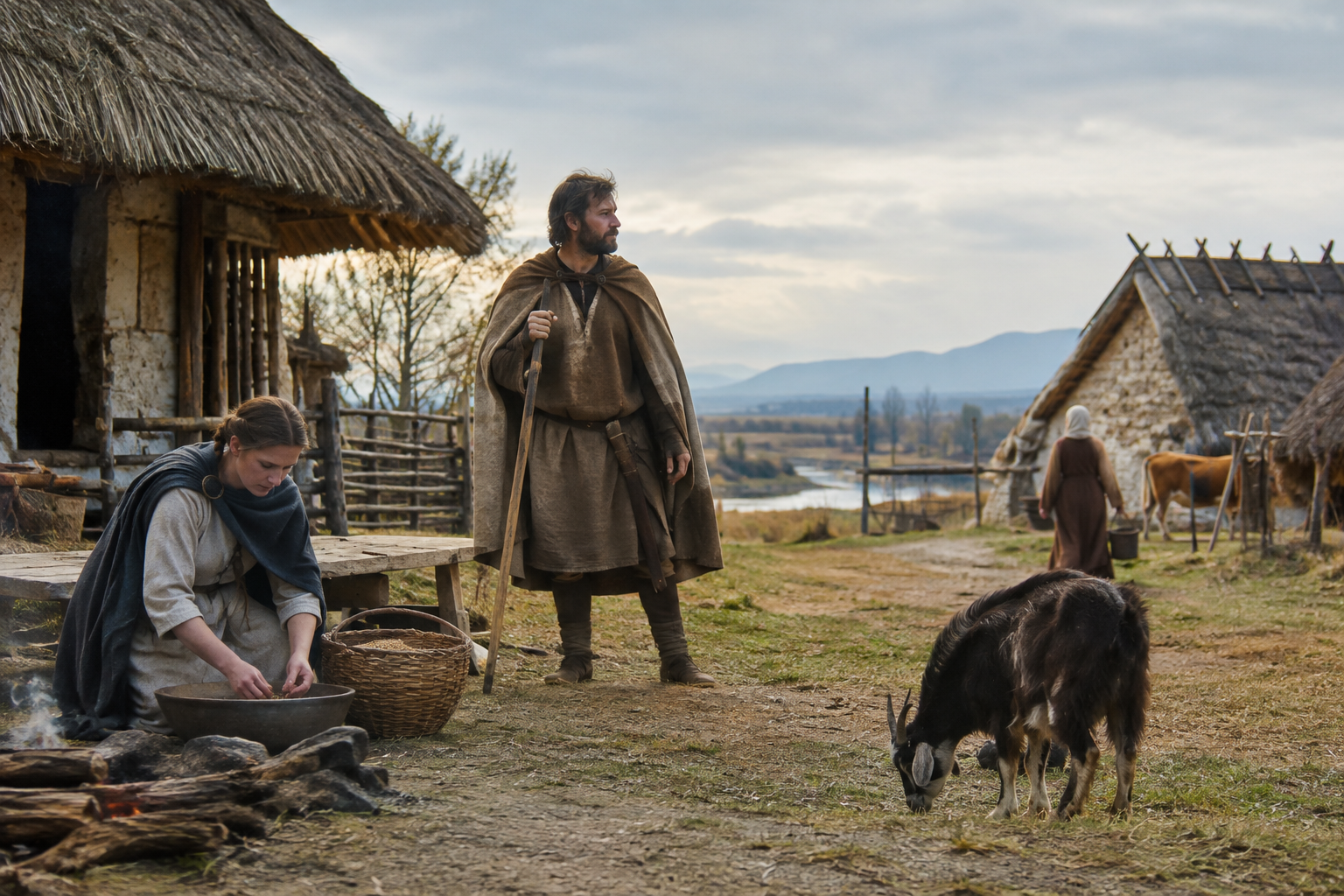
At Csokorgasse in the Vienna Basin, one early medieval burial has an unexpectedly long afterlife in genetic history. The individual known as CSK003, dated to around AD 650, is one of those finds that reminds us how much movement and mixture sat behind the old labels of "Roman," "barbarian," or "local." In MyTrueAncestry terms, this burial is associated with the Y-DNA haplogroup E1b1b1a1b1a6a1f.
That string of letters and numbers is very specific, but the wider family it belongs to is easier to place. E1b1b is a broad paternal lineage with a long history in parts of Africa, the Mediterranean, and the Near East. A much narrower branch such as E1b1b1a1b1a6a1f does not by itself tell us an ethnicity, a language, or a single migration story. What it does offer is a sharply focused paternal signal inside a real archaeological setting: early medieval Austria, at a moment when the old Roman world had fractured and Central Europe was being reassembled through mobility, settlement, and new political identities.
The Vienna Basin in the centuries after the fall of Roman authority was not some empty stage waiting for "new peoples" to arrive. It was a lived-in frontier zone with surviving provincial populations, incoming groups, shifting alliances, and connections stretching across the Danube and beyond. A burial such as CSK003 matters because it places a paternal line associated with E1b1b1a1b1a6a1f within that mixed early medieval landscape.
The site name, Csokorgasse, points us to a cemetery context in the Vienna area rather than to a famous royal tomb or a single monumental grave. In some ways that makes the evidence more valuable. Ancient DNA is often most revealing when it comes from ordinary burial grounds, because they show us populations rather than legend. One individual cannot stand for all early medieval Austria, of course, but CSK003 does show that lineages now often discussed in Mediterranean or Balkan contexts were present in the Middle Danube world by the mid-7th century.
A museum and research overview from Vienna's Natural History Museum provides the institutional context for the work on these remains and the wider archaeology of the region: research on the archaeological and anthropological collections of the Vienna area. It is exactly the sort of setting in which genetics becomes most useful: not as a replacement for archaeology, but as one more way of seeing who was actually buried in these cemeteries.
For many readers, the surprise will be the location. When people think of early medieval Austria, they often imagine Germanic-speaking groups, Avars, Slavs, and the fading remains of Roman provincial society. All of that is fair enough, but ancient DNA keeps showing that these categories were never neat biological boxes. A paternal lineage within the broad E1b1b family appearing in this setting fits a larger pattern seen across late antique and early medieval Europe: the Danube frontier was a corridor, not a wall.
That matters especially for a branch as precise as E1b1b1a1b1a6a1f. The narrower the branch, the less useful it is to make sweeping civilizational claims, but the more useful it can be for tracing actual paternal continuities and divergences among related men over time. In practical terms, if you carry this haplogroup today, CSK003 does not prove descent from that man, still less from a named tribe. It does, however, show that your paternal line had reached, or was already established in, the early medieval Middle Danube world by around AD 650.
The date attached to CSK003 is important. Around AD 650, the Vienna Basin sat in a world shaped by the aftermath of Rome, the power of the Avar Khaganate in the Carpathian Basin, and the growing importance of Slavic-speaking communities in surrounding regions. It was a time when people, objects, and loyalties crossed political boundaries with surprising ease.
This is precisely why a haplogroup finding should not be pressed into a single ethnic story. A man buried in early medieval Austria with a paternal line linked to E1b1b1a1b1a6a1f might have belonged to a community speaking one language while carrying paternal ancestry that ultimately branched elsewhere. That is not a contradiction; it is normal human history. Archaeology has been telling us for years that frontier societies were socially mixed, and genetics now lets us see some of that mixture at the level of individual burials.
Readers interested in how varied 7th-century European burial populations could be may want to compare this with evidence from Iberia, where early medieval cemeteries also reveal striking diversity.
It is worth pausing over the genetic classification itself. E1b1b is one of the major Y-chromosome families of the Old World, with important branches distributed across North Africa, the Balkans, the eastern Mediterranean, and parts of the Near East and Europe. That broad picture is well established. But an article on E1b1b1a1b1a6a1f has to be more careful than that, because a terminal or near-terminal branch does not automatically inherit the entire biography of its parent clade.
So the responsible reading is a modest one. CSK003 shows that a paternal line assigned within this narrow branch was present in early medieval Austria. The deeper prehistoric and late antique route by which that particular branch reached the Vienna Basin is not demonstrated by this burial alone. It may reflect long-term Balkan or Danubian continuity, movement under Roman rule, post-Roman mobility, or some mixture of those processes.
That caution is not a weakness. In fact, it is what makes archaeogenetics useful. The field works best when we allow one burial to answer one properly scaled question. Here, the answer is that the paternal landscape of early medieval Austria was more varied than older, simpler models once allowed.
Balkan Roots and Medieval Admixture
Austria is particularly interesting because it sits between several big archaeological stories. To the south and southeast lay the Balkan worlds where branches of E1b1b have a notable history in later populations. To the west and south, the former Roman provinces remained tied into Alpine and Italian exchange networks. To the east, the Pannonian and steppe-linked political sphere brought in new elites and fresh population contacts. A burial like CSK003 belongs in that broad zone of interaction.
Ancient DNA studies from nearby parts of Central Europe have repeatedly shown that population history after Rome was not a matter of total replacement. Some lineages persisted locally, others arrived, and still others were absorbed into new communities whose burial rites and material culture could change faster than ancestry did. That is why a single Y-chromosome result can be revealing without being all-explaining. It captures one paternal thread inside a much bigger social fabric.
There is also a useful comparison to be made with Roman and post-Roman frontier regions elsewhere in Europe. From the Lower Rhine to Iberia, genomic work has increasingly shown that military service, trade, settlement, marriage, and local continuity all contributed to diverse burial populations. The Vienna Basin fits that larger pattern rather well.
Roman-Barbarian Frontier Mixing
If your paternal line belongs to E1b1b1a1b1a6a1f, CSK003 offers something better than a myth of instant origins. It gives you a real, dated human presence for your lineage in the early medieval Vienna Basin, around AD 650, in a region where Roman inheritance, Danubian movement, and new early medieval identities overlapped. That is a solid archaeological foothold.
The most distinctive lesson here is not that this branch "belongs" to one people, but that it appears in exactly the sort of contact zone where identities were being remade. Your direct paternal line, traced by Y-DNA alone, may therefore connect to a history of mobility and mixture in Central Europe that was already well underway in the 7th century.
Comments