Haplogroup E1b1b1a1b1a2

– 5 min read


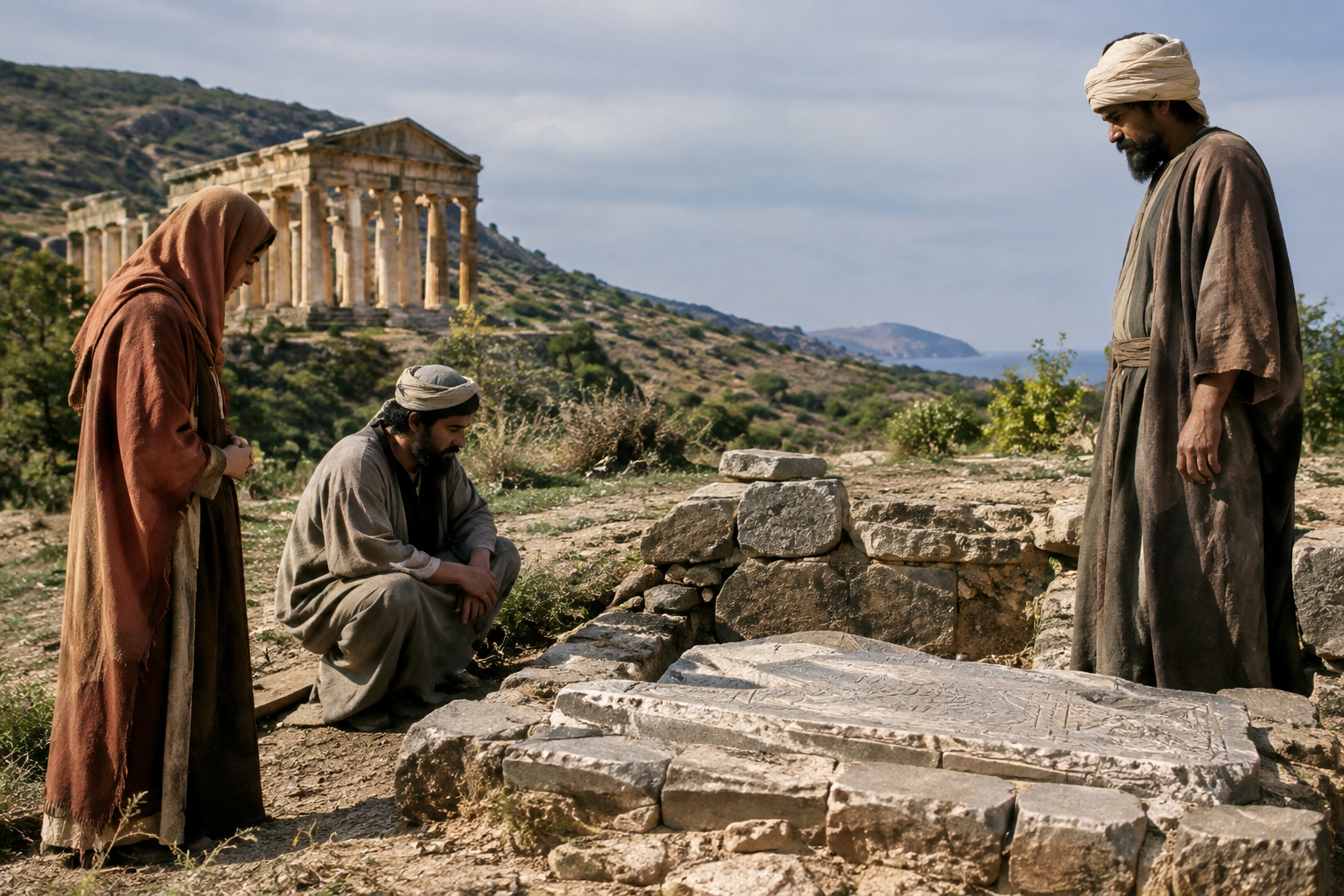
At Segesta in western Sicily, one excavated burial has become an unexpectedly sharp little window into the medieval Mediterranean. The individual identified as SGBN19, dated to around AD 1250 and described as a Muslim grave, has been associated here with the Y-DNA haplogroup E1b1b1a1b1a2. That may sound like a string of letters and numbers fit only for a genetics lab, but in historical terms it points us toward something much more vivid: Sicily not as a sealed island, but as a place of arrivals, survivals, and stubborn continuities.
The important thing to say at once is that Y-DNA traces one direct paternal line only. It does not sum up a whole person, a whole community, or a whole ethnicity. Even so, when a lineage such as E1b1b1a1b1a2 appears in a medieval Sicilian Muslim burial, it becomes part of a bigger archaeological question: who was still living in Sicily after the Norman conquest, and how much of the island's Islamic-era population endured into the 13th century?
Segesta is one of those Sicilian places where layers of history pile up almost absurdly: an ancient Elymian city, a famous classical site, and then, much later, a medieval burial landscape tied to a very different religious world. By the mid-13th century, Muslim communities in Sicily were living through intense political pressure. Norman and then Hohenstaufen rule had not simply erased the island's earlier Islamic population overnight, but it did transform their status, settlement, and future.
SGBN19 matters because he belongs to that late phase. A Muslim burial from around AD 1250 is not evidence for the beginning of Islamic Sicily; it is evidence for its persistence. That is a rather different historical point, and a more interesting one. It suggests that paternal lines linked to North African and wider Mediterranean movements were still present on the island generations after the original Arab-Berber conquest and long after Sicily had become politically Christian again.
An ancient DNA study examining medieval Sicilian burials has helped bring this period into focus, showing just how mixed and historically layered these communities were: research published on medieval Sicily. The broader lesson is not that one lineage "explains" a population, but that burials like SGBN19 preserve the human scale of these transitions.
Medieval Sicily's multi-faith DNA
The haplogroup label here is very specific, but it sits within the wider Y-chromosome family usually abbreviated as E1b1b1 or E-M35, a major branch with deep roots in parts of Africa and a long history around the Mediterranean. That wider family appears in many different regions and periods. It would be careless to take the broad fame of E1b1b1 and pin every bit of that history directly onto the narrower branch E1b1b1a1b1a2 without case-by-case evidence.
Still, the setting matters. In medieval Sicily, a paternal lineage from this wider family fits a world shaped by movement across the Strait of Sicily, by North African military and civilian settlement, by trade, slavery, administration, and intermarriage. Sicily in the Islamic and post-Islamic centuries was not merely touched by the Maghreb; it was entangled with it.
That is why this single grave is more than a genetic curiosity. It gives a paternal thread within a society that historical sources often describe in blunt religious or political terms. The DNA does not replace those written sources, but it complicates them in exactly the way archaeology ought to do.
There is a tendency, when telling Sicilian history, to make the island change hands in one dramatic flourish: Byzantine, then Islamic, then Norman, and so on. Real populations do not behave so neatly. Cemeteries are often where that tidy political storytelling begins to fail.
A Muslim burial at Segesta around AD 1250 belongs to a period when Muslim communities in Sicily faced forced relocation, social restriction, and eventual dispersal. Under Frederick II, many Sicilian Muslims were deported to Lucera on the mainland. Yet burial evidence shows that Islamic identity and Islamic communities did not vanish from every part of the island at once. SGBN19 belongs precisely in that uncomfortable, transitional world.
This is where Y-DNA becomes historically useful in a modest, grounded way. E1b1b1a1b1a2 does not prove where this man's grandfather came from, nor does it tell us what language he spoke at home. But in combination with the burial's Muslim context, it supports the picture of medieval Sicily as a place where lineages linked to southern Mediterranean networks remained physically present on the island late into the medieval period.
Genetic diversity in medieval Sicily
None of this should surprise us if we take Sicily's geography seriously. The island sits between Italy and North Africa, and throughout antiquity and the Middle Ages it was tied into shipping routes, military campaigns, pilgrimage traffic, commercial exchange, and forced migration. In genetic terms, that tends to produce variety rather than purity.
The more interesting question is not whether Sicily was connected. Of course it was. The question is how long those connections remained visible in local communities, even after states changed and elites changed. A burial like SGBN19 suggests that older Islamic-era demographic layers remained embedded in parts of the population well into the 13th century.
This also fits with a broader body of work on Sicilian and southern Italian ancient DNA, where continuity and mixture often sit side by side rather than cancelling each other out. Some communities show deep local roots; others reveal new arrivals; many show both. Medieval Sicily is particularly valuable because its written history is so rich, yet the genetics still manage to surprise it.
Ancient DNA of Italian islands
It is easy to become sniffy about single samples. Quite right too, up to a point. No lone burial can stand in for all Sicilian Muslims, all bearers of E1b1b1a1b1a2, or all medieval Mediterranean migration. But archaeology is full of cases where one securely placed individual tells us something no grand generalization can.
SGBN19 is useful because the context is so pointed: medieval, Sicilian, Muslim, and late. The combination helps anchor the haplogroup in a historical setting where written sources speak of conflict, control, and relocation, while the cemetery evidence shows actual people still there. That tension between state policy and lived survival is one of the most revealing features of medieval Sicily.
For readers interested in parallel cases elsewhere in the western Mediterranean, Iberian material offers another reminder that medieval religious frontiers were also biological meeting zones, not sealed barriers.
Medieval Islamic Ibiza burials
If your Y-DNA falls under E1b1b1a1b1a2, the most responsible historical takeaway is not a single origin story but a Mediterranean one. The clearest ancient clue here places this branch in a Muslim burial at Segesta in medieval Sicily, a setting shaped by North African links, island continuity, and the long afterlife of conquest. That does not narrow your paternal past to one people or one port of departure, but it does place your line within the sort of world where Sicily, the Maghreb, and southern Europe were tightly connected.

Comments