Haplogroup E1b1b1a1b1a1

– 5 min read


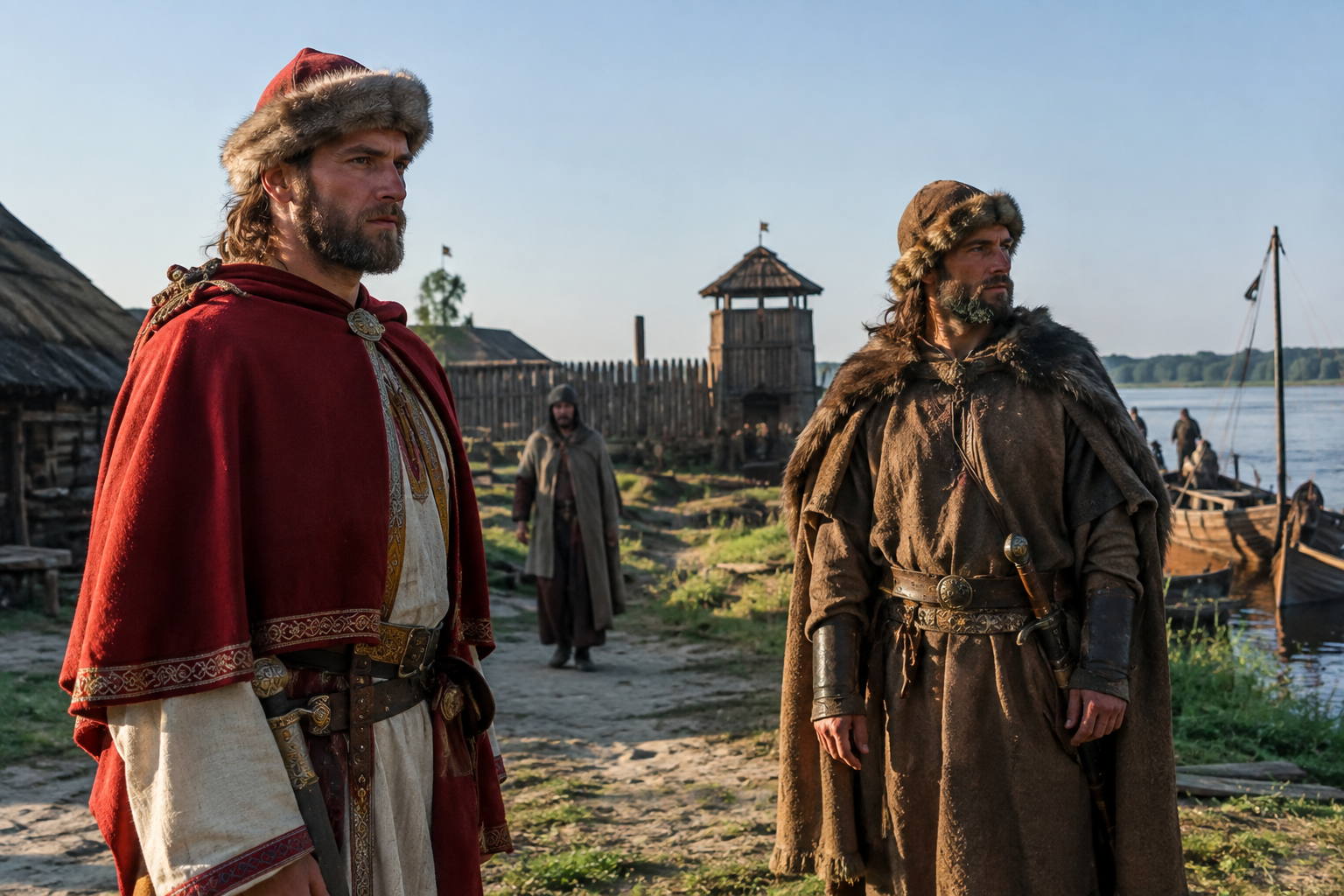
At Poznan-Srodka in Greater Poland, one medieval male labelled PCA0255 has become unexpectedly important for the story of Y-DNA haplogroup E1b1b1a1b1a1. Dated to around AD 1100 and associated with the Piast dynastic milieu, he places this paternal line in the political heartland of early medieval Poland rather than on some faraway historical fringe. That matters because E1b1b1a1b1a1 belongs to the wider E1b1b family, a major Y-chromosome lineage with deep roots outside northern Europe, yet here it appears in a setting tied to one of the first ruling houses of the Polish state.
This is exactly the sort of finding that ancient DNA handles rather well when treated carefully. Y-DNA traces one direct paternal line only, not a person's whole ancestry, language, or identity. Even so, when a branch like E1b1b1a1b1a1 turns up in medieval Central European contexts, it reminds us that royal courts, frontier societies, and Christianizing kingdoms were populated by men whose paternal histories were often more varied than neat national stories suggest.
PCA0255 comes from Poznan-Srodka-Lad, in the orbit of the Piast world of Greater Poland. Archaeologically and historically, this is not a marginal place. Greater Poland was one of the core regions from which the early Piast rulers consolidated power in the 10th and 11th centuries, building up an emergent kingdom through dynastic politics, warfare, church patronage, and control of strongholds.
So when an individual from that landscape is associated with E1b1b1a1b1a1, the interest lies less in any melodramatic claim about a single founder and more in what it says about elite-era population complexity. Medieval courts and church centers were magnets. Clerics, warriors, retainers, dependants, and marriage networks linked Poland to Bohemia, the Empire, Rus', Hungary, and further south into the Balkans and Mediterranean-connected worlds. A paternal lineage with wider southeastern or Mediterranean associations appearing in Piast Poland is therefore notable, but not at all implausible.
Recent work touching on the medieval Piast rulers has pushed this question into sharper focus, especially around paternal-line continuity and possible foreign connections within the dynasty's wider network. One useful point of comparison is the MyTrueAncestry article on the Piasts themselves.
A recent ancient DNA study on the medieval Piast milieu has helped frame these questions, though one should resist the temptation to turn every associated male into a dynastic spokesman. PCA0255 is valuable because he anchors this haplogroup in a real early medieval burial context in Poland. He does not, by himself, define the whole Piast male line, nor does he turn E1b1b1a1b1a1 into a specifically "Polish" haplogroup.
The other ancient individual here, CGG018923, comes from Cifer-Pac in present-day Slovakia and is dated to around AD 950. The label attached to the burial describes a Medieval Slav Avar context, which is already a clue to the historical complexity of the region. This was a zone shaped by the fading memory of the Avar Khaganate, the expansion of Slavic-speaking communities, and the political rearrangements that preceded and accompanied the rise of medieval Hungary.
That makes Cifer-Pac a very good companion to the Polish evidence. If Poznan-Srodka gives us E1b1b1a1b1a1 in a Piast-era core territory, Cifer-Pac places the same branch in the Carpathian Basin's northern approaches, where post-Avar and Slavic populations met, mixed, and reorganized. It is a reminder that paternal lines do not obey later state borders. They move through households, warbands, villages, and marriage networks, often surviving political collapse better than political names do.
There is also a wider archaeological point here. Labels like "Slav" and "Avar" are useful shorthand, but they do not map perfectly onto genetics. In the 9th and 10th centuries especially, burial customs, language, political allegiance, and paternal ancestry could intersect in many combinations. A man buried in a community described archaeologically as Slavic or post-Avar was not thereby genetically uniform with every other man around him.
Frontier Diversity in the Early Middle Ages
The wider E1b1b family is best known for its strong presence around parts of North Africa, the Balkans, the eastern Mediterranean, and the Near East, with some branches spreading widely into Europe over different periods. But that broad picture is not the same thing as the history of E1b1b1a1b1a1 itself. The narrower the branch, the more careful we have to be. One cannot simply inherit the entire migration story of a parent haplogroup and paste it onto a much more specific descendant line.
Still, the two medieval samples together suggest something historically quite sensible: this branch was present in Central Europe by the 10th-11th centuries in settings linked to mobile, mixed, and politically important populations. That does not tell us when the branch first arrived in the region. It could reflect older Balkan or Carpathian dispersals, movements tied to late Roman and post-Roman networks, medieval ecclesiastical and military mobility, or a blend of several such processes.
Indeed, some of the most useful parallels for thinking about E1b1b in Europe come from regions where Rome, frontier movement, and later medieval transformations overlapped. Readers interested in that wider background may find Roman-period Iberia a revealing comparison, not because it proves the same route here, but because it shows how southern-associated lineages could become embedded far from their earlier centers.
Roman Hispania's Genetic Legacy
There is an old habit in popular history of imagining early medieval Central Europe as if each people sat tidily in its own box: Poles here, Avars there, Slavs somewhere in between, all genetically straightforward. Ancient DNA has been steadily dismantling that picture. What it shows instead is local continuity mixed with repeated episodes of migration, incorporation, and long-distance contact.
The medieval appearances of E1b1b1a1b1a1 fit that broader pattern rather well. Neither Poznan nor western Slovakia was isolated. The first sat within a dynastic core connected to Latin Christendom and eastern neighbours alike; the second belonged to a corridor shaped by the movements of steppe powers, Slavic settlement, Moravian and Hungarian expansion, and inherited Roman-era routes through the Danube basin.
For the earlier background to this kind of Central European mixing, research on post-Roman cemeteries is especially helpful. A genetic study of post-Roman populations in Central Europe showed just how varied these communities could be, and how difficult it is to reduce archaeological labels to a single biological profile. That does not directly identify the exact history of E1b1b1a1b1a1, but it gives the right historical frame: movement, mixture, and social reassembly were normal.
If one had to ask where this haplogroup's medieval Central European appearances point most suggestively, the answer is not to a single dramatic migration, but to a contact zone. The Carpathian Basin and the Balkans have long been major regions for branches of E1b1b. From there, movement northward into Hungary, Slovakia, and southern Poland is historically unsurprising. Trade, military service, ecclesiastical links, colonization, and dynastic politics all offered routes by which paternal lines could travel without leaving a clean documentary trail.
That makes the Slovakia sample especially useful beside the Polish one. CGG018923 stands in a region where south-north and east-west connections crossed constantly. PCA0255, by contrast, shows that by the 11th century this was not merely a borderland phenomenon. The lineage had reached, or was already present within, the heart of a major Central European kingdom.
For a broader look at how southeastern European ancestries persisted and shifted over long periods, the Albanian and Balkan evidence offers a good comparative frame.
Deep Balkan Roots and Medieval Admixture
With only two ancient samples named here, the responsible conclusion is modest but still interesting. Y-DNA haplogroup E1b1b1a1b1a1 is documented in medieval Central Europe in two historically meaningful settings: one in the Piast sphere of Greater Poland, the other in a 10th-century Slovak context shaped by Slavic and post-Avar history. Together, they suggest that this paternal branch formed part of the real human variety of early medieval Central Europe, including regions at the center of state formation rather than merely along the edges.
For someone researching this haplogroup today, that is the useful takeaway. Your direct paternal line may connect, not to a single ethnic label or royal fantasy, but to the densely connected world of medieval Europe, where lineages with deeper southern and southeastern associations could become thoroughly woven into Polish and Carpathian history.

Comments