Haplogroup E1b1b1a1a2

– 5 min read


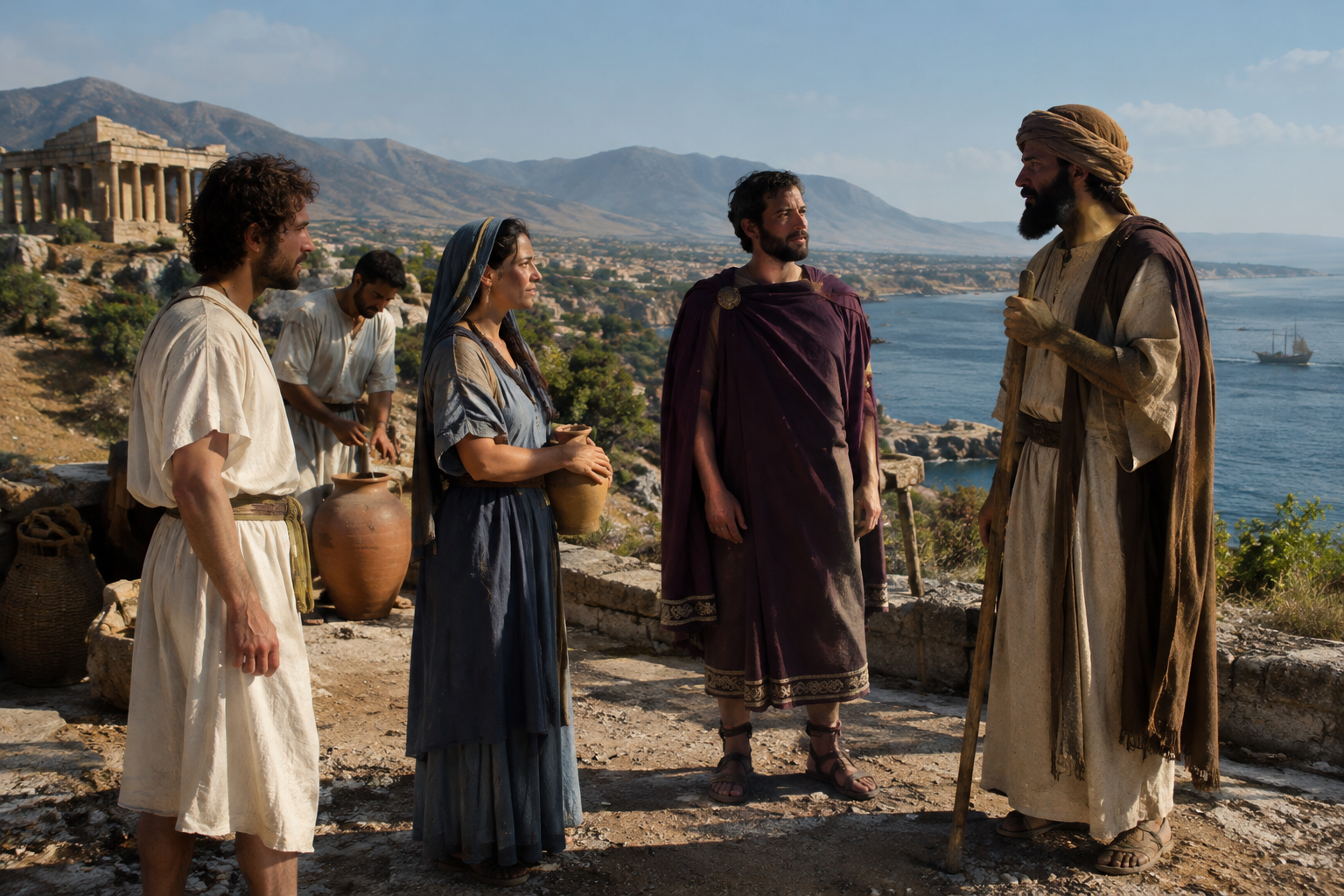
At Selinunte on the southwest coast of Sicily, one ancient male sample stands out for what it quietly suggests about Mediterranean history. Sample I21195, dated to around 550 BC and associated with Hellenic Sicily at Selinunte-Case Manuzza, belongs to the Y-DNA haplogroup E1b1b1a1a2. That is a very particular paternal signal turning up in a Greek colonial city at exactly the sort of place where archaeologists expect movement, mixture, and new local identities to be forming.
That matters because Y-DNA follows one direct paternal line only, not a person's whole ancestry. Even so, when the same lineage appears again in later eastern Mediterranean settings, it begins to look less like an isolated curiosity and more like part of a long-lived pattern. For E1b1b1a1a2, the ancient evidence offered here points above all to a Mediterranean story: coastal cities, imperial networks, and the human traffic linking Sicily, Anatolia, and the Levant.
Selinunte was one of the great Greek foundations in Sicily, a city tied into wider exchange across the central Mediterranean. By the 6th century BC, this was not a sealed ethnic enclave but a colonial landscape shaped by Greeks, indigenous Sicilians, and contacts reaching toward Punic and wider Mediterranean spheres. A paternal lineage such as E1b1b1a1a2 appearing here fits that historical reality rather well.
What we can say securely is modest but important. I21195 places this haplogroup in an urban colonial setting in western Sicily during the Archaic period. It does not tell us that all men of this lineage in Sicily were Greeks, nor that the branch arrived in a single migration. But it does show that one bearer of this paternal line was part of the lived population of a major Greek city in the island world where identities were constantly being negotiated.
This is especially interesting in Sicily because the island repeatedly appears in ancient DNA as a place of convergence rather than isolation. That broader context makes a lineage like E1b1b1a1a2 historically intelligible: not an anomaly, but one thread in a very busy maritime fabric.
The label E1b1b1a1a2 is a narrow branch within the broader E1b1b paternal family, a major lineage with deep roots in parts of Africa, the Mediterranean, and southwest Eurasia. But it is crucial not to flatten those scales. The ancient presence of the wider E1b1b family in many places does not automatically explain the exact history of this more specific branch.
So the sensible approach is to stay close to the evidence. In the material here, E1b1b1a1a2 is attested in western Sicily in the mid-1st millennium BC, in Saifi, Lebanon during the Hellenistic period, and in Caria on the Aegean coast of Anatolia during the Byzantine era. That distribution does not prove a single uninterrupted family chain across a thousand years. It does, however, place the haplogroup repeatedly in eastern and central Mediterranean zones where ports, armies, merchants, pilgrims, and administrators regularly crossed paths.
For readers exploring their own paternal ancestry, that is often the most useful level of historical interpretation: not a fantasy pedigree, but a map of environments in which a lineage is actually found.
The sample SFI-12, dated to around 149 BC from Saifi, Lebanon, provides another important anchor point. Here the lineage appears in a Levantine context during the Hellenistic age, after the conquests of Alexander and during the centuries when the eastern Mediterranean was tied together by new kingdoms, old cities, and intense commercial movement.
This is a useful contrast with Selinunte. Sicily gives us a western Mediterranean colonial city; Saifi gives us an eastern Mediterranean urban setting in the Hellenistic world. The recurrence of E1b1b1a1a2 in both places suggests a lineage at home in the connected coastal societies of the sea itself, not just on one shore.
Research on ancient populations of the broader region has repeatedly shown how difficult it is to draw hard lines between "local" and "foreign" in these periods. The Hellenistic world thrived on circulation. A man carrying this paternal branch in Lebanon need not represent recent arrival from Sicily, or vice versa. The more careful point is that the lineage sits comfortably within the human mobility that defined the age.
The strongest cluster in this small dataset comes much later, from Caria on the Aegean coast of Anatolia. Three samples from about AD 604 - I20261, I20264, and I20265 - are all associated with the Byzantine era and with the same haplogroup, E1b1b1a1a2. That repetition is archaeologically valuable because it moves us from isolated occurrence to local concentration.
Now, one must not overplay it. Three men from one place and period do not amount to a dynasty, a whole province, or even necessarily one close family. But they do show that this paternal line was established enough in Byzantine western Anatolia to appear more than once in the surviving ancient DNA record.
Caria was an excellent place for such continuity. Long before the Byzantines, this coastline had been woven into Greek, Persian, Hellenistic, and Roman political worlds. By the early 7th century AD it remained part of a deeply connected Christian empire, facing both the Aegean and the interior of Anatolia. A lineage found there may have been locally rooted for centuries, or maintained through repeated movements around the imperial Mediterranean; either scenario fits the history of the region better than any simple one-origin tale.
An ancient DNA study of Mediterranean populations published in Science helped underline just how mobile and intermixed many Mediterranean communities were across antiquity. Even without forcing every sample into one grand migration route, that larger picture makes the Carian cluster easier to understand.
Anatolia and Mediterranean DNA
Put these finds side by side and a distinctive picture emerges. Selinunte in Archaic Sicily, Saifi in Hellenistic Lebanon, and Caria in Byzantine Anatolia are not random dots. They are all coastal or near-coastal nodes in the old Mediterranean system, places where empires changed but connectivity endured.
That does not mean E1b1b1a1a2 was a "Greek haplogroup," a "Byzantine haplogroup," or a marker of any single language or people. Ancient men with the same Y-lineage could have spoken different languages, served different states, and identified with very different communities. What the evidence does suggest is persistence within the kinds of societies that made the Mediterranean such a famously entangled world.
For Sicily in particular, this is a useful reminder that ancient colonization was never a matter of neat replacement. Genetic evidence keeps pushing us back toward the messy truth: ancient cities were populated by real communities formed through contact, marriage, migration, and adaptation over generations. A lineage like E1b1b1a1a2 belongs neatly in that untidy reality.
A more recent study of ancient Sicilian populations, published in Nature, has added to this broader understanding of the island as a place of long-term genetic diversity and connection. That wider Sicilian setting helps make sample I21195 more historically meaningful than a bare code on a chart.
On present evidence, E1b1b1a1a2 is best understood here as a paternal lineage documented in several linked Mediterranean worlds rather than in one isolated ethnic pocket. Its ancient appearances in Sicily, Lebanon, and Byzantine Anatolia suggest durability in regions shaped by seaborne exchange, imperial rule, and mixed urban populations. For someone researching this haplogroup today, the most responsible historical takeaway is not a single heroic origin story, but a strong connection to the old eastern and central Mediterranean corridors where people, goods, and families moved for centuries.



Comments