Haplogroup R1b1a1b1

– 5 min read


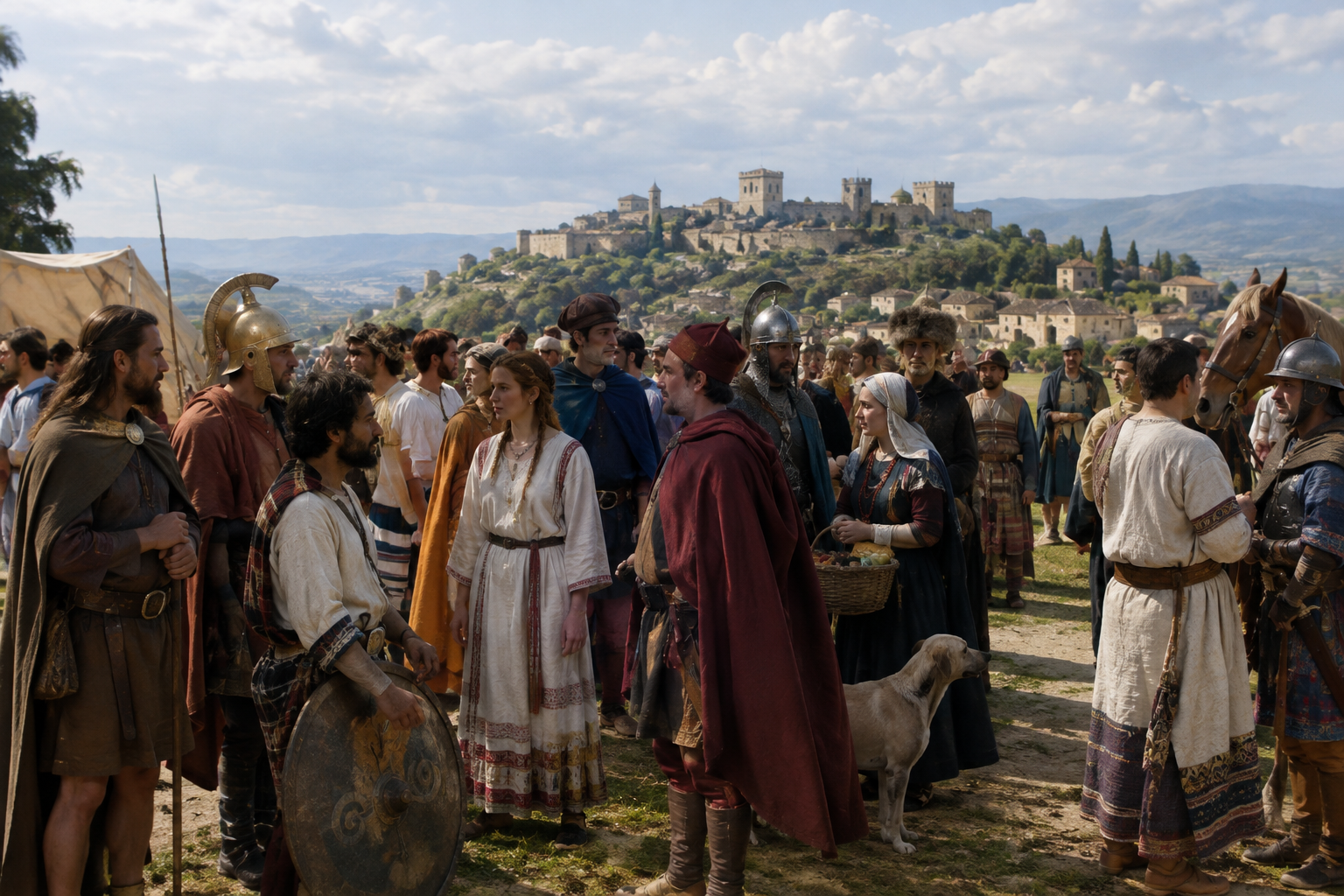
At Las Gobas in northern Spain, one medieval man dated to about AD 1000, sample ldo160, offers a neatly focused way into haplogroup R1b1a1b1. He is not famous, not royal, and not accompanied here by a saga. What makes him interesting is simpler and, in some ways, better: he belongs to a paternal line that keeps turning up in very different archaeological settings, from Bronze Age central Europe to Iron Age Italy, the north Pontic steppe, and medieval Iberia.
That is the useful scale for thinking about a Y-DNA branch like R1b1a1b1. Y-DNA follows one direct male line only, so it does not describe a person's whole ancestry or identity. But when the same branch appears in graves from several regions and periods, it can illuminate how male lines persisted, moved, and were folded into new societies over a very long stretch of European history.
Las Gobas sits in a landscape shaped by late antique and medieval settlement in northern Iberia. With ldo160, the significance is not a dramatic burial narrative but the broader historical setting: by around AD 1000, northern Spain was a zone of continuity and mixture, where local post-Roman communities, older Iberian populations, and lineages shaped by centuries of movement across western Europe all met.
Seen in that context, R1b1a1b1 at Las Gobas is a reminder that some paternal lines reached the medieval far west of Europe not as a single sudden migration, but as part of a much longer history. The branch is also present in other Iberian contexts in this sample set, including early medieval Tarragona individuals I29537 from Cambrils Torre Bargallona, dated about AD 525, and I29629 from Cambrils La Mineta, dated about AD 575, as well as the Barcelona soldier L017 from the Catalan Revolt in AD 1652. That spread across time matters. It suggests not an isolated appearance, but repeated survival in Iberia through late Roman, early medieval, and early modern periods.
A related MyTrueAncestry discussion of this wider setting is worth reading here:
If Las Gobas shows R1b1a1b1 on Europe's Atlantic-facing edge, Iron Age Italy shows it in an entirely different cultural world. Three individuals from Etruscan Italy at Monteriggioni Colle di Val d'Elsa, EV15A, EV16D1, and EV7A, all dated around 600 BC, are associated with this haplogroup in the material provided here. So too are three individuals connected with the Piceni on the Adriatic coast at Novilara, PN62, PN43, and PN52, dated around 650 BC.
This is precisely the sort of evidence that stops us from telling over-simple stories. The Etruscans and the Picenes were not the same people, did not occupy the same political space, and left behind different archaeological signatures. Yet a related paternal branch appears in both settings. That does not mean all these men were close kin, or that Y-DNA can explain Etruscan language or Picene identity. It does mean that one male line could be absorbed into very different Iron Age societies in peninsular Italy.
Research on ancient Italian populations has increasingly emphasized this combination of cultural distinction and biological variety. For readers interested in how genetics is complicating older ideas about Italy's ancient peoples, this companion piece fits well:
There is another point here. The article haplogroup is R1b1a1b1, a broad label compared with the finer subclades often used in specialist Y-chromosome work. So the safest reading is not that all these Italian men belonged to one tightly defined recent family branch, but that they fall within a wider paternal lineage already established in Iron Age Italy.
One of the deepest samples in this set is I3141, identified as an ancient Yamnaya individual from Donetsk in Ukraine, dated around 3000 BC. That matters because the Yamnaya horizon looms large in discussions of steppe ancestry and the expansion of several important paternal lines across Europe. But caution is needed: a broad Y-DNA label in a downstream article should not be used to flatten the very complex branching history of steppe populations.
Still, the presence of a Yamnaya-associated individual, followed much later by UKR132, a Scythian from a rich grave at Psiochyn near Kharkiv dated around 400 BC, and UKR135-1_II, a later Saltiv-context individual from Ukraine dated around AD 229, gives this haplogroup a striking north Pontic dimension. Here the same larger paternal tradition appears not in settled Mediterranean city cultures but in the mobile and mixed societies of the steppe frontier.
An ancient DNA study examining mobility in Ukraine and the wider north Pontic zone helps frame why this region matters so much for lineages like this one: https://www.researchgate.net/publication/380994383_North_Pontic_crossroads_Mobility_in_Ukraine_from_the_Bronze_Age_to_the_early_modern_period. The point is not that one grave can be tied directly to another over millennia, but that the steppe repeatedly acted as a corridor through which paternal lines were redistributed into new political worlds.
For a broader look at that same region and its long-term movement of peoples, this related post is especially relevant:
The branch also appears well west of the steppe in Bronze Age central Europe. Sample LEU053 from Leubingen-Sommerda in Thuringia, Germany, dated around 1950 BC and associated here with the Unetice world, is a particularly telling case. Unetice was part of the early Bronze Age transformation of central Europe: metalworking, elite burial traditions, and dense regional exchange networks. A paternal lineage found here is already participating in a settled, stratified society far from the open grasslands of the Pontic zone.
Two still earlier southeastern European examples broaden that picture further: I18801 from Boyanovo in Bulgaria, dated around 2750 BC, and I19457 from Tell Ezero, dated around 2275 BC. These are not identical cultural settings, but together they show that the wider paternal background linked with R1b1a1b1 was present across key zones connecting the Balkans, the steppe, and central Europe during the Bronze Age.
One of the landmark large-scale studies on Bronze Age Eurasia remains useful for understanding why such patterns recur across different regions and archaeological labels: https://www.science.org/doi/10.1126/science.abm4247. What these central and southeastern European samples suggest is not a single homeland for the exact narrow branch, but a durable paternal framework that was already widespread in the Bronze Age worlds from which later European populations emerged.
Later samples show the branch persisting through the centuries usually described as Europe's age of migrations. In Pannonia, sample Hacs_15 from Hacs in Hungary, dated around AD 450, sits in the post-Roman world of shifting military and political alliances. In Italy, CL97, described as Celto-Germanic Lombard and dated around AD 580, and CL110, a Roman outlier in a Lombard grave from the same period, place the lineage in another mixed frontier context where older Roman populations and incoming groups overlapped rather than existing in sealed compartments.
Northwestern Europe adds yet more variation. BUK023 from Buckland Dover, dated around AD 400 in the early Anglo-Saxon period, shows the branch in southern England during the formation of early medieval English society. Much later, VK267 from Viking Age Karda in Smaland, Sweden, dated around AD 1000, carries it into Scandinavian Christian-era burial landscapes. And PCA0656, a male of the Piast Masovian dynasty dated around AD 1370, shows the same paternal umbrella in medieval Poland, though any precise dynastic implications depend on the exact resolution achieved in the underlying study rather than the broad haplogroup label alone.
That is the real pattern worth noticing. R1b1a1b1 is not confined to one ethnic label, one kingdom, or one migration episode. It appears in Roman-border communities, Anglo-Saxon England, Viking Age Sweden, and medieval dynastic Europe because paternal lines survive political upheaval rather better than historians' neat categories do.
For readers interested in the Polish dynastic angle, this related article is the best match:
The most distinctive thing about haplogroup R1b1a1b1 in this evidence is its breadth across real archaeological settings: Yamnaya-associated steppe populations, Bronze Age central Europe, Iron Age Italy, post-Roman frontier zones, and medieval western and northern Europe. For someone researching this paternal line today, that does not point to one romantic destination. It points instead to a long-lived male lineage that repeatedly became local wherever history placed it.






Comments