Haplogroup E1b1a1a1a2a1a3a1d

– 4 min read


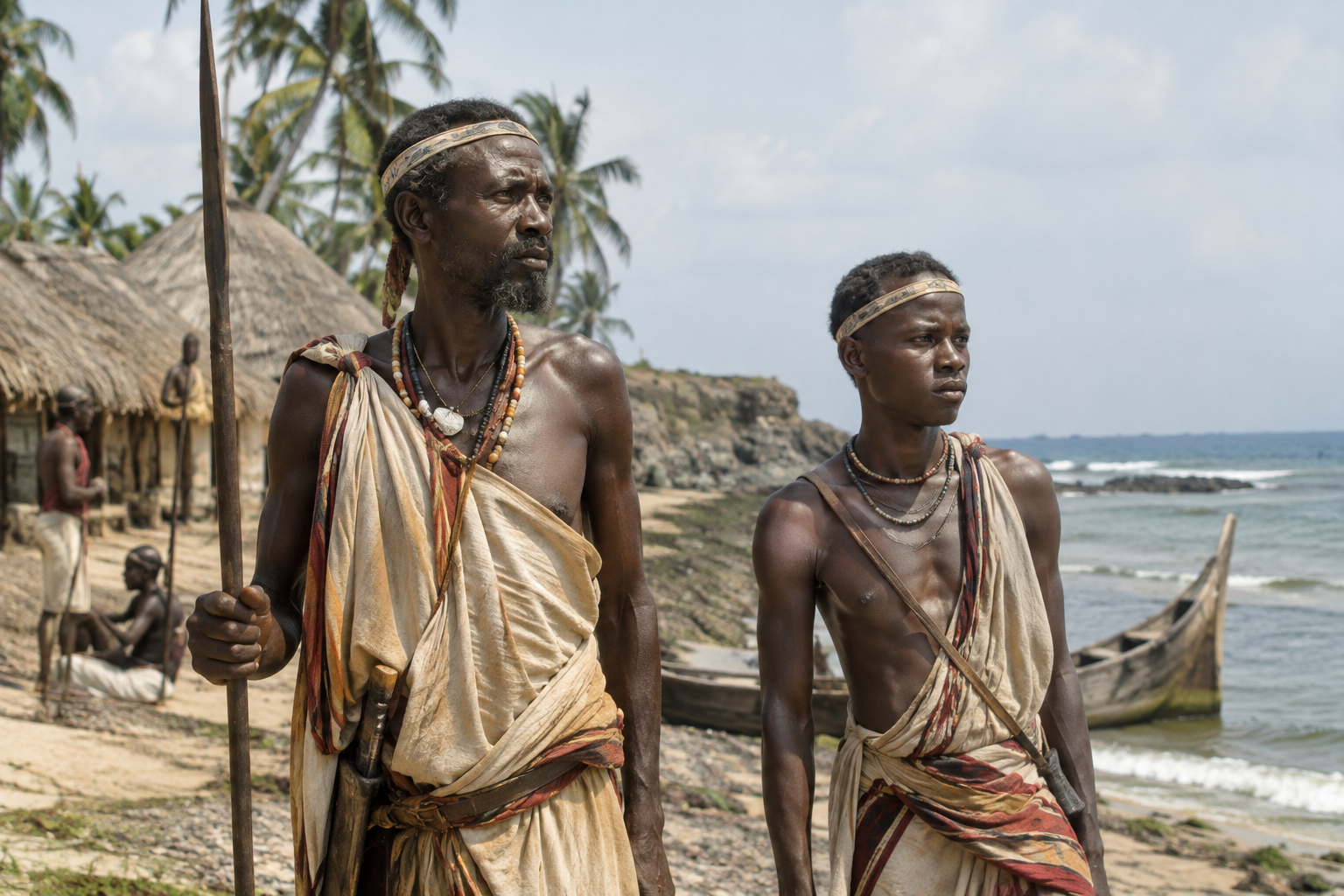
At Makwasinyi in Taita Taveta, inland from the Kenyan coast, two medieval-era men stand out for anyone tracing the Y-DNA haplogroup E1b1a1a1a2a1a3a1d. They are sample I14001, dated around 1550 AD, and I13874, dated around 1750 AD. That is already interesting before one says anything grander: the same narrow paternal branch appears at the same site across roughly two centuries, in a region where coast and interior met through trade, marriage, religion, and movement of people.
That makes Makwasinyi a better place to begin than with a sweeping map of Africa. Y-DNA follows one direct paternal line only, not the whole ancestry of a person or community, but even so it can reveal continuity that archaeology alone might miss. In this case, the branch E1b1a1a1a2a1a3a1d points us toward a local historical story in medieval and early modern East Africa rather than an abstract tale of ancient migrations.
Makwasinyi sits in the Taita Taveta region, a zone that mattered precisely because it was not simply "the coast" and not simply "the interior". It lay within networks linking the Indian Ocean towns to upland communities, caravan routes, and agricultural settlements. By the sixteenth to eighteenth centuries, this was a world shaped by commerce, shifting political ties, and long-running contact between African populations with different local histories.
The two relevant individuals, I14001 and I13874, belong to that historical setting. The dates place them after the classic florescence of many Swahili coastal towns, but still firmly within the long life of eastern African exchange systems. The fact that both are associated with E1b1a1a1a2a1a3a1d suggests that this paternal line was not a one-off arrival represented by a solitary burial; it was present at Makwasinyi across generations.
That continuity matters. Ancient DNA often gives us single snapshots. Here, sparse though the evidence is, there is at least a sequence: one man around 1550 AD, another around 1750 AD, same site, same reported branch. In archaeological terms, that is far more suggestive than a lone isolated occurrence.
The exact label in this article is E1b1a1a1a2a1a3a1d, a very specific terminal branch within the broader E1b1a complex that is widely associated with many populations in sub-Saharan Africa. It is important not to blur those levels together. The wider parent lineage has a long and complicated history across Africa, but that does not mean every fine-grained descendant branch can be given the same age, homeland, or route without direct evidence.
So the responsible reading is a modest one. These Makwasinyi men are reported under this narrow paternal branch, and that makes the site valuable for members of the MyTrueAncestry community who carry the same line today. What it does not do is identify an ethnicity, language, clan, or political identity by itself. A paternal line can persist through communities that changed language, marriage patterns, or social allegiance over time.
That caution is especially necessary in East Africa, where identities were layered. A man buried at an inland site tied to coastal exchange might have local ancestry in many lines, regional connections through marriage, and cultural affiliations shaped by both African and Indian Ocean worlds. Y-DNA gives one thread from that larger historical fabric.
There is a temptation, whenever a haplogroup is identified, to leap instantly into a continent-scale migration narrative. But with Makwasinyi, the better historical question is smaller and sharper: what does repeated paternal continuity tell us about this community? The answer is that at least one male line endured locally through a period of major change in East African history.
Between about 1550 AD and 1750 AD, eastern Africa saw transformations in trade, power, and external influence, including the Portuguese presence on the coast and the continued importance of older African commercial systems. Through all that, the same reported Y-line appears at Makwasinyi. That does not prove an unbroken father-to-son chain between I14001 and I13874, but it does show that this branch remained part of the site's male population over time.
For family historians, that is often the most meaningful kind of ancient DNA result: not a mythical founder, but a documented pattern of persistence in a real landscape. Archaeology is at its best when it keeps us close to place. Makwasinyi was a lived community, not a dot on a migration map.
A broader ancient DNA study of the region, available as research on medieval and later eastern African populations, has helped bring sites like this into view, showing how genetically informative such coastal and near-coastal communities can be even when the headline result is not a royal tomb or lavish cemetery.
Taita Taveta is particularly useful because it sits at a hinge-point in East African history. The region links the Kenyan coast to the interior uplands and onward to wider networks. That means the men buried there were not living in isolation, yet neither were they simply urban coastal elites from places like Mombasa or Kilwa. Inland communities mattered in their own right, and ancient DNA is finally helping to restore them to the story.
Seen in that light, E1b1a1a1a2a1a3a1d at Makwasinyi becomes evidence of African local continuity within a connected world. Histories of the Swahili sphere have too often been written as if the interesting movement always came from overseas. Genetics has complicated that picture. The eastern African coast and its hinterlands were sustained by African populations with their own deep roots, and paternal lines such as this one are part of that record.
This is also why the site matters beyond haplogroup enthusiasts. Ancient DNA from East Africa has begun to show that medieval communities could be culturally mixed, mobile, and regionally entangled without losing local genetic continuity. That is a much more interesting historical result than any crude opposition between "local" and "foreign."
If your paternal line falls under E1b1a1a1a2a1a3a1d, Makwasinyi offers a concrete ancient anchor: two men from coastal Kenya's inland-connected world, living around 1550 AD and 1750 AD, carried that same reported branch. That does not mean you descend from those individuals, nor that your family history must pass through Taita Taveta. It does mean that this lineage is now visible in a documented archaeological setting tied to the medieval and early modern history of eastern Africa.
The real value of that finding is its specificity. Not just Africa in the broadest sense, and not just a parent haplogroup spread across many populations, but a named site, a pair of dated individuals, and a glimpse of paternal continuity in a historical community. For a Y-DNA lineage, that is the sort of evidence that turns abstraction into history.
Comments