Haplogroup D1a1

– 5 min read


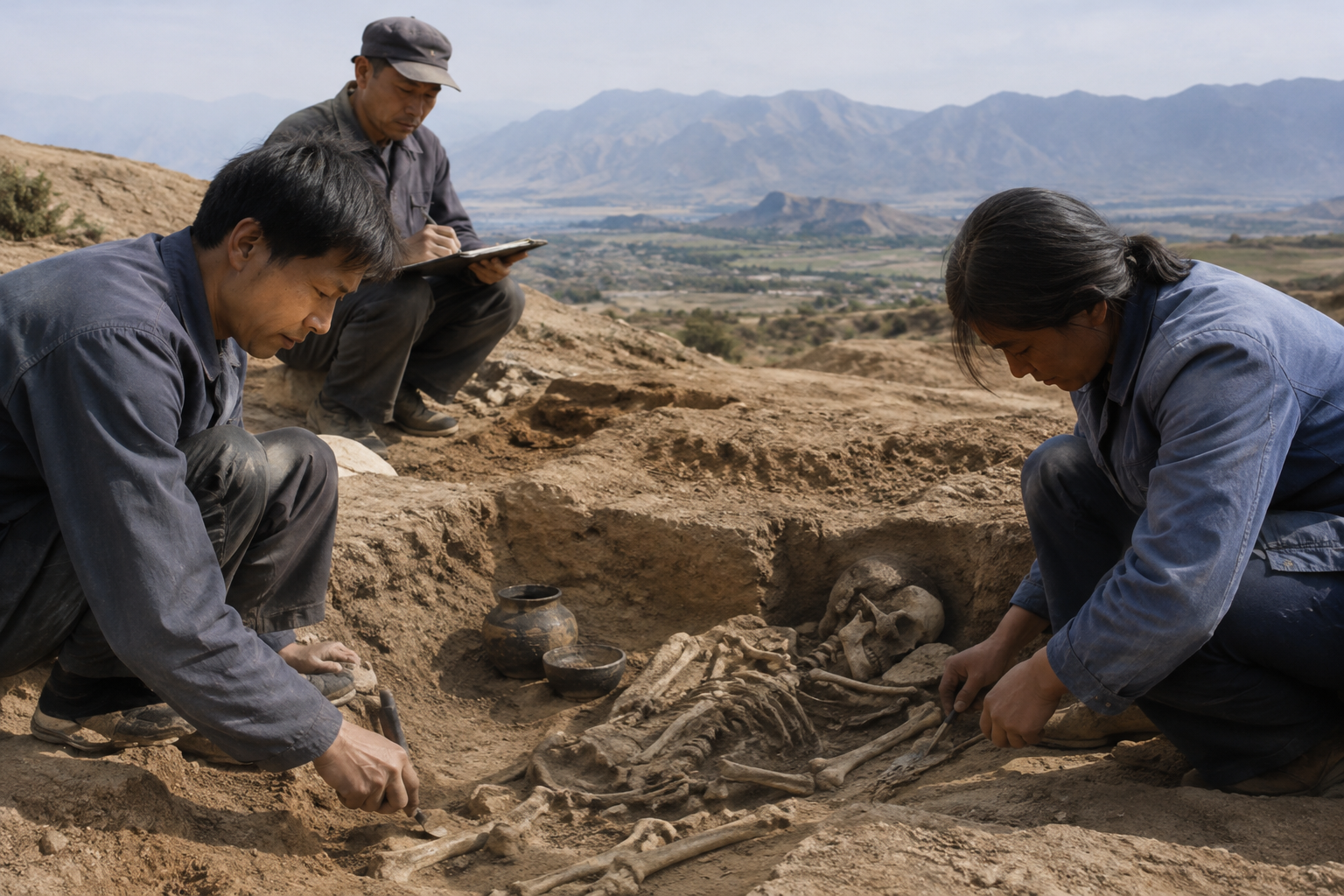
At Xiahaishi in Honggu, near Lanzhou in Gansu, one late Neolithic man has become unexpectedly important for the history of a rare paternal line. The individual labeled XiahaishiM22, dated to around 1950 BC and associated with the Machang Culture, carries a reported connection to Y-DNA haplogroup D1a1. That may sound like a tiny technical footnote, but in ancient DNA terms it is anything but. Haplogroup D is one of the most distinctive old branches in Eurasia, and every securely placed ancient male matters.
The fascination here lies in both the place and the timing. XiahaishiM22 comes from the upper Yellow River world, a region that sat between farming communities of northwestern China and the wider corridors leading toward Inner Asia. A single Y-chromosome does not tell us a person's whole ancestry or identity, but it does trace one direct paternal line, and in this case that line adds a striking detail to the genetic landscape of late Neolithic and early Bronze Age Gansu.
The Machang Culture is usually placed in the later phase of the Majiayao cultural tradition of northwestern China. Archaeologically, this was a world of painted pottery, settled farming communities, and regional interaction across the river valleys of Gansu and Qinghai. By around the early 2nd millennium BC, these communities were living at a crossroads: not yet the steppe polities of later centuries, but certainly not isolated either.
XiahaishiM22 belongs to that setting. Even with sparse sample notes, the combination of place, date, and haplogroup is valuable. A report of D1a1 in this context suggests that paternal diversity in Bronze Age Gansu included lineages that today are better known from East Asia's deeper population history than from the more familiar West Eurasian steppe narratives that often dominate discussion of ancient northern China.
That matters because Gansu is so often described as a corridor. Corridors are not occupied by one neat stream of people moving in a single direction. They are crowded places, full of pauses, overlaps, local continuities, and newcomers. XiahaishiM22 is a reminder that the men living in this region around 1950 BC could preserve paternal lines with very old roots while participating in a changing archaeological world.
A broader MyTrueAncestry discussion of this region's later prehistory is worth comparing here:
Haplogroup D1a1 is a sub-branch within the wider Y-DNA haplogroup D family, an ancient paternal lineage with a scattered and historically intriguing distribution in Asia. That wider family includes branches known in places such as Tibet, Japan, and parts of East and Southeast Asia. But one must be careful here: the history of the parent haplogroup is not automatically the history of every sub-branch, and the label D1a1 should not be stretched into a grand migration map unless the evidence really supports it.
What we can say responsibly is narrower and more interesting. The reported presence of D1a1 in a Machang-associated individual from Gansu shows that this paternal branch, or a line close enough to be classified within it, was present in northwestern China by the early 2nd millennium BC. That places D-lineage history firmly inside the archaeological story of the upper Yellow River, not only in later or more easterly settings.
In other words, XiahaishiM22 is useful precisely because he resists lazy shortcuts. He is not a mascot for a whole people, a language, or a culture. He is one excavated man from one archaeological context. Yet when rare lineages appear in securely dated remains, they can sharpen the outlines of prehistoric population structure far better than sweeping generalizations ever do.
Northwestern China has an awkward habit of defeating tidy textbook categories. Gansu linked the Central Plains, the Tibetan Plateau margins, Hexi Corridor networks, and the eastern steppe. Communities here farmed, exchanged goods, adapted to changing climates, and took part in cultural developments that do not fit a single ethnic or genetic label.
That is why a D1a1 result from XiahaishiM22 is so revealing. It fits a region where local ancestry, long-term settlement, and wider connections could all coexist. Ancient DNA studies of northern China increasingly show that prehistoric populations were structured, varied, and regionally distinct rather than simple copies of one another. For readers following that larger picture, another useful comparison is this post on deep genomic history further east in the Yellow River sphere:
That does not make Xiahaishi a Central Plains site, and it should not be forced into that box. Rather, it helps show how different regional histories within northern China can be brought into conversation. The upper Yellow River was part of a broad northern world, but it kept its own character.
One of the most useful disciplines in reading ancient DNA is learning not to ask one skeleton to do too much work. XiahaishiM22 tells us that a man linked to the Machang cultural horizon in Gansu carried D1a1. He does not, by himself, prove that Machang males generally belonged to D1a1, or that this was the dominant lineage of the site, the valley, or the region.
Still, single individuals can matter enormously when they belong to unusual or historically informative lineages. In many parts of Eurasia, ancient Y-chromosome history is dominated by a few repeatedly sampled branches. Finds like XiahaishiM22 widen the frame. They remind us that prehistoric China contained multiple paternal histories at once, some common, some rare, and some still poorly sampled enough that each new case changes the conversation.
That is one reason ancient East Asian Y-chromosome work has become so important. Studies focused on paternal lineages have started to reveal how coastal and inland population histories differed, and how later historical distributions only partly reflect earlier realities. A related MyTrueAncestry article explores that broader question directly:
East Asian Y-Chromosome Migrations
The sample information for XiahaishiM22 is tied to research archived through a genetic study of ancient individuals from China. Even when a public summary gives only concise archaeological metadata, such work is part of a much larger shift in the field: prehistoric sites once known mainly from pottery styles and settlement archaeology are now also yielding direct evidence about biological ancestry and paternal descent.
For Gansu, that is especially significant. The region's archaeology has long suggested contact, movement, and local development over many centuries. Ancient DNA does not replace that archaeological record; it complicates it in productive ways. A Y-line such as D1a1 appearing at Xiahaishi adds one more layer to the history of who lived in these communities and how diverse their backgrounds could be.
There is also a wider East Asian context to keep in mind. Later historical populations in China, Tibet, the Japanese archipelago, and surrounding regions preserve different branches of deep eastern Eurasian ancestry in different proportions. Ancient samples like XiahaishiM22 are precious because they help pin those broad patterns to specific times and places instead of leaving them floating in modern distributions alone.
If you belong to D1a1 today, XiahaishiM22 does not make you a descendant of the Machang Culture in any simple storybook sense. What he does offer is something better: a real archaeological anchor. By around 1950 BC, a direct paternal line reported within D1a1 was present in the upper Yellow River region of Gansu, inside a settled late Neolithic community with its own local history.
That is the distinctive value of this evidence. D1a1 is not appearing here as an abstract tree label but as the lineage of a man who actually lived in a documented prehistoric landscape. For members of this haplogroup, that gives the paternal line a concrete foothold in ancient northwestern China, at a time when regional societies were already complex, connected, and genetically varied.
For a broader East Asian comparison, this related piece on later Chinese remains is also useful:
Comments