Haplogroup C2a1a3

– 5 min read


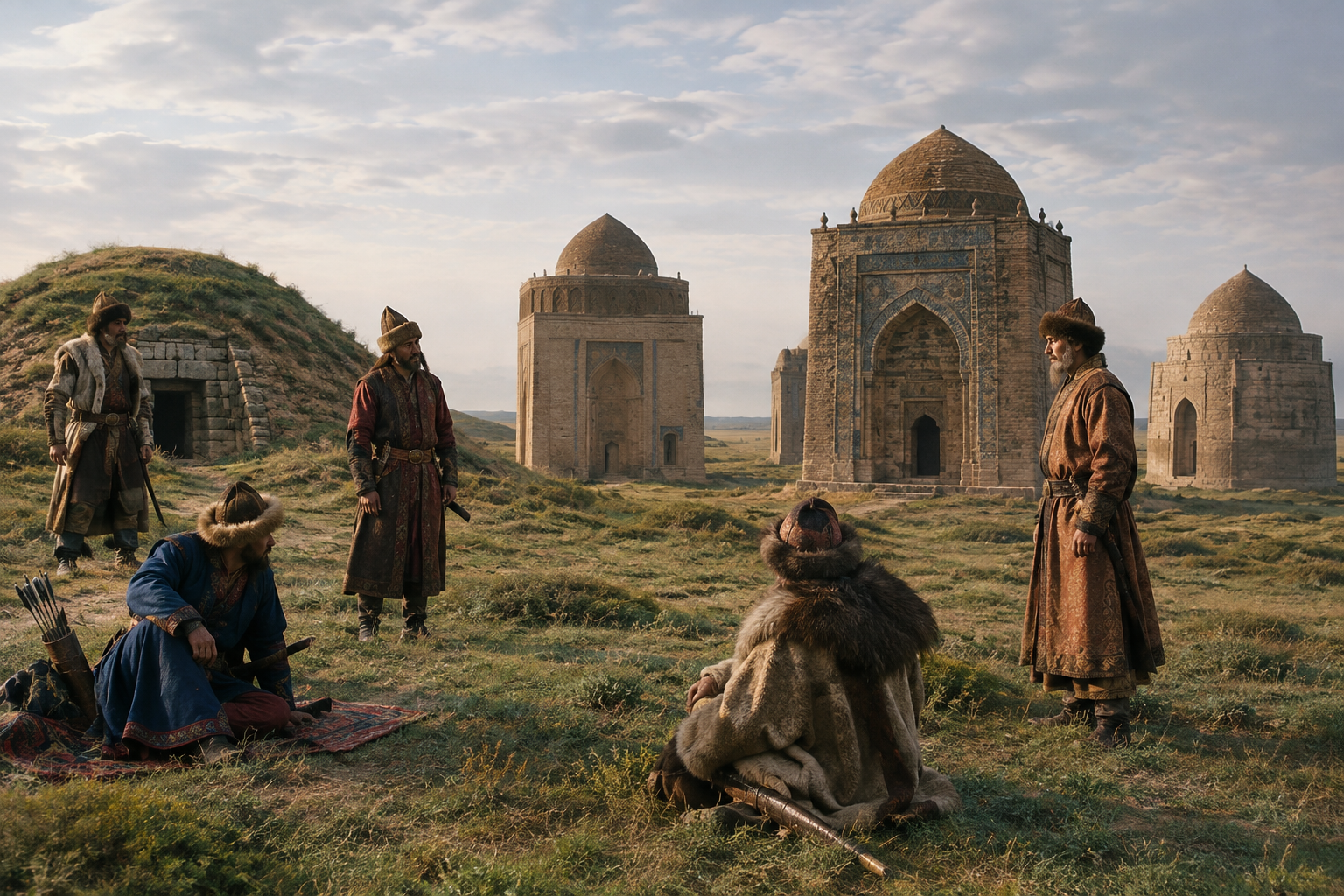
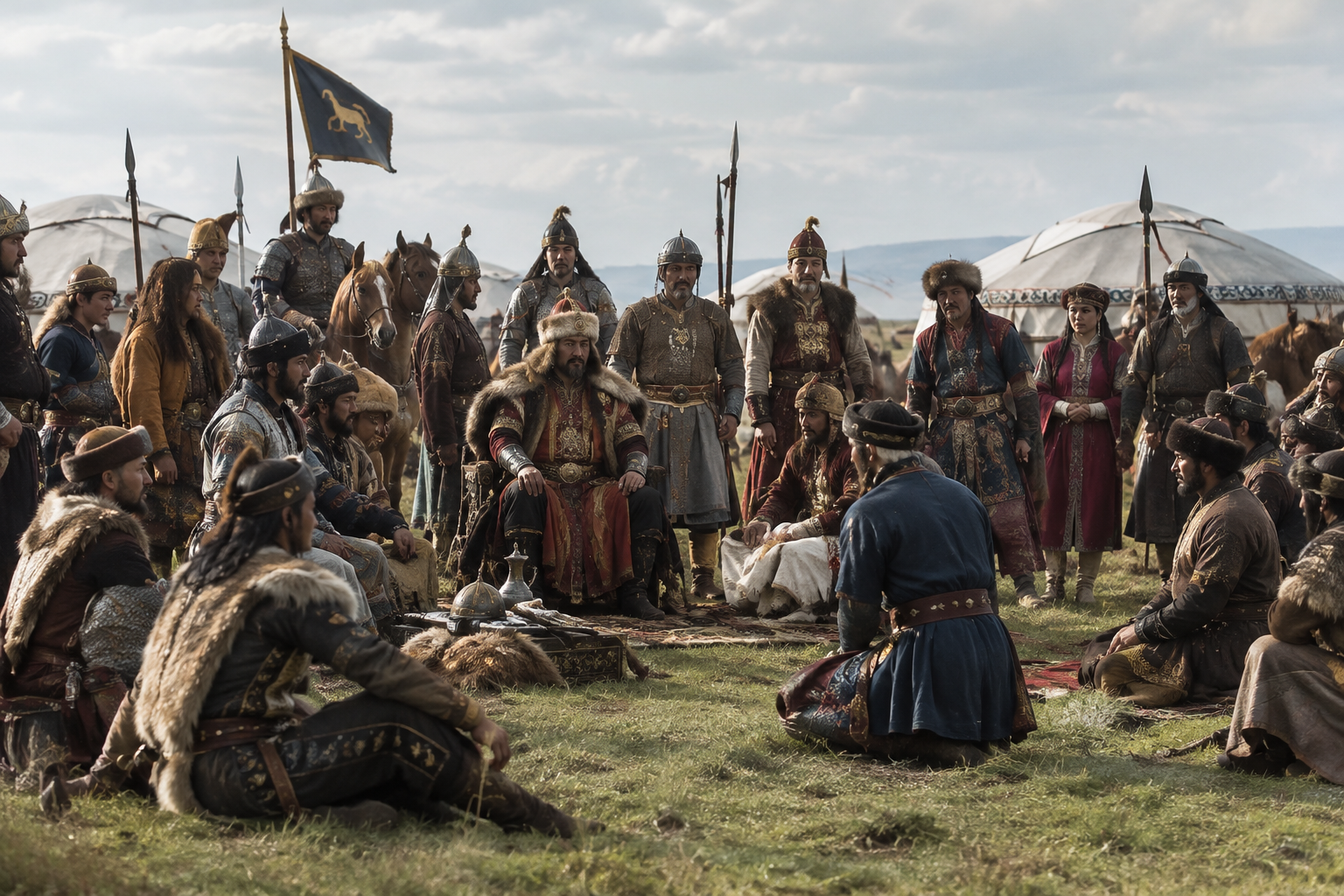
One of the clearest clues for Y-DNA haplogroup C2a1a3 in this set of ancient evidence comes from the mausoleum associated with Jochi Khan in Kazakhstan, where sample CZK002 is dated to around 1227 AD. That is already enough to make an archaeologist sit up a little straighter. Jochi was the eldest son of Genghis Khan and founder of the Jochid line, so any securely studied burial connected with that world belongs not just to family history, but to the political machinery of the Mongol empire and its western successor, the Golden Horde.
What matters here is not a romantic tale of imperial blood, but a pattern. The haplogroup C2a1a3 appears in this group of medieval and early modern steppe-linked burials stretching from Kazakhstan to southern Ukraine. Y-DNA traces one direct paternal line only, not a person's whole ancestry, but in a steppe context that is precisely why it is so useful: it can show how particular male lines persisted through mobile, elite, and often militarized societies.
Sample CZK002 from the mausoleum of Jochi Khan is the most historically charged case in this cluster. Even with that, caution is essential. A mausoleum association is not the same thing as a simple genealogical certificate, and a haplogroup match is not proof that every man buried in a dynastic monument was a close biological relative of the founder. Still, a C2a1a3 assignment in this context fits a broader picture in which branches of haplogroup C2 are repeatedly linked with eastern steppe and Mongol-period paternal lines.
That is why this evidence is valuable. It places C2a1a3 not in a vague map of "Central Asia somewhere," but in an actual funerary landscape attached to the Jochid sphere. A recent ancient-DNA study centered on Golden Horde elite burials is directly relevant here, because it examines precisely the kind of archaeological and historical setting represented by these Kazakhstan mausolea: https://www.biorxiv.org/content/10.1101/2025.06.11.659160v1.
The Jochi Khan mausoleum is not alone. Two other elite graves from Kazakhstan in this set, CZK003 from the mausoleum of Ayakkamir, dated around 1310 AD, and CZK001 from the mausoleum of Alasha Khan, dated around 1700 AD, extend the pattern across several centuries. That is the sort of recurrence that makes ancient DNA historically interesting: not a solitary outlier, but the repeated appearance of a paternal branch in high-status steppe contexts.
These mausolea belong to a world shaped by the afterlife of Mongol imperial rule. By the thirteenth and fourteenth centuries, the Golden Horde governed a vast zone of exchange and coercion stretching across the Eurasian steppe. Its elites were not biologically uniform, of course, and no single Y-chromosome can stand in for the entire polity. But the recurrence of C2a1a3-linked males in burials associated with that environment suggests continuity of particular male lines within the ruling and post-ruling strata of the steppe.
The later date of CZK001 matters especially. Around 1700 AD, we are well beyond the founding age of the Mongol empire, yet a related paternal signature still appears in a prestigious funerary setting. That hints at endurance: lineages born to prominence in the imperial era could remain socially important long after the first conquests were over.
The sample KLK002, described as a medieval nomad from the Kayalyk mausoleum and dated to around 950 AD, pushes the story earlier. Chronologically, this is important because it predates the rise of the Golden Horde. In other words, C2a1a3 in this article is not appearing from nowhere in the thirteenth century. It is already present in the wider steppe world before Jochi's descendants built their western empire.
Kayalyk sat in a corridor where trade, pastoral movement, and political competition overlapped. Such places often reveal how lineages travel before they become attached to famous dynasties. A paternal line found in a later imperial elite can first be visible among mobile groups operating in the same broad Inner Asian networks. That does not mean the man from Kayalyk was an ancestor of later Jochid burials, only that the branch belonged to the older genetic landscape from which Mongol-era ruling groups emerged.
Mongolian steppe genetic history
The westernmost sample in this cluster is UKR017, from Mamay-Gora in the Zaporizhzhia region of Ukraine, dated around 1450 AD. This is a striking placement. By the fifteenth century, the north Pontic steppe was a contact zone where post-Mongol powers, local communities, and mobile groups interacted across the lower Dnipro and Black Sea corridors.
Mamay-Gora helps show that the history of C2a1a3 was not confined to the eastern heartlands of Inner Asia. It also had a presence in the western steppe frontier, in a region deeply entangled with the political and demographic legacy of the Golden Horde. Research on mobility in Ukraine from prehistory into the early modern period is relevant background for understanding such finds in the north Pontic region: https://www.researchgate.net/publication/380994383_North_Pontic_crossroads_Mobility_in_Ukraine_from_the_Bronze_Age_to_the_early_modern_period.
Archaeologically, this is exactly the sort of place where one might expect mixed histories rather than neat ethnic boxes. A Y-chromosome associated with eastern steppe lineages can appear in Ukraine without making the whole cemetery "Mongol" in any simple sense. The north Pontic region was full of people carrying different ancestries, languages, loyalties, and life histories. What UKR017 demonstrates is that one paternal branch connected with steppe imperial networks had indeed reached, and persisted within, that western zone.
There is a temptation, whenever haplogroup C2 appears, to leap straight to sweeping claims about Genghis Khan, conquest, or universal Mongol identity. Better to be stricter than that. The parent haplogroup has a broad history across eastern Eurasia, while C2a1a3 is a narrower branch whose significance here comes from these particular archaeological settings: a pre-Golden Horde nomadic context at Kayalyk, elite mausolea in Kazakhstan tied to the Jochid and post-Jochid world, and a later steppe burial in Ukraine.
Taken together, those finds suggest a paternal line with real staying power in the medieval steppe belt. It appears in mobile contexts, in elite commemorative architecture, and in the western reaches of the old Horde's sphere. That combination is more informative than any one sample on its own.
If your paternal line falls under C2a1a3, this set of ancient matches points most clearly toward the medieval Eurasian steppe, especially the political and social worlds linked to nomadic mobility and the Golden Horde's long shadow. It does not prove descent from a famous ruler, nor does it reduce your ancestry to one imperial story. But it does place your direct male line in a branch that turns up in a very specific and historically important corridor: from pre-Horde Inner Asia to Jochid-era Kazakhstan and onward into the north Pontic steppe.
Comments